News

Can Using a Public Figure’s Photo Online Lead to a Portrait Rights Claim?

Overview

Using a person's photograph in corporate online content can create unexpected legal risks, particularly when the person is a public figure and the photograph was obtained from a publicly accessible source.

In this China portrait rights dispute, a company published an article through its corporate WeChat account that included photographs of a former public figure. The individual subsequently brought a lawsuit alleging infringement of portrait rights and sought monetary compensation, recovery of rights-protection expenses and a public apology.

The company disputed the alleged infringement. It argued that the article was a positive feature about the individual's career and achievements, the photographs had been obtained from publicly available online sources, and the publication did not distort, defame or otherwise misuse the individual's image. The company also challenged the extent of the claimed damages and the requested form of public apology.

Importantly, the case did not end with a court finding that the company had infringed the individual's portrait rights. Following the court's mediation, the parties reached a settlement that brought the dispute to a final conclusion without an infringement judgment.

The case illustrates an important risk-management issue for companies operating websites, WeChat accounts and other digital media: the fact that an image is publicly available online does not by itself eliminate portrait-rights risk, and the appropriate response to a claim may involve both substantive defenses and settlement strategy.


Case Snapshot

ItemDetails
Case TypeIntellectual Property / Portrait Rights Dispute
JurisdictionMainland China
CourtShanghai Putuo District People's Court
IndustryCommercial / Consumer Business
Dispute TypeAlleged unauthorized use of a person's photograph in corporate online content
Original Claim ValueApproximately RMB 160,000
Main ClaimsCompensation, reasonable rights-protection expenses and public apology
Key Legal IssueWhether the publication of publicly available photographs constituted an actionable portrait-rights infringement
Key StrategySubstantive defense + litigation risk control + judicial mediation
Final ResolutionSettlement through court mediation; no judicial finding of infringement
AttorneyYu Yuting / Sun Jianhui
Law FirmNEO-ARK Law Firm

The Core Legal Issues

1. Does using a publicly available photograph automatically constitute portrait-rights infringement?

The central issue was not simply whether the photograph had been used, but whether the circumstances of its use gave rise to legal liability.

The company argued that the photographs were obtained from publicly accessible online sources and were used in an article describing the individual's career and achievements.

The defense therefore distinguished between:

  • the existence of a photograph online;
  • the circumstances in which the photograph was obtained;
  • the purpose and context of publication;
  • whether the image was altered or presented in a derogatory manner; and
  • whether the publication created a commercial association or other legally significant use.

This distinction was important because online availability should not be treated as an automatic license to use a person's image for any purpose. At the same time, the legal assessment of an alleged portrait-rights infringement depends on the specific circumstances of the publication.

2. Does the use of a public figure's image receive greater tolerance?

The claimant was a public figure, which formed part of the company's defense.

The company argued that the article was a positive presentation of the individual's career and did not contain defamatory, degrading or misleading content.

The defense therefore focused on the context and nature of the publication, rather than relying solely on the claimant's public status.

This is an important distinction for businesses: being a public figure does not mean that a person's portrait can be freely used without legal consideration.

Instead, the purpose, presentation, context and potential commercial implications of the use should all be assessed.

3. How should a company respond when the claimant seeks both compensation and a public apology?

The claimant sought not only financial compensation and rights-protection expenses, but also a public apology in a widely circulated newspaper.

From the defendant's perspective, the potential risk therefore extended beyond financial liability.

A judgment requiring a public apology could potentially create additional reputational and commercial consequences for the company.

The defense accordingly challenged both the alleged infringement and the proportionality of the requested remedies.

This allowed the litigation strategy to focus not only on the amount of potential compensation, but also on preventing an unnecessarily broad form of public remedy.


Legal Strategy

IssueApproach
Alleged portrait-rights infringementChallenge whether the specific use of the photograph constituted actionable infringement
Source of photographsEstablish that the images had been obtained from publicly accessible online sources while avoiding reliance on this fact alone
Publication contextEmphasize the positive, non-derogatory nature of the article and the context in which the photographs were used
Commercial-use allegationChallenge the asserted connection between the publication and commercial exploitation of the claimant's portrait
DamagesChallenge the basis and reasonableness of the claimant's compensation demand
Public apologyChallenge the necessity and proportionality of the requested form of public remedy
Overall riskSeek a resolution that would avoid an adverse infringement judgment and minimize the company's financial and reputational exposure

The case therefore required more than a simple argument that the photographs were “found online.” The strategy addressed the legal nature of the use, publication context, alleged commercial purpose, requested remedies and overall litigation risk.


Settlement Strategy and Risk Control

An important feature of this case was that the objective was not merely to minimize the amount eventually paid.

The company also sought to avoid a formal judicial finding of infringement.

This distinction can be significant in intellectual property and personality-rights disputes.

A court judgment expressly finding infringement may create additional reputational consequences and may become relevant to future disputes or business communications.

Through active defense and court-led mediation, the parties ultimately reached a settlement.

The settlement:

  • resolved the dispute on a one-time basis;
  • did not contain a judicial finding that the company had infringed the claimant's portrait rights;
  • did not require the company to issue the originally requested public apology; and
  • brought the dispute to a final resolution.

For businesses, this demonstrates why settlement structure can be as important as settlement amount.


Outcome

The case was ultimately resolved through court mediation rather than an infringement judgment.

Under the settlement arrangement, the company made a one-time payment to resolve the financial aspects of the dispute, with the final amount being substantially lower than the claimant's original demand.

The company was not required to publish the requested public apology.

The mediation agreement also provided for a comprehensive resolution of the dispute, preventing the parties from continuing to pursue additional claims arising from the same matter.

For confidentiality reasons, the specific settlement amount and other detailed financial terms are not disclosed in this case study.


Why This Case Matters

Publicly available images still require legal review

Businesses should not assume that an image can be freely used simply because it can be found through a search engine or on a public website.

The source of an image, the identity of the person depicted, the purpose of publication and the context of use should all be considered before publication.

Portrait rights and copyright are different issues

A company may face more than one type of legal risk when publishing a photograph.

Copyright concerns may relate to the ownership or licensing of the photograph itself, while portrait-rights issues concern the rights and interests of the person depicted.

A compliance review should therefore consider both dimensions where appropriate.

Public figures are not automatically free to use

The fact that a person is well known does not eliminate portrait-rights considerations.

The purpose and manner of use remain important.

Settlement can protect against reputational consequences

In a personality-rights dispute, avoiding an adverse judicial finding may be commercially important.

A negotiated resolution can sometimes provide a more controlled outcome than allowing the dispute to proceed to a final judgment.

The form of relief matters

A claimant's requested compensation is only one aspect of the litigation risk.

Requests for public apologies, publications or other forms of corrective action may create additional business and reputational consequences.

Companies should therefore assess the full range of requested remedies, not just the monetary claim.


Frequently Asked Questions

Can a company use a public figure's photograph in a corporate WeChat article?

Not necessarily. The fact that an image is publicly accessible does not automatically mean that a company has unrestricted rights to use the person's portrait.

The purpose, context, manner and potential commercial implications of the use should be reviewed.

Does using a photograph from the internet eliminate portrait-rights liability?

No. An image being available online does not by itself establish that its use is legally permissible.

Businesses should separately consider the rights of the photographer or copyright owner and the portrait rights of the person depicted.

Are public figures treated differently in portrait-rights disputes?

A person's public status may be relevant to the legal assessment, but it does not mean that the person has no portrait rights.

The circumstances and purpose of the specific use remain important.

Can a company avoid a public apology through settlement?

Potentially. If the parties reach a settlement before judgment, the final resolution may differ significantly from the claimant's original requests.

In this case, the dispute was resolved through mediation without the company being required to issue the requested public apology.

Is mediation appropriate in an intellectual property or portrait-rights dispute?

It can be, particularly where the parties want to control financial exposure, reputational risk and the scope of any public-facing remedy.

The appropriate strategy depends on the facts and the client's commercial objectives.


Key Takeaways

For companies publishing photographs of individuals through websites, WeChat accounts, social media or other digital channels:

  1. Do not assume that publicly available photographs are automatically free to use.
  2. Assess portrait rights separately from copyright and image-licensing issues.
  3. Consider the purpose, context and manner of publication.
  4. For public figures, assess whether the use creates a commercial association or other legally significant implication.
  5. When facing a claim, challenge both liability and the scope of the remedies being requested.
  6. In appropriate cases, settlement can help control both financial and reputational risk.
  7. A settlement that avoids an infringement finding may be materially different from simply negotiating the amount of compensation.

This case demonstrates that effective litigation strategy in a portrait-rights dispute is not limited to defending the alleged infringement itself. Controlling the form of the final resolution can be equally important to the client's long-term commercial interests.


About the Author

Yu Yuting
Partner | NEO-ARK Law Firm

Lawyer Yu focuses on foreign-related litigation, cross-border disputes, commercial matters, and legal services for overseas individuals and businesses in China.

Email: [email protected]

About NEO-ARK Law Firm

NEO-ARK Law Firm provides legal services in foreign-related litigation, commercial disputes, family law, and cross-border legal matters, assisting both international and domestic clients throughout China.


Recommend
Canton Fair Legal Insights: How Foreign Investors Can Set Up a Company in China and Manage Compliance Risks

During the 140th Canton Fair, yu yuting—Partner, Head of the International Legal Affairs Department at Neo-Ark Law Firm, and duty lawyer at the Guangzhou Foreign-Related Legal Services Port—received numerous inquiries from international buyers regarding foreign direct investment (FDI), company establishment, tax optimization, and intellectual property compliance.

To support international entrepreneurs and corporate investors planning China entry, this Q&A guide synthesizes key registration procedures, entity selection frameworks, regional tax incentives, and legal risk mitigation strategies under current Chinese corporate and foreign investment laws.

I. Corporate Entity Selection: Five Common Investment Structures

Foreign investors establishing a legal presence in China should select an entity form aligned with their commercial goals, capital allocation, and operational scope:

Foreign Investment Entity TypePrimary Commercial Use CasesOperational Scope & Features
Wholly Foreign-Owned Enterprise (WFOE)
(外商独资企业)
E-commerce independent platforms, foreign tech subsidiaries, manufacturing plants.100% foreign-owned limited liability company; full commercial, trading, and operational authority.
Sino-Foreign Joint Venture (JV)
(中外合资经营企业)
Auto parts manufacturing, medical equipment diagnostic centers, restricted tech sectors.Equity or cooperative partnership between foreign and domestic Chinese entities; shared capital and technology.
Foreign-Invested Partnership (FIP)
(外商投资合伙企业)
Cross-border venture capital funds, USD private equity funds, professional consultancies.Flexible capital contributions, flow-through tax structures, and customized partner governance.
Branch Office of a Foreign Company
(外国公司分支机构)
Foreign bank branches, international inspection and certification conglomerates.Direct extension of the parent company; non-independent legal personality with parent assuming liabilities.
Representative Office (RO)
(外国企业常驻代表机构)
Market research, liaison offices, product promotion for foreign brands.Non-profit generating entity; restricted strictly to market research, quality control, and liaison activities.

II. Key Registration Procedures and Operational Compliance Requirements

Establishing a compliant corporate entity in China requires navigating several administrative, tax, and banking steps:

1. Corporate Registration & Business License Application

Submit notarized investor qualification documents, Articles of Association, legal representative appointment resolutions, Ultimate Beneficial Owner (UBO) disclosures, and a verified commercial property lease contract to the State Administration for Market Regulation (SAMR).

2. Capital and Operating Bank Accounts

Open an RMB Basic Deposit Account for daily domestic operations alongside a Foreign Exchange Capital Account under State Administration of Foreign Exchange (SAFE) guidelines for equity infusions and cross-border remittances.

3. Foreign Investment Information Reporting

Complete mandatory online reporting through the National Enterprise Credit Information Publicity System and commercial regulation portals.

4. Customs Registration for Import/Export Entities

Enterprises engaged in physical goods trading must obtain Customs Declaration Registration as a Consignor/Consignee of Imported and Exported Goods alongside specialized import/export administrative permits.

5. Tax Registration and Regional Incentives

Complete tax setup, tax type determinations, invoice (Fapiaos) issuance permissions, and establish compliant statutory accounting ledgers.

Regional Tax Highlight (Guangzhou Nansha): Qualified foreign-invested enterprises in encouraged industries within the starting area of Nansha, Guangzhou enjoy a reduced 15% Enterprise Income Tax (CIT) rate (compared to the standard 25% statutory rate). Qualified overseas high-end talent may also access individual income tax subsidies, subject to maintaining substance-based operational requirements (real personnel, real assets, and actual commercial operations).

6. Foreign Staff Work Permits & Visas

Expatriate personnel working within the Chinese entity must secure formal Foreigner's Work Permits (Class A/B) and residence permits prior to commencing employment.

7. Retention of Chinese Legal Counsel

Engage domestic legal counsel to draft Articles of Association, structure equity ownership, formulate labor compliance systems, review cross-border contracts, and build IP defensive barriers.

III. Six Critical Legal Risk Areas and Compliance Strategies

1. Negative List & Market Access Audits

  • Risk: Investing in restricted or prohibited market sectors, or engaging sanctioned counterparties.
  • Compliance Strategy: Screen business scopes against the Special Administrative Measures (Negative List) for Foreign Investment Access. Sectors like news media are strictly prohibited, while telecommunications and aviation carry foreign equity caps. Perform background checks against global credit blacklists and immigration restriction databases.

2. Address Compliance and Operational Anomaly Listings

  • Risk: Using fictitious addresses or failing to update corporate registry entries upon relocating triggers an official "Operational Anomaly" (经营异常) listing.
  • Compliance Strategy: Maintain a physical, verifiable commercial lease with actual operations on-site. Operational anomalies cause bank account freezes, tax holdbacks, and work visa rejections.

3. Subscribed Capital Contribution Timelines

  • Risk: Civil liability and shareholder default claims resulting from unfulfilled capital contributions.
  • Compliance Strategy: Under Article 47 of the amended Company Law of the People's Republic of China, shareholders of limited liability companies must pay their subscribed capital contributions in full within five years of establishment. Structure realistic capital timelines during incorporation.

4. Real Trade Backgrounds & Anti-Money Laundering (AML)

  • Risk: Account freezing, tax audits, or criminal investigation triggered by non-compliant fund routing.
  • Compliance Strategy: Ensure every transaction is backed by genuine trade background documentation, matching invoices, and complete shipping records. Strictly avoid third-party pool accounts or fictitious invoicing (虚开增值税发票).

5. Labor Law & Employment Compliance

  • Risk: Wrongful termination claims, unpaid mandatory social benefits, or illegal employment of foreign nationals.
  • Compliance Strategy: Chinese labor laws enforce strict statutory protections. Employers must contribute to social insurance and housing provident funds. Illegal employment of foreign nationals lacking valid work permits leads to severe administrative fines and corporate credit debits.

6. Intellectual Property: "Register First, Use Later"

  • Risk: Bad-faith trademark squatting (恶意抢注) or patent infringement claims by local competitors.
  • Compliance Strategy: China strictly operates on a "First-to-File" system for trademarks and patents. Foreign brands should secure domestic registrations prior to market entry or trade show displays.

PCT & Priority Rights Advantage: International applicants from Patent Cooperation Treaty (PCT) or Paris Convention member states can leverage priority right windows (12 months for patents, 6 months for trademarks) to lock in original foreign filing dates in China. Preserve evidence of prior rights immediately upon detecting infringement.

Conclusion

Establishing a successful foreign-invested enterprise in China requires matching commercial objectives with appropriate corporate structures, securing statutory registrations, and maintaining active legal and tax compliance. Seeking professional guidance from experienced cross-border legal counsel ensures seamless entry and operational stability in the Chinese market.

About the Author

Yu Yuting
Partner | NEO-ARK Law Firm

Lawyer Yu focuses on foreign-related litigation, cross-border disputes, commercial matters, and legal services for overseas individuals and businesses in China.

Email: [email protected]

About NEO-ARK Law Firm

NEO-ARK Law Firm provides legal services in foreign-related litigation, commercial disputes, family law, and cross-border legal matters, assisting both international and domestic clients throughout China.

2026-10-30

Tea Culture & Legal Elegance: Guangdong Neo-Ark Law Firm Hosts Traditional Tea Culture & Etiquette Workshop

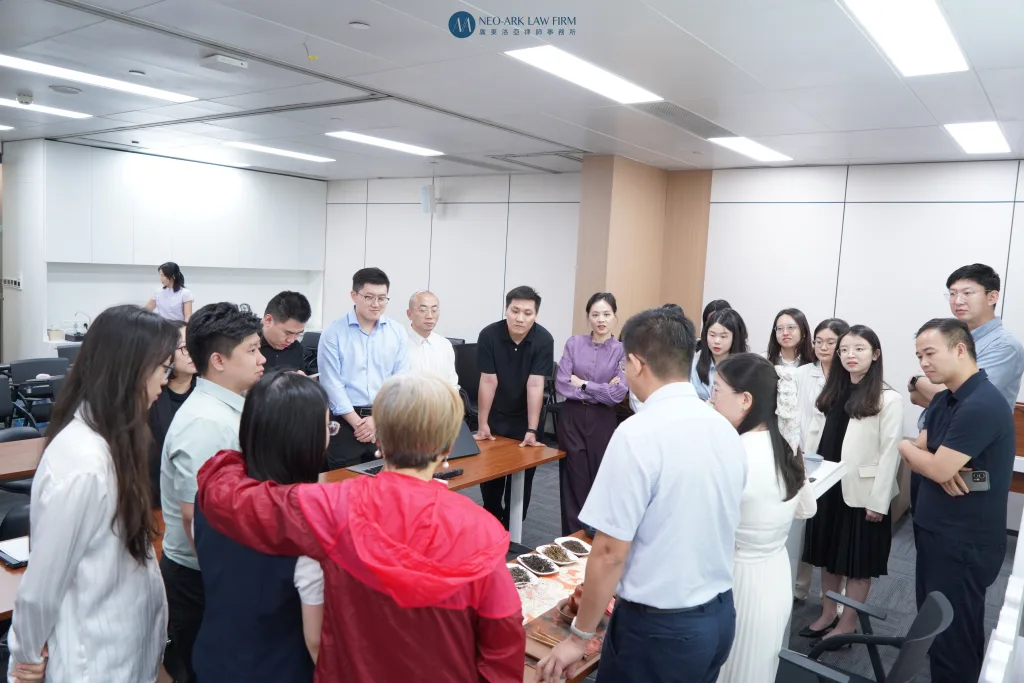
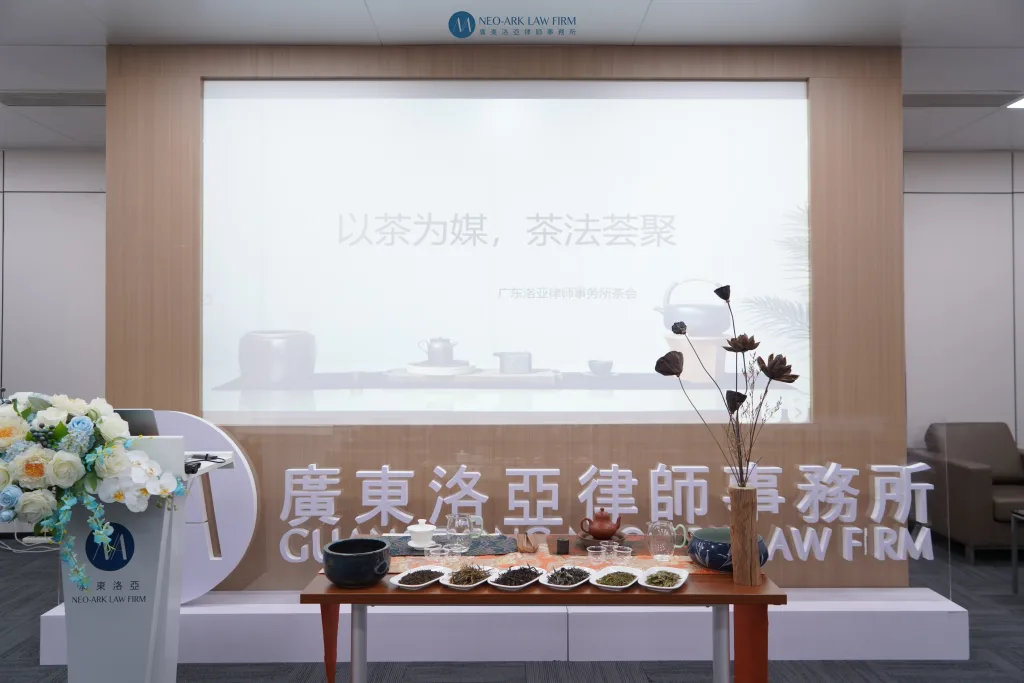
On the afternoon of October 23, 2026, Guangdong Neo-Ark Law Firm hosted a traditional tea appreciation and professional etiquette workshop entitled "Tea Culture & Legal Elegance" (“茶香法韵,雅集洛亚”).

Organized to support work-life balance and refine professional etiquette for practicing attorneys, the salon featured guest speakers Shaoguo Chen, founder of Guangdong Penglaixuan Trade Development Co., Ltd. and advocate for Mengxiyun tea culture, alongside certified tea master Xiaojuan Xu. Hosted by Attorney Tao Zou, the event brought together partners, associates, and administrative staff for an afternoon of traditional tea education, etiquette training, and sensory tasting.

I. The Art & Science of Tea Classification

During the keynote sharing, Mr. Shaoguo Chen introduced the foundational classification of Chinese tea based on processing and fermentation levels across six major tea categories:

  • The Six Major Categories: Green, White, Yellow, Oolong (Cyan), Red (Black), and Dark (Fermented) teas.
  • Tea History & Market Realities: Chen provided historical background on famous teas, noting that commercial "Dahongpao" on today's market is derived from propagated cultivars rather than the original six mother trees on Wuyi Mountain, which are strictly protected state treasures with harvesting prohibited.
  • Business Etiquette & Social Protocols: The lecture addressed practical tea etiquette in corporate and legal networking settings, helping attorneys handle business tea service with confidence and cultural understanding.

II. Master Class: The Ten Steps of Tea Service & Guest Etiquette

Tea Master Xiaojuan Xu led a practical demonstration focusing on the Ten Steps of Tea Preparation (行茶十式) and client hospitality rules:

III. Interactive Blind Tasting & Firm Culture

Following the instructional session, attorneys engaged in a multi-sensory tasting exercise covering six representative teas: Tieguanyin Oolong, Dianhong Black Tea, Silver Needle White Tea, Wuyi Rougui Rock Tea, Duck Shit Aroma Oolong, and Ripe Pu'er Dark Tea.

Attorneys analyzed leaf shape, aroma, and liquor color using traditional sensory evaluation techniques. The highlight of the workshop featured a blind tasting competition, where attorneys Kaiyang Sun and Shuying Lv successfully identified all six tea samples by aroma and taste profile.

By pairing professional etiquette with team bonding, Guangdong Neo-Ark Law Firm continues to enrich its workplace culture, cultivating well-rounded legal professionals and strengthening team cohesion.

About the Author

Yu Yuting
Partner | NEO-ARK Law Firm

Lawyer Yu focuses on foreign-related litigation, cross-border disputes, commercial matters, and legal services for overseas individuals and businesses in China.

Email: [email protected]

About NEO-ARK Law Firm

NEO-ARK Law Firm provides legal services in foreign-related litigation, commercial disputes, family law, and cross-border legal matters, assisting both international and domestic clients throughout China.
2026-10-26

Multiple Neoark Lawyers Selected into the Guangdong Lawyers Association Emerging Foreign-Related Legal Talent Pool

Achievement Announcement

On October 22, 2026, the Guangdong Lawyers Association officially announced the 7th batch of the Guangdong Foreign-Related Law Firm Directory and Foreign-Related Legal Talent Pool. Four young lawyers from Neoark Lawyers—Li Yubo, Yu Yuting, Liu Xinyi, and Tang Jingying—were successfully selected into the Guangdong Lawyers Association Emerging Foreign-Related Legal Talent Pool based on their practical legal expertise and cross-border service capabilities.

About the Talent Pool

The Guangdong Lawyers Association Emerging Foreign-Related Legal Talent Pool serves as a core talent reserve platform for cross-border legal services in Guangdong Province. It focuses on identifying and cultivating high-caliber young legal professionals with international perspectives, mastery of foreign-related legal practice, and alignment with cross-border business demands. The selection of four Neoark lawyers marks another significant milestone in the firm’s development in foreign-related legal practice.

Neoark Lawyers continues to focus on international legal practice, building a dedicated team of lawyers with overseas educational backgrounds, fluency in international business rules, and foreign language proficiency. Covering practice areas such as cross-border investment, international trade, dispute resolution, and intellectual property, the firm delivers multi-tiered cross-border legal solutions to help clients navigate complex international regulatory risks.

Profiles of the Selected Lawyers

1. Li Yubo
  • Practice Areas: Criminal-Civil Intersecting Litigation, Civil & Commercial Litigation, Matrimonial & Wealth Succession, Intellectual Property, Corporate Counsel, Complex Dispute Resolution.
  • Key Appointments: Member of the Criminal-Civil Committee of Guangdong Lawyers Association; Director of the Hong Kong, Macao & Taiwan Law Research Association of Guangdong Law Society; External Supervisor at Guangdong University of Foreign Studies Law School; Arbitrator at Zhanjiang International Arbitration Court and Yulin Arbitration Commission.
  • Biography: With over 20 years of legal experience across foreign trade commissions, state-owned enterprises, and multinational corporations, Attorney Li Yubo has handled high-profile patent infringement cases, trademark disputes, major criminal defense matters, and government land expropriation legal projects.

2. Yu Yuting
  • Practice Areas: Civil & Commercial Litigation, Criminal Defense, Corporate Legal Counsel, Foreign-Related Disputes.
  • Key Appointments: Director of Digital Law Research Association and Family Law Research Association of Guangdong Law Society; Officer of Foreign-Related Legal Services Branch of Guangzhou Lawyers Association; Legal Counsel to Guangzhou Association of Enterprises with Foreign Investment.
  • Biography: Prior to practicing law, Attorney Yu Yuting served in the legal department of a public security organ. She has provided specialized legal services to state-owned entities such as CCCC Group and CCEC5, as well as ongoing counsel for multinational and domestic corporations. Fluent in English, she handles bilingual contract drafting and international commercial litigation and arbitration.

3. Liu Xinyi
  • Practice Areas: Talent & Artist Representation, Civil & Commercial Dispute Resolution, Intellectual Property, Corporate Governance.
  • Key Appointments: Member of Trade Secrets & Privacy Protection Committee of Guangzhou Lawyers Association; Member of Neoark Family Law Research Center.
  • Biography: Holding an LL.B. from East China University of Political Science and Law with 6+ years of practice experience, Attorney Liu Xinyi has handled over 100 litigation and non-litigation IP enforcement matters. She specializes in corporate brand protection, MCN entertainment contracts, live-streaming industry compliance, and corporate governance.

4. Tang Jingying
  • Practice Areas: Internet-Related Dispute Resolution, Contract Disputes, Labor Disputes, Family Law, Corporate Compliance, Criminal Defense.
  • Key Appointments: Director of "San Nong" Legal Research Association; Director of Family Law Research Association of Guangdong Law Society; Senior Corporate Compliance Officer.
  • Biography: Attorney Tang Jingying holds a Master of Laws (LL.M.) in Civil and Commercial Law from Guangdong University of Foreign Studies. One of her representative contract dispute cases was selected among the "Top 50 Annual Cases" by the People's Court Press under the Supreme People's Court. She also developed award-winning legal compliance products for MCN agencies.

Future Outlook

Neoark Lawyers will use this recognition to further enhance its foreign-related legal talent development, strengthen cross-border service capabilities, and support high-quality foreign-related legal developments in Guangdong Province.

About the Author

Yu Yuting
Partner | NEO-ARK Law Firm

Lawyer Yu focuses on foreign-related litigation, cross-border disputes, commercial matters, and legal services for overseas individuals and businesses in China.

Email: [email protected]

About NEO-ARK Law Firm

NEO-ARK Law Firm provides legal services in foreign-related litigation, commercial disputes, family law, and cross-border legal matters, assisting both international and domestic clients throughout China.

2026-10-23

When a Brand Owner Faces Customs Seizure in China: Acquiring a Registered Trademark

Overview

Foreign businesses that manufacture products in mainland China should not assume that a trademark registered in their home country is automatically protected in China. Trademark rights are territorial, and failing to secure local trademark protection can create serious risks when products bearing a brand logo are manufactured, stored, or exported from China.

NEO-ARK Law Firm assisted a Thai home furnishings company after a shipment of lighting products manufactured in mainland China was detained by Chinese Customs. The products displayed the company's brand logo, which was registered as a trademark in Thailand but had not been registered in mainland China.

The immediate problem was that another party had already registered the corresponding trademark in China and recorded its trademark rights with the Chinese Customs authorities. During an inspection, Customs identified the mark on the products and detained the shipment on suspicion of trademark infringement.

The company needed to resolve the issue promptly to recover its goods and avoid further disruption to its supply chain. Rather than focusing exclusively on the immediate release of the detained shipment, counsel assessed the status of the Chinese trademark, the available legal challenges, and the company's longer-term commercial risks.

After negotiations with the trademark owner, the parties reached an agreement for the acquisition and transfer of the registered Chinese trademark to the Thai company. This provided a more stable basis for the company's continued use of its brand in mainland China.

Case Snapshot

ItemDetails
Matter TypeTrademark Acquisition and Transfer
Practice AreaIntellectual Property
ClientThai home furnishings company
IndustryLighting and home products
JurisdictionMainland China
Key IssueChinese trademark registration and Customs detention
Legal ServiceCommercial negotiation and trademark transfer
AttorneyYu Yuting
Law FirmNEO-ARK Law Firm
OutcomeTrademark acquired and transferred to the client

The Legal and Commercial Issues

1. Does a Thai Trademark Registration Protect Products Manufactured in China?

No. Trademark rights are territorial. Registration in Thailand does not automatically grant exclusive trademark rights in mainland China.

This distinction is particularly important for foreign companies that outsource manufacturing to Chinese factories. Even if a company owns and uses its brand overseas, another party may independently obtain registration of the same or a similar mark in China, subject to the applicable registration rules.

In this case, the Thai company had registered its logo in Thailand but had not secured corresponding protection in mainland China. As a result, its products were exposed to a trademark conflict when they were manufactured and handled in China.

The matter demonstrates why overseas brand owners should consider Chinese trademark registration before placing orders with mainland Chinese manufacturers.

2. Why Were the Products Detained by Chinese Customs?

The company discovered that another party had registered the relevant trademark in mainland China and recorded its trademark rights with Customs.

Chinese Customs provides intellectual property protection for goods entering or leaving the country. Trademark recordation can help Customs identify suspected infringing goods during import and export inspections.

When the products bearing the company's logo were inspected, the registered trademark and Customs recordation created a basis for the detention of the shipment for further examination.

For foreign brand owners, this means that trademark clearance should be considered not only when entering the Chinese consumer market, but also when manufacturing products in China for overseas distribution.

3. Could the Existing Chinese Trademark Be Challenged or Cancelled?

An important part of the legal assessment was determining whether the existing Chinese registration could realistically be challenged.

The trademark had been registered for more than five years. This affected the availability of certain invalidation grounds based on earlier rights. Under the applicable Chinese Trademark Law, certain invalidation requests based on prior rights are subject to a five-year period, although statutory exceptions may apply.

However, the passage of five years does not mean that a trademark becomes immune from every challenge. Other grounds may remain relevant, including certain absolute grounds for invalidation and cancellation for non-use for three consecutive years without a justifiable reason.

Counsel assessed the registration history and the available legal options and explained the uncertainty associated with pursuing a cancellation strategy.

The client therefore needed to consider not only whether a challenge might succeed, but also whether it was commercially sensible to leave its detained goods and future brand operations dependent on a potentially lengthy and uncertain dispute.

4. Why Was Acquiring the Registered Trademark the More Practical Solution?

The client needed a solution that addressed both the immediate Customs issue and the long-term security of its brand.

After reviewing the registration status and negotiating with the existing trademark owner, counsel helped the parties reach an agreement for the acquisition and transfer of the trademark.

This approach addressed the underlying ownership conflict rather than relying solely on a temporary solution for the detained shipment.

The transaction allowed the client to obtain the registered trademark rights in mainland China and establish a more secure legal basis for continuing to use its brand on products manufactured in the country.

Legal Strategy

IssueLegal ApproachCommercial Purpose
Existing Chinese trademarkReviewed the registration status and relevant legal historyDetermined the practical options available to the client
Potential invalidation or cancellationAssessed the applicable time limits and non-use cancellation risksAvoided relying on an uncertain legal challenge
Customs detentionConsidered the relationship between the registered trademark, Customs recordation, and the detained productsAddressed the immediate supply-chain disruption
Trademark acquisitionConducted commercial negotiations with the registered ownerSecured a route to obtain the Chinese trademark rights
Long-term brand protectionConsidered the client's future manufacturing and sales activities in ChinaReduced the risk of recurring trademark conflicts

Outcome

Following negotiations, the Thai company successfully acquired the registered Chinese trademark through a transfer arrangement.

The transaction resolved the ownership issue that had placed the shipment at risk and enabled the client to proceed with the process of recovering the detained products. More importantly, it gave the company a more secure basis for using its brand in mainland China in the future.

The key value of the representation was not simply completing a trademark transfer. It was identifying that the client's immediate Customs problem was connected to a broader weakness in its China trademark protection strategy.

By considering the registration history, the potential legal challenges, and the commercial consequences of delay, counsel helped the client pursue a solution addressing both immediate operational needs and longer-term brand security.

Practical Lessons for Foreign Businesses Manufacturing in China

Register Your Trademark in China Before Manufacturing

Foreign trademark registrations do not automatically protect a brand in mainland China. Businesses should consider filing Chinese trademark applications before supplying logos, packaging, or product designs to mainland manufacturers.

Check Trademark Ownership and Customs Recordation

Before beginning production or arranging exports, businesses should conduct trademark clearance in China. They should also consider whether relevant trademarks have been recorded with Customs and whether any existing registrations may affect their products.

Do Not Assume a Trademark Can Easily Be Invalidated

The availability of invalidation or cancellation procedures depends on the specific grounds, registration history, use of the mark, and applicable statutory requirements. A legal assessment should be conducted before relying on a challenge as the primary commercial solution.

Consider the Commercial Cost of Waiting

When goods have already been detained, a prolonged dispute may affect delivery schedules, customer relationships, and supply-chain operations. Negotiated acquisition of a trademark may be a practical option where the existing registration cannot readily be overcome and the commercial value of securing the mark justifies the transaction.

Complete the Trademark Transfer Properly

A trademark acquisition should not end with a private purchase agreement. The parties should complete the required registration transfer procedures and verify the relevant goods and classes covered by the registered mark. Businesses should also review related trademarks and future filing needs to reduce the risk of further conflicts.

Frequently Asked Questions

Does a foreign trademark registration protect a brand in mainland China?

No. Trademark rights are territorial. A registration in Thailand or another country does not automatically grant trademark protection in mainland China. Foreign businesses should consider applying for Chinese trademark registration if they manufacture, distribute, or sell branded products in China.

Can Chinese Customs detain products bearing a trademark registered by another party?

Chinese Customs may detain goods suspected of infringing intellectual property rights, including registered trademarks, in accordance with the applicable customs protection procedures. Whether the goods ultimately infringe the registered rights depends on the circumstances and the relevant legal assessment.

Can a Chinese trademark be invalidated after five years?

Certain invalidation grounds based on prior rights are subject to a five-year time limit under Chinese trademark law. However, the five-year period does not eliminate every possible challenge. Other statutory grounds, including certain absolute grounds and cancellation for non-use, may still be relevant depending on the facts.

What is cancellation for non-use in China?

Under the Chinese Trademark Law, an entity or individual may apply to cancel a registered trademark if it has not been used for three consecutive years without a justifiable reason. The trademark owner may be required to provide evidence of use or explain the justified reason for non-use.

Can a foreign company acquire a trademark registered in China by another party?

Yes. A registered trademark may be transferred in accordance with Chinese trademark law and the applicable registration procedures. The parties should verify the registration status, designated goods and classes, ownership, and any related restrictions before completing the transaction.

Conclusion

This matter illustrates a common but potentially costly risk for foreign businesses that manufacture branded products in mainland China without securing local trademark protection.

A foreign trademark registration alone may not prevent another party from obtaining rights in the same or a similar mark in China. When such a conflict leads to Customs detention, businesses need to assess both the available legal remedies and the commercial consequences of delay.

Through trademark review, risk assessment, and commercial negotiation, NEO-ARK Law Firm helped the Thai company acquire the relevant Chinese trademark and address the underlying brand ownership problem.

For foreign businesses using Chinese manufacturers, early trademark registration and pre-production clearance can be far more efficient than resolving a dispute after goods have already been detained.

About the Author

Yu Yuting
Partner | NEO-ARK Law Firm

Lawyer Yu focuses on foreign-related litigation, cross-border disputes, commercial matters, and legal services for overseas individuals and businesses in China.

Email: [email protected]

About NEO-ARK Law Firm

NEO-ARK Law Firm provides legal services in foreign-related litigation, commercial disputes, family law, and cross-border legal matters, assisting both international and domestic clients throughout China.

2026-10-23

Scroll to Top

+86 13503030053

BackToTop

Inquiry Inquiry Email Email Tel Tel

Request A Quote

×
Please enable JavaScript in your browser to complete this form.