Skip to content
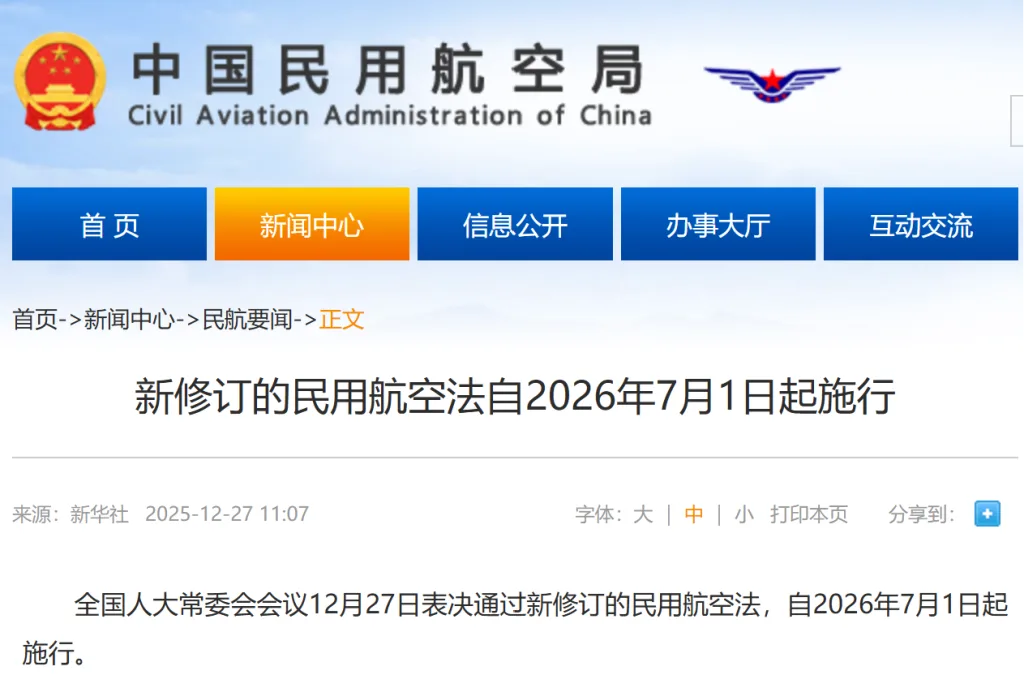
The newly amended Civil Aviation Law of the People's Republic of China officially takes effect today. As a comprehensive overhaul of the foundational legal statute that has governed China’s civil aviation sector for three decades, this legislative landmark transitions the low-altitude economy from fragmented regional trial programs into a unified, rule-of-law operational era.
(Source: Civil Aviation Administration of China)
Core Structural Shifts at a Glance:
- Statutory Airspace Allocation: For the first time, low-altitude economy development is legally integrated into high-level airspace planning and local government infrastructure mandates.
- Lifecycle Drone Identification: Mandatory airworthiness certifications and unique product identification codes (Product IDs) extend regulatory enforcement upstream to manufacturers.
- Dynamic Enforcement & Countermeasures: Civil aviation authorities receive expanded enforcement powers, including site inspections, asset seizures, and mandatory anti-drone defense systems near sensitive zones.
- Data Security & Privacy Safeguards: Explicit restrictions govern data collection, surveillance, and international data transfers during commercial drone operations.
I. Institutional Guarantee for Low-Altitude Airspace Allocation
Previously, low-altitude airspace opening and spatial planning relied primarily on local municipal rules or industry guidance, lacking direct grounding in national statute.
- Core Statutory Provisions (Articles 74 & 225): The amended law explicitly mandates that airspace classification principles must incorporate the needs of low-altitude economic development. It adds a dedicated "Development Promotion" chapter, establishing legal duties for local governments at or above the county level to plan infrastructure and support industry growth.
- Legal Impact: The law provides a solid legal foundation for government-led low-altitude infrastructure (such as physical vertiports, eVTOL landing pads, and integrated sensing-and-communication networks), accelerating municipal infrastructure investment and project rollouts.
II. Digital ID Enforcement: Full-Lifecycle Traceability for Unmanned Aircraft
To address public safety concerns surrounding commercial and consumer drones, the regulatory boundary extends directly upstream into aircraft design and manufacturing.
- Core Statutory Provision (Article 34): Entities engaged in the design, production, import, maintenance, and flight operations of civil unmanned aircraft must obtain airworthiness approval, unless explicitly exempted by law. Furthermore, manufacturers are legally required to assign a standardized, unique product identification code to every aircraft.
- Legal Impact: Commercial drones enter a fully transparent, lifecycle-monitored regulatory framework. Non-compliant manufacturers using uncertified components or failing safety standards will be phased out. In instances of unauthorized flights ("black flying") or property damage, regulatory agencies can achieve full-chain traceability from the aircraft straight to the registered operator.
(Source: Guangdong Digital Jurisprudence Society)
III. Enforcement Powers & Sensitive Zone Countermeasures
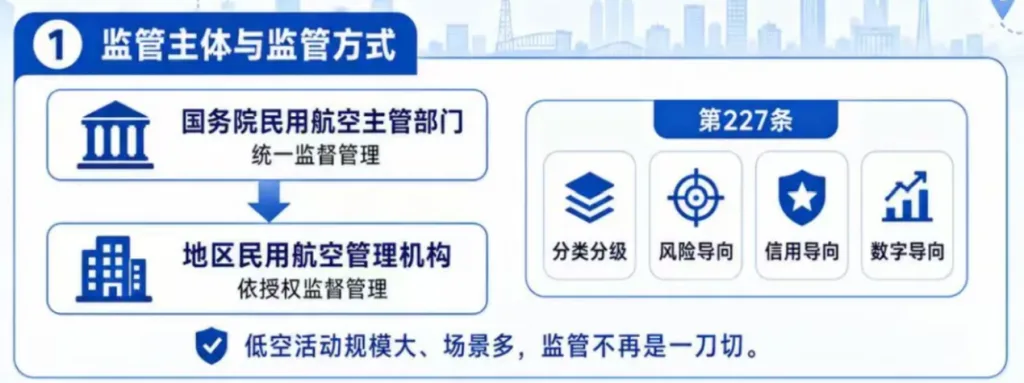
Recognizing the high volume and complex operational scenarios of low-altitude activities, the law equips civil aviation administrative authorities with enhanced enforcement mechanisms.
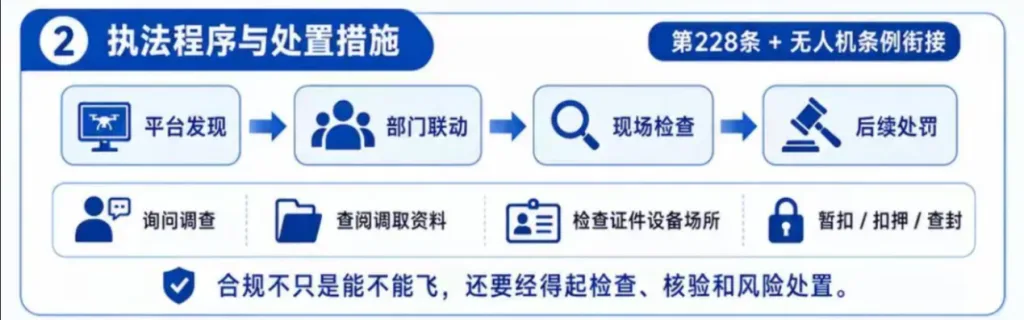
- Core Statutory Provisions (Articles 61 & 228): Authorities are granted explicit powers for on-site inspections, data retrieval, asset impoundment, and temporary seizures. Additionally, civil airports are required to delineate designated drone control zones and equip them with detection and anti-drone countermeasure systems.
- Legal Impact: Compliance for commercial low-altitude operators shifts from a one-time permit to continuous operational logging. Enterprises must maintain verifiable flight logs, real-time telemetry reporting, and audit trails to handle random dynamic inspections.

(source: Civil Aviation Administration of China)
IV. Urban Airspace Operational Restrictions
The law reinforces strict boundaries regarding flight paths over densely populated urban areas.
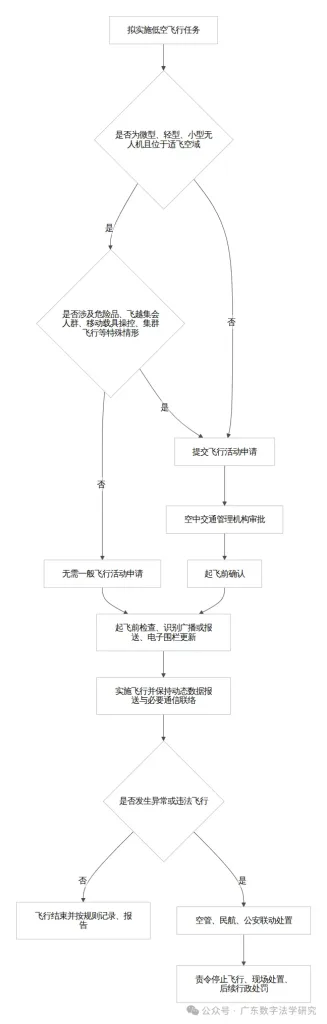
- Core Statutory Provision (Article 83): Preserves the strict restriction that civil aircraft shall not fly over urban areas, unless strictly required for takeoff, landing, or designated flight corridors, maintaining altitudes sufficient to exit urban airspace in an emergency without endangering ground safety, or operating under special regulatory approval.
- Legal Impact: Legislative encouragement of the low-altitude economy does not translate to unregulated urban flights. For enterprises planning urban air logistics or intercity eVTOL passenger transport, core competitiveness depends on maintaining superior safety standards, real-time airspace monitoring, and coordination with local air traffic control to secure special route permits.
(Source: Guangdong Digital Jurisprudence Society)
V. Data Privacy & Cross-Border Data Compliance
As aerial photography, infrastructure inspection, and geographic surveying become widespread, data privacy and national security controls have intensified.
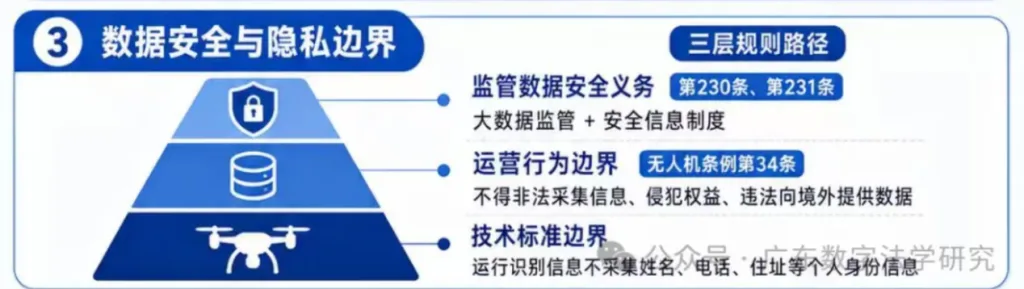
- Core Statutory Provisions (Articles 230 & 231): While encouraging the use of big data technologies for oversight, civil aviation authorities are legally bound to protect data security. In tandem with the Interim Regulations on the Flight Management of Unmanned Aircraft, the law strictly prohibits illegal data collection, infringement of individual privacy rights, and unauthorized cross-border data transfers.
- Legal Impact: Enterprises utilizing drones for geographic mapping, industrial inspection, or high-definition surveying must implement strict data residency and access controls. Capturing sensitive geographic data or transferring flight telemetry abroad without security assessments triggers severe administrative and data privacy liabilities.
(Guangdong Digital Jurisprudence Society))
Conclusion
The implementation of the amended Civil Aviation Law reshapes legal predictability across the low-altitude sector, bringing an end to unregulated growth. Future market leaders will be those who seamlessly integrate airworthiness certification, data security protocols, and operational compliance into their core commercial architecture.
(Guangdong Digital Jurisprudence Society))
Disclaimer & Copyright: This article is co-authored by Mandy Wu and Yu Yuting. The insights shared are for general compliance trends only and do not constitute formal legal advice.As a specialized cross-border legal institution, Neo-Ark Law Firm provides comprehensive global compliance and rights-protection support for expanding enterprises. For more international legal updates, please visit the Neo-Ark Law Firm Official Websites (https://www.neoarklawyers.com/news).