...

News

China R Visa Guide: A Practical Guide for Foreign High-Level Talent

For foreign high-level talents intending to come to China for scientific research cooperation, business operations, investment, entrepreneurship, or professional development in various fields, the R visa represents a key institutional arrangement for obtaining long-term entry eligibility. This visa category is designed for foreign nationals who meet China’s talent recognition standards and can be issued with a validity of up to 10 years. This article provides a complete overview of the application process and critical practical considerations from a legal perspective.
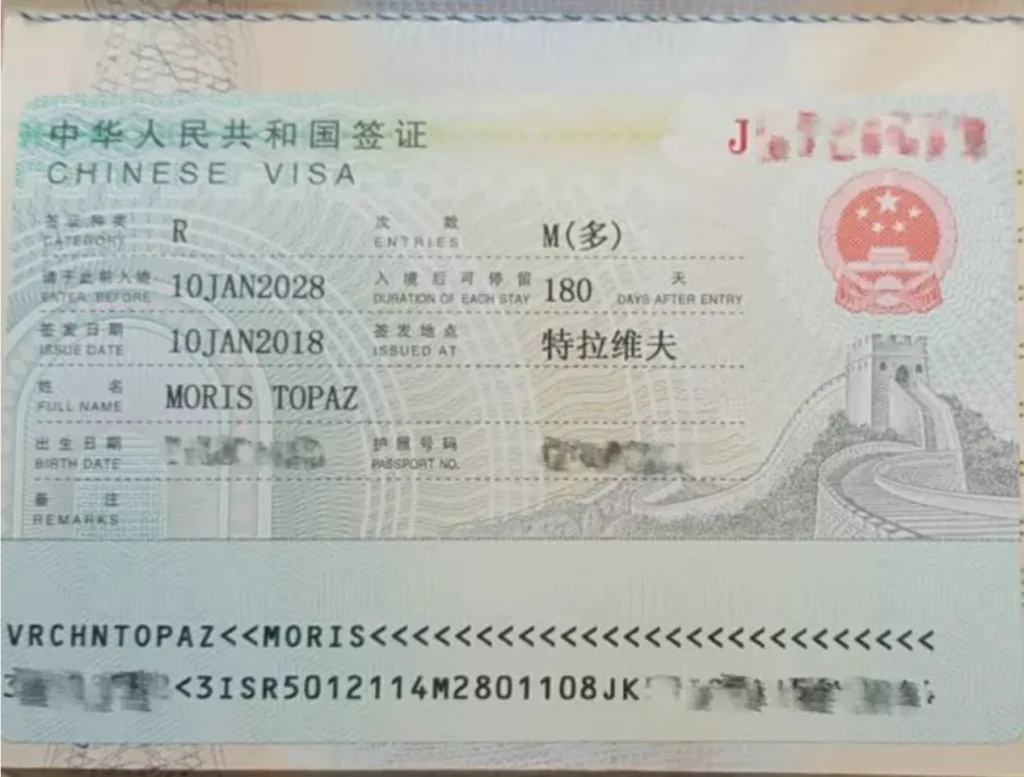
(R visa sample – Source: China Association for International Exchange of Personnel )


I. Overview of the R Visa

The R visa is specifically established for foreign high-level talents and urgently needed professionals that serve China’s national socioeconomic development. Once approved, the R visa is valid for 5 to 10 years, allows multiple entries, and permits a single stay of up to 180 days. The spouse and minor children of the visa holder may apply for corresponding visas of the same validity and multiple-entry privileges.


II. Eligibility Requirements

To apply for an R visa, the applicant must first be recognized as a foreign high‑level talent (Category A). According to the Classification Criteria for Foreigners Working in China (Trial), individuals falling into any of the following six major categories may apply if they meet the respective criteria:

1. Selected into relevant Chinese talent introduction programs
Individuals who have been selected into talent introduction programs recognized by talent authorities at or above the deputy provincial level, as approved or filed by the Organization Department of the CPC Central Committee, the Ministry of Human Resources and Social Security, or the State Administration of Foreign Experts Affairs.

2. Meeting internationally recognized professional achievement standards
(1) Top awards: Recipients of internationally renowned awards such as the Nobel Prize, Turing Award, Fields Medal, Pritzker Architecture Prize, etc.
(2) Authoritative status: Members of national academies of sciences or engineering; key members of internationally renowned academic institutions or international organizations.
(3) Research leadership: Directors of national research institutes or national laboratories; editors‑in‑chief or deputy editors of high‑impact scientific journals (JCR Q1 and Q2), or authors of core papers in such journals.
(4) Cultural and sports figures: Professors at renowned music or art academies; chief conductors or principal performers of leading orchestras; top‑eight athletes and head coaches in Olympic Games or World Championships.

For the complete list of 18 recognition criteria, please refer to:
https://fuwu.most.gov.cn/r/cms/zwpt/web/pdf/wgrlhzq/20180731103648_983.pdf

3. Meeting market‑oriented encouraged job positions
(1) Personnel with senior management or technical positions employed by central government‑owned enterprises and their secondary subsidiaries, global or regional headquarters of Fortune 500 companies, national high‑tech enterprises, or large‑scale enterprises.
(2) Personnel with senior management or technical positions working at nationally recognized enterprise engineering research centers, engineering laboratories, engineering technology research centers, enterprise technology centers, or local technological innovation service platforms.
(3) Personnel with senior management or technical positions employed by medium‑sized domestic or foreign enterprises, or chairpersons, legal representatives, general managers, or chief technical experts of small foreign‑invested enterprises that fall under the encouraged industry categories of the Catalogue of Industries for Guiding Foreign Investment or the Catalogue of Superior Industries for Foreign Investment in Central and Western Regions.
(4) Personnel appointed to senior management positions at higher education institutions or research institutes, or to associate professor, associate researcher, senior lecturer, or senior internship instructor positions at vocational colleges.
(5) Personnel appointed to senior management or senior professional technical positions (deputy senior or above) at top‑tier general hospitals in China, specialized hospitals at or above the deputy provincial city level, or foreign‑invested hospitals.
(6) Chief conductors, artistic directors, and principal performers employed by leading domestic orchestras and other arts groups.
(7) Personnel with senior management or technical positions such as editors‑in‑chief, deputy editors‑in‑chief, chief broadcasters, senior hosts, planning directors, and layout design directors employed by central or local mainstream media.
(8) Key athletes, head coaches, or core coaching team members employed by national or provincial sports teams or clubs.
(9) Foreign talents whose average salary income is no less than six times the previous year’s average social salary in the local region.

4. Innovative and entrepreneurial talents
(1) Founders of enterprises who have contributed major technological inventions, patents, or other proprietary intellectual property or know‑how as capital, with stable investment over three consecutive years, cumulative actual investment of no less than USD 500,000, and personal shareholding of no less than 30%.
(2) Chairpersons, legal representatives, general managers, or chief technical experts of enterprises with annual sales of RMB 10 million or above, or annual tax payments of RMB 1 million or above for three consecutive years, where the enterprise’s core assets include major technological inventions, patents, or proprietary intellectual property.
(3) Personnel with senior management or technical positions employed by units included in innovation enterprise lists or science and technology innovation occupation lists formulated by relevant provincial authorities.

5. Outstanding young talents
Young talents under the age of 40 who have completed postdoctoral research at high‑level overseas universities or domestic institutions in China.

6. Scoring 85 points or above in the points‑based system
Based on the points calculation table that evaluates factors such as annual salary, education level, work experience, Chinese language proficiency, and age, applicants with a total score of 85 or higher qualify.

For the complete points table, please refer to:
https://fuwu.most.gov.cn/r/cms/zwpt/web/pdf/wgrlhzq/20180731103648_983.pdf

Detailed standards are set out in the Classification Criteria for Foreigners Working in China (Trial).
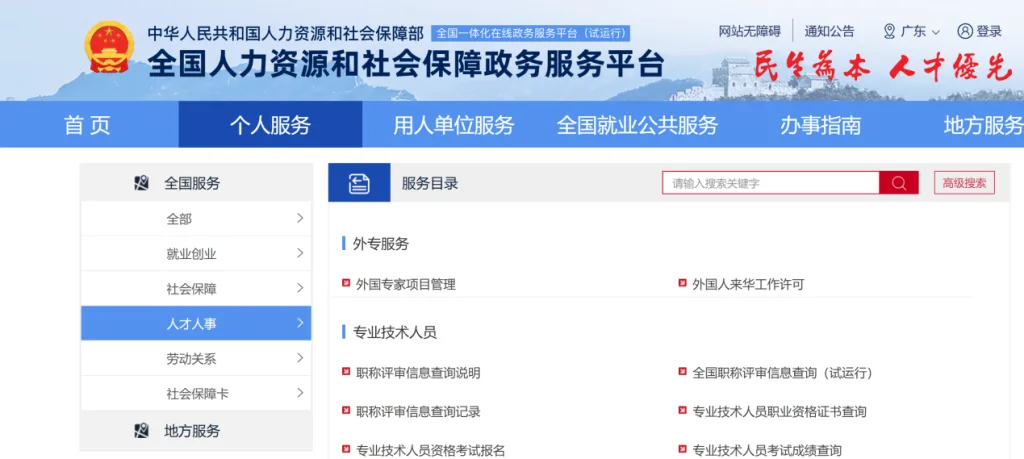
(Government service platform – Source: Ministry of Science and Technology of the People's Republic of China (Administrative Service Platform))


III. Application Process

Step 1: The inviting entity in China applies for the Confirmation Letter for Foreign High‑Level Talents
The inviting entity (employer) submits an application to the provincial‑level foreign experts work administration department where it is located. The application, including the online form, an invitation letter from the Chinese entity, and supporting documents evidencing that the applicant meets the R‑visa talent criteria, must be submitted online.

If the applicant meets the high‑level talent standards, the provincial‑level authority will issue the Confirmation Letter for Foreign High‑Level Talents online within the prescribed timeframe and share the information with the Chinese embassy or consulate in the applicant’s home country (or region).

Step 2: Apply for the R visa at the overseas Chinese embassy or consulate
The applicant submits the following materials to the Chinese embassy or consulate (or other overseas institutions authorized by the Ministry of Foreign Affairs) to apply for the R visa:
(1) Visa application form
(2) Passport (valid for at least 6 months) and compliant photos
(3) Printed copy of the Confirmation Letter for Foreign High‑Level Talents
(4) Other materials required by the embassy or consulate

If eligible, the embassy or consulate will issue an R visa with a validity of 5 to 10 years and multiple entries.

Step 3: Apply for the work permit after entry
Foreigners working in China with an R visa must apply for a Foreigner’s Work Permit from the local foreign experts work administration department in the place where the employer is located. The application can be submitted online, including documents such as the employment contract or certificate of appointment, medical examination certificate, R visa endorsement page, and passport information page. The specific processing method and timeline are subject to the requirements of the local authority.

Certain documents may be submitted under a “commitment system” (i.e., a self‑declaration in lieu of original certificates):
(1) For Category A talents falling under (1) selected into talent programs, (2) meeting internationally recognized professional achievement standards, (3) meeting market‑oriented encouraged job positions, or (4) innovative and entrepreneurial talents, the highest degree/diploma certificate may be submitted under a commitment system under prescribed conditions.
(2) For Category A talents falling under (1) and (2), proof of work experience and certificate of no criminal record may also be submitted under the commitment system under certain conditions.

Step 4: Apply for a work‑type residence permit
After obtaining the Foreigner’s Work Permit, the applicant must apply for a work‑type residence permit from the exit‑entry administration department of the public security authority. Once issued, the holder may enter and exit China multiple times with the residence permit within its validity period.
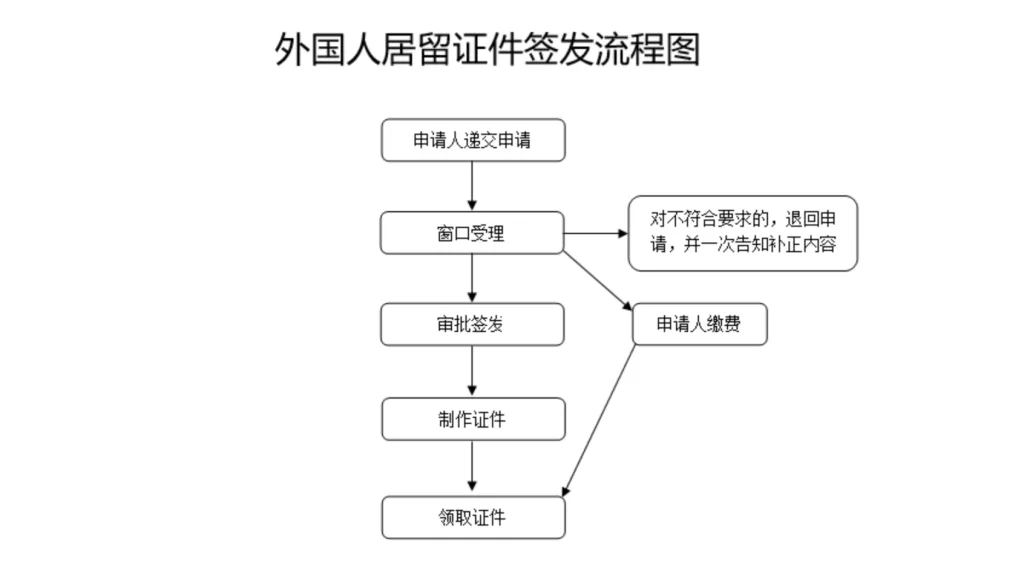
(Application process flowchart – Source: National Human Resources and Social Security Administrative Service Platform)


IV. Key Considerations

  1. Meeting the Category A talent criteria under the Classification Criteria for Foreigners Working in China (Trial) is a prerequisite for obtaining the R visa. Employers and applicants are advised to self‑assess against the criteria in advance and prepare the necessary supporting documents.
  2. The R visa is an entry visa and is not equivalent to a work permit. If the R‑visa holder plans to work in China or engage in activities that legally require a work permit, they must apply for the Foreigner’s Work Permit and complete the relevant residence formalities in accordance with the regulations.
  3. Certain Category A talents may benefit from “flexible document submission” and the “commitment system.” For items processed under the commitment system, applicants are advised to keep the original supporting documents properly for future renewal or change procedures.
  4. If changing employers within China, the new employer should, in principle, apply for the work permit modification and, depending on the actual circumstances, update the relevant residence permit. Whether the R visa needs to be re‑applied for depends on the specific visa and residence permit status.

Conclusion

For foreign high‑level talents, the R visa offers a long validity period and significant entry facilitation, making it a premium channel for developing a career in China. Seizing this policy opportunity is a strategic first choice for entering the Chinese market.

About the Author

Yu Yuting
Partner | NEO-ARK Law Firm

Lawyer Yu focuses on foreign-related litigation, cross-border disputes, commercial matters, and legal services for overseas individuals and businesses in China.

Email: [email protected]

About NEO-ARK Law Firm

NEO-ARK Law Firm provides legal services in foreign-related litigation, commercial disputes, family law, and cross-border legal matters, assisting both international and domestic clients throughout China.
Recommend
Guidelines for International Lawyers on Researching Foreign Civil and Commercial Law

With the implementation of the Provisions of the State Council on Outbound Investment in July 2026, compliance requirements for companies expanding overseas have been heightened. This article covers key jurisdictions with the closest economic and trade ties to China, organized according to both legal systems and regions. It balances the use of research tools with practical considerations to help cross-border lawyers identify relevant laws and prepare preliminary legal assessments.


指南|涉外律师域外民商事法律检索指引 Guidelines for International Lawyers on Researching Foreign Civil and Commercial Law

(Source: Ministry of Commerce of the People's Republic of China (for the screenshot of the official notice)

I. Common Law Systems: the United States, Canada, and Singapore

1. United States: Laws vary significantly across the 50 states; federal and state laws coexist
(1) Key Laws: Foreign Investment Risk Review Modernization Act of 2018 (FIRRMA)Export Administration Regulations (EAR)Foreign Corrupt Practices Act (FCPA)
(2) Search Resources: Justia, Congress.gov, Federal Register, etc.
(3) Practical Tips: U.S. case law evolves rapidly; it is recommended to use “Shepard’s Citations” to verify that a case is still in force.

2. Canada: Common Law and the Civil Code of Québec coexist
(1) Key Laws: Investment Canada Act (ICA)Civil Code of Québec
(2) Search Resources: CanLII, Justice Laws Website, etc.
(3) Practical Tips: Investments in critical minerals require special attention to the new regulations taking effect in 2024.

3. Singapore: The Asian Arbitration Hub
(1) Key Laws: Companies ActPersonal Data Protection Act (PDPA)Limited Liability Partnership Act
(2) Search Resources: Singapore Statutes Online, etc.
(3) Practical Tips: Singapore serves as a “gateway” for researching ASEAN laws; English translations of many Thai and Indonesian laws can be found in Singaporean databases.


II. Civil Law Systems: Germany, France, Japan, South Korea, Russia, Thailand

1. Germany: A federal civil law system centered on the Civil Code
(1) Key Laws: German Civil Code (BGB)Foreign Trade and Payments Ordinance (AWV)Supply Chain Due Diligence Act (LkSG)General Data Protection Regulation (GDPR)
(2) Search Resources: Gesetze im Internet, EUR-Lex (EU law), Beck-Online, etc.
(3) Practical Tips: German laws are frequently amended; be sure to verify the version date.

2. France: Unitary Civil Law System
(1) Key Laws: French Monetary and Financial CodeFrench Labor CodeGeneral Data Protection Regulation (GDPR)
(2) Search Resources: Légifrance, EUR-Lex (EU law), etc.
(3) Practical Tips: Case law from the French Council of State (Conseil d’État) is crucial for understanding the application of the law.

3. Japan: Civil Law System + Local Characteristics
(1) Key Laws: Foreign Exchange and Foreign Trade ActCompanies ActAct on the Protection of Personal InformationEconomic Security Promotion ActCivil Rehabilitation Act
(2) Search Resources: e-Gov Legislation Search, JETRO Investment Guide, etc.
(3) Practical Tips: Starting in 2024, Japan will tighten export controls on semiconductors to China, and the Foreign Exchange and Foreign Trade Act is frequently amended; it is recommended to subscribe to METI email notifications.

4. South Korea: Civil Law System
(1) Key Laws: Foreign Investment Promotion Act (FIPA)Monopoly Regulation and Fair Trade ActPersonal Information Protection Act (PIPA)Commercial Act
(2) Search Resources: Korea Law Information Center, The Supreme Court of Korea, etc.
(3) Practical Tips: South Korea has recently made a series of significant adjustments to its foreign exchange regulations; it is recommended to stay informed about updates to these regulations.

5. Russia: Civil law system, influenced by Soviet law
(1) Key Laws: Foreign Investment LawLaw on Foreign Investment in Strategic EntitiesRussian Personal Data Law (152-FZ)Civil Code of the Russian Federation, Part Four (intellectual property)
(2) Search Resources: GARANT, ConsultantPlus, Russian Agency of Legal and Judicial Information (RAPSI), etc.
(3) Practical Tips: Due to the international situation, legal information updates may be delayed; it is recommended to verify information through a local partner law firm.

6. Thailand: Civil Law System
(1) Key Laws: Foreign Business Act (FBA 1999)Investment Promotion Act, B.E. 2542 (1999)Land Code
(2) Search Resources: Royal Thai Government Gazette, BOI official website, etc.
(3) Practical Tips: On June 30, 2026, Thailand deposited its instrument of accession to the Hague Apostille Convention with the Dutch Ministry of Foreign Affairs, pending official confirmation of the specific date of accession by the Hague Conference on Private International Law.

(World Legal Systems Map – Source: Juriglobe)


III. “Graded Search” for Cross-Legal System Investments: The Middle East and Africa

1. Middle East: A hybrid of Sharia law and civil/common law
(1) Key Laws: Investment Law of the Kingdom of Saudi Arabia (revised 2025); Commercial Companies Law (UAE)Foreign Investment Promotion and Protection Act (FIPPA, Iran)
(2) Search Resources: The Ministry of Justice (Saudi Arabia), Thomson Reuters Practical Law, national investment ministries, etc.
(3) Practical Tips: In the commercial sphere, modern codified investment laws predominate, while Islamic law primarily influences family law, security interests, contract interpretation, and Islamic finance. Some Middle Eastern countries have implemented separate legal systems in specific regions to attract foreign investment; therefore, it is necessary to conduct separate searches for these region‑specific legal frameworks.

2. Africa: A mix of customary law and colonial law
(1) Key Countries: Egypt (Civil Law), Nigeria (Common Law), South Africa (Mixed Legal System)
(2) Key Laws: Investment Law No.72 of 2017 (Egypt)Nigerian Investment Promotion Commission ActInvestment Proclamation No.1180/2020 (Ethiopia)
(3) Search Resources: AfricanLII, African Union (AU), national official gazettes, etc.
(4) Practical Tips: Given Africa’s weak legal infrastructure, it is recommended to consult with local law firms.


IV. Commonly Used Research Resources

(World Legal Systems Map – Source: Juriglobe)


Conclusion
Cross-border lawyers with the ability to conduct cross‑jurisdictional research can help companies expanding overseas clarify the boundaries of applicable law in their target countries and make preliminary legal assessments. It is important to note that legal services in every country are subject to territorial practice restrictions, and core issues such as the extraterritorial application of laws and the practical details of local legal procedures are highly specific to each jurisdiction. Therefore, during the implementation phase of cross‑border legal services, the final legal framework and practical recommendations must still be based on the professional advice of local licensed attorneys.

About the Author

Yu Yuting
Partner | NEO-ARK Law Firm

Lawyer Yu focuses on foreign-related litigation, cross-border disputes, commercial matters, and legal services for overseas individuals and businesses in China.

Email: [email protected]

About NEO-ARK Law Firm

NEO-ARK Law Firm provides legal services in foreign-related litigation, commercial disputes, family law, and cross-border legal matters, assisting both international and domestic clients throughout China.
2026-08-05

Legal Guidance for a Brighter Future: Neo-Ark Law Firm Partners with Guangdong Juvenile Offender Custody House (Baiyun Prison) for Public Welfare Co-Building

On July 31, 2026, Guangdong Neo-Ark Law Firm hosted a joint symposium and official signing ceremony with the Guangdong Juvenile Offender Custody House (Baiyun Prison) at Neo-Ark’s headquarters. The event established a standardized, long-term, and institutionalized public welfare partnership aimed at enhancing legal education, aiding juvenile offender rehabilitation, and smoothing the transition for rehabilitated youth back into society.

Key leadership from the prison administration, including Deputy Director Chengjun Peng, engaged in in-depth exchanges with senior partners and attorneys from Neo-Ark Law Firm. During the ceremony, official appointment letters were presented to 16 outstanding attorneys as "Legal Education Counselors," cementing a shared commitment to legal reform and juvenile protection.

I. Institutional Partnership & Signing Ceremony

  • Delegation & Representation: The visiting delegation was led by Chengjun Peng (Member of the Party Committee and Deputy Director of the Custody House), accompanied by key department heads from Education & Rehabilitation and Criminal Penalty Execution. Neo-Ark Law Firm was represented by Director Jianqiu Huang, Party Branch Secretary Zhimin Liu, Senior Partner Xiaofeng Liang, along with partners and associate attorneys.
  • Welcoming Remarks & Strategic Alignment: Secretary Zhimin Liu highlighted Neo-Ark's long-standing dedication to protecting minors' rights and its systematic approach to public welfare legal education. Deputy Director Chengjun Peng commended Neo-Ark’s professional contributions and outlined the strategic importance of legal co-building for the correction and reintegration of juvenile offenders.
  • Formalizing the Agreement: Senior Partner Jianbo Lin and Deputy Director Chengjun Peng signed the official Public Welfare Cooperation Agreement on behalf of both institutions, marking the official transition toward a permanent, structured legal service mechanism.

II. Recognition & Practical Legal Exchange

1. Public Welfare Recognition

To honor the firm's ongoing frontline contributions within the custody facility, Department Chief Jiexiong Xu presented Neo-Ark Law Firm with a commemorative silk banner. Additionally, 16 Neo-Ark attorneys received official appointment letters as "Legal Education Counselors" (法治教育辅导员) in recognition of their dedicated legal counseling and education work.

2. Key Legal & Operational Issues Discussed

Following the ceremony, attorneys and correctional officers engaged in an intensive practical seminar focused on critical intersections between prison enforcement and legal defense practice:

  • Property Penalty Fulfillment (财产刑履行): Evaluating how restitution and fine payments impact eligibility reviews for sentence reductions and parole.
  • Criminal Appeals (刑事申诉): Clarifying procedural standards and practical impacts of pending appeals on sentence modification evaluations.
  • Post-Parole Community Corrections: Addressing procedural handovers between prison release and local community correction supervisory bodies.
  • Implementation of the Updated Prison Law: Exchanging frontline insights on legal standards, administrative procedures, and practical compliance barriers under evolving regulatory frameworks.

III. Mission & Future Outlook

As the sole specialized facility in Guangdong Province responsible for housing and rehabilitating juvenile offenders, the Guangdong Juvenile Offender Custody House fulfills a critical judicial role in youth guidance and rehabilitation.

Through this formalized partnership, Neo-Ark Law Firm will continue to leverage its legal expertise to deliver structured legal counseling, regular educational outreach, and practical assistance within the facility—building a robust legal protection framework for juvenile rehabilitation.

About the Author

Yu Yuting
Partner | NEO-ARK Law Firm

Lawyer Yu focuses on foreign-related litigation, cross-border disputes, commercial matters, and legal services for overseas individuals and businesses in China.

Email: [email protected]

About NEO-ARK Law Firm

NEO-ARK Law Firm provides legal services in foreign-related litigation, commercial disputes, family law, and cross-border legal matters, assisting both international and domestic clients throughout China.
2026-08-03

Can an E-Commerce Seller Defend a Design Patent Infringement Claim? A China IP Litigation Case

Overview

A Hong Kong-related e-commerce business faced a design patent infringement claim before the Guangzhou Intellectual Property Court after selling an electric fabric shaver through an online retail platform.

The patent owner alleged that the product sold by the client infringed its registered design patent and sought legal remedies against multiple parties involved in the distribution and supply chain.

Representing the defendant, Yu Yuting, Attorney at NEO-ARK Law Firm, developed a defence focusing on both the substantive comparison between the accused product and the patented design and the client's lawful source of the products.

The plaintiff subsequently voluntarily withdrew the lawsuit. The court approved the withdrawal, and the client was not ordered to pay damages.

Can an E-Commerce Seller Defend a Design Patent Infringement Claim? A China IP Litigation Case

ItemDetails
Practice AreaIntellectual Property Litigation
Case TypeDesign Patent Infringement Dispute
Cross-Border ElementHong Kong – Mainland China
ClientE-Commerce Trading Company
IndustryConsumer Electronics
ProductElectric Fabric Shaver
Core Legal IssuesDesign Patent Infringement & Legitimate Source Defense
Dispute ValueApproximately RMB 300,000+
ResolutionPlaintiff Voluntarily Withdrew the Claim
Lead LawyerYu Yuting / Sun Jianhui
Law FirmNEO-ARK Law Firm

Case Snapshot

Client's Situation

1. Patent Infringement Claim

The plaintiff alleged that the client's electric fabric shaver infringed its registered design patent.

The claim was brought before the Guangzhou Intellectual Property Court and involved several parties within the product distribution chain.


2. Dispute Over Product Design

The defence examined the visual and structural features of the accused product and identified differences in several design elements, including the indicator light, control openings, handle structure, and opening mechanism.

The client therefore disputed the allegation that the accused product was identical or substantially similar to the patented design.


3. Lawful Source of the Products

The client had purchased the products through an established online procurement channel and had paid consideration for the goods.

The defence therefore also examined whether the client could rely on the legitimate source defence available under Chinese patent law.


4. Product Removal

Before the litigation, the client had already removed the relevant product from sale.

This was also taken into consideration as part of the overall defence strategy.


Outcome

The plaintiff voluntarily withdrew the lawsuit during the proceedings.

The Guangzhou Intellectual Property Court approved the withdrawal, with the plaintiff bearing the court acceptance fee.

The client was not ordered to pay damages or other infringement compensation.

The result protected the client's commercial interests while avoiding further litigation exposure.


Why This Case Matters

Online sellers can face intellectual property claims even when they are not the manufacturers of the disputed products.

For e-commerce businesses, a strong response to a patent infringement claim may involve more than simply arguing that the product is different.

The seller's procurement records, transaction history, supplier information, product comparisons, and actions taken after receiving the claim may all become relevant to the defence.

This case demonstrates the importance of responding quickly to a patent claim and developing multiple lines of defence rather than relying on a single argument.


Frequently Asked Questions

Can an e-commerce seller be liable for selling a product that allegedly infringes a design patent?

Potentially, yes.

The seller's liability depends on the applicable patent law, the circumstances of the sale, the nature of the alleged infringement, and available statutory defences.


What is the legitimate source defence in China patent disputes?

Under certain circumstances, a seller may defend against a patent infringement claim by demonstrating that the allegedly infringing products were obtained from a legitimate source and that the statutory requirements are satisfied.

Whether the defence applies depends on the specific facts and evidence.


Why are procurement records important in patent litigation?

Purchase contracts, invoices, payment records, supplier information, and other transaction documents can help establish where products came from and may be important when a legitimate source defence is raised.


Does removing a product from sale eliminate patent infringement liability?

Not necessarily.

Removing a product may help limit continuing commercial exposure, but whether a party remains liable for past conduct depends on the applicable law and circumstances of the case.


Key Takeaways

  • E-commerce sellers can face design patent infringement claims even when they are not manufacturers.
  • Product design comparison is an important part of defending a design patent claim.
  • A legitimate source defence may be available where its statutory requirements are satisfied.
  • Procurement and payment records can be critical in protecting an online seller.
  • Early legal action can help reduce litigation and commercial exposure.

About the Author

Yu Yuting
Partner | NEO-ARK Law Firm

Lawyer Yu focuses on foreign-related litigation, cross-border disputes, commercial matters, and legal services for overseas individuals and businesses in China.

Email: [email protected]

About NEO-ARK Law Firm

NEO-ARK Law Firm provides legal services in foreign-related litigation, commercial disputes, family law, and cross-border legal matters, assisting both international and domestic clients throughout China.
2026-07-31

Trademark Infringement or Cultural Borrowing? LV Wins RMB 10.3M First-Instance Judgment Against Molly Tea

The Intermediate People's Court of Suzhou, Jiangsu Province, issued a first-instance civil judgment in the trademark infringement and unfair competition lawsuit brought by Louis Vuitton Malletier (LV) against the Chinese tea beverage brand "Molly Tea" (茉莉奶白) and its local franchisee.

(Image Source: The Beijing News)

The court ordered Molly Tea to pay LV RMB 10 million in economic losses and RMB 300,000 in reasonable legal expenses, totaling RMB 10.3 million. This marks one of the highest damages awards in recent intellectual property disputes within the Asian beverage and consumer goods sector. Although Molly Tea has announced its intention to appeal, the case provides vital strategic guidance regarding international trademark cross-class protection, commercial copyright limits, and corporate Freedom to Operate (FTO) compliance.

I. Case Background & Litigation Timeline

  • Core Dispute: In 2021, Molly Tea built its initial identity around traditional Chinese aesthetic elements. During a subsequent visual rebrand, the company introduced a main logo featuring a four-petaled geometric flower and widely deployed a repeating quadrupled pattern on cups, paper bags, and store fascias. The pattern led consumers on social media to highlight striking visual similarities with LV’s famous Monogram design.
  • Prior Application History: Public records reveal that starting in 2022, Molly Tea submitted multiple applications to register four-petal geometric device marks with the China National Intellectual Property Administration (CNIPA). These applications were repeatedly rejected or placed under refusal review due to conflicts with prior registered marks held by LV. Despite these administrative refusals, the brand fully deployed the disputed pattern across its commercial operations.
  • Court Jurisdiction Strategy: LV initiated the suit in Suzhou by naming a local Suzhou franchisee alongside Molly Tea's Shenzhen headquarters as co-defendants. Under Article 29 of the Civil Procedure Law of the PRC, jurisdiction lies with the court at the place of the tortious act or the defendant's domicile. This strategy successfully anchored jurisdiction with the Suzhou Intermediate People's Court, home to the specialized Suzhou IP Court.
  • Current Status: Filed in May 2025, the case resulted in a first-instance ruling on June 29, 2026. Molly Tea has updated its digital applet icons and announced a formal appeal.

(Image Source: Molly Tea Mini-Program)

II. Judicial Reasoning & Legal Analysis

1. Why Copyright Registration Fails as a Defense

Molly Tea argued that it held valid copyright registration certificates for the artwork, claiming independent creation. The court rejected this defense:

  • Functional Distinction: Copyright protects original artistic expression, whereas trademark law governs commercial identifiers that indicate product origin.
  • Commercial Conversion: Once the geometric pattern was affixed to packaging, store signage, and marketing collaterals, its function converted into trademark-style use (商标性使用).
  • Prior Right Priority: Under Article 32 of the PRC Trademark Law, subsequent copyright registrations cannot infringe upon an entity's prior registered trademark rights.

(Image Source: China Trademark Office)

2. Secondary Meaning of Geometric Patterns

While basic four-petal designs exist in the historical public domain, LV's extensive global commercial use and marketing have established significant acquired distinctiveness (后天显著性). Intensive commercial use of highly similar visual symbols by a competitor in consumer-facing markets constitutes bad-faith goodwill freeloading (攀附商誉) and likelihood of confusion.

3. Cross-Class Protection for Well-Known Marks

LV operates primarily under Class 18 (leather goods) and Class 25 (apparel), while Molly Tea operates under Class 30 (beverages) and Class 43 (catering services).

  • Under Article 13(3) of the PRC Trademark Law, protection for registered well-known trademarks (驰名商标) extends across non-similar product and service categories.
  • The court found that using an almost identical pattern on beverage products misleads the public into inferring an authorized commercial relationship or collaboration, diluting the distinctive character and goodwill of LV's well-known mark.

(Image Source: Huibiao.com)

4. Basis for the RMB 10.3 Million Award

The RMB 10.3 million award exceeds the statutory compensation ceiling of RMB 5 million outlined in Article 63(3) of the PRC Trademark Law. The court applied discretionary damages (裁量性赔偿) based on:

  1. Scale of Infringement: Molly Tea operates a vast nationwide store network where the infringing visual assets were deployed systematically.
  2. Subjective Bad Faith: Proceeding with commercial deployment after repeated trademark application rejections by the CNIPA demonstrated intentional infringement (明知故犯).

III. Corporate IP Compliance Roadmap

  • Conduct Freedom to Operate (FTO) Audits: Conduct comprehensive trademark clearance and cross-class risk evaluations prior to finalizing brand rebrand designs or expanding into international franchise markets.
  • Avoid Commercializing Unapproved Trademarks: Rolling out visual identities that have been formally rejected by IP authorities exposes companies to high claims of intentional bad faith, elevating potential damages into punitive or discretionary tiers.
  • Differentiate Copyright from Trademark Use: A copyright registration certificate does not grant an automatic legal shield to use an artistic graphic as a commercial identifier if it conflicts with prior registered trademarks.

(Image Source: Tianyancha)

About the Author

Yu Yuting
Partner | NEO-ARK Law Firm

Lawyer Yu focuses on foreign-related litigation, cross-border disputes, commercial matters, and legal services for overseas individuals and businesses in China.

Email: [email protected]

About NEO-ARK Law Firm

NEO-ARK Law Firm provides legal services in foreign-related litigation, commercial disputes, family law, and cross-border legal matters, assisting both international and domestic clients throughout China.
2026-07-27

Scroll to Top

+86 13503030053

BackToTop

Inquiry Inquiry Email Email Tel Tel

Request A Quote

×
Please enable JavaScript in your browser to complete this form.