...

News

Aviation & Tech Compliance | The New Civil Aviation Law Takes Effect: Key Rules for Low-Altitude Economy & Drone Operations

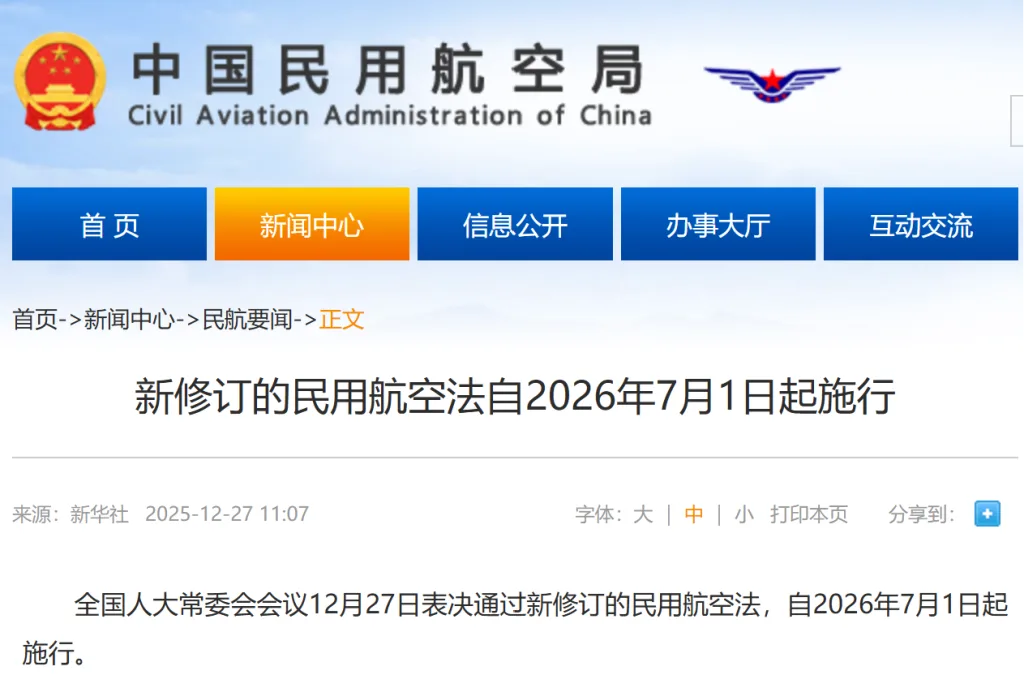
The newly amended Civil Aviation Law of the People's Republic of China officially takes effect today. As a comprehensive overhaul of the foundational legal statute that has governed China’s civil aviation sector for three decades, this legislative landmark transitions the low-altitude economy from fragmented regional trial programs into a unified, rule-of-law operational era.
(Source: Civil Aviation Administration of China)

Core Structural Shifts at a Glance:

  • Statutory Airspace Allocation: For the first time, low-altitude economy development is legally integrated into high-level airspace planning and local government infrastructure mandates.
  • Lifecycle Drone Identification: Mandatory airworthiness certifications and unique product identification codes (Product IDs) extend regulatory enforcement upstream to manufacturers.
  • Dynamic Enforcement & Countermeasures: Civil aviation authorities receive expanded enforcement powers, including site inspections, asset seizures, and mandatory anti-drone defense systems near sensitive zones.
  • Data Security & Privacy Safeguards: Explicit restrictions govern data collection, surveillance, and international data transfers during commercial drone operations.

I. Institutional Guarantee for Low-Altitude Airspace Allocation

Previously, low-altitude airspace opening and spatial planning relied primarily on local municipal rules or industry guidance, lacking direct grounding in national statute.

  • Core Statutory Provisions (Articles 74 & 225): The amended law explicitly mandates that airspace classification principles must incorporate the needs of low-altitude economic development. It adds a dedicated "Development Promotion" chapter, establishing legal duties for local governments at or above the county level to plan infrastructure and support industry growth.
  • Legal Impact: The law provides a solid legal foundation for government-led low-altitude infrastructure (such as physical vertiports, eVTOL landing pads, and integrated sensing-and-communication networks), accelerating municipal infrastructure investment and project rollouts.

II. Digital ID Enforcement: Full-Lifecycle Traceability for Unmanned Aircraft

To address public safety concerns surrounding commercial and consumer drones, the regulatory boundary extends directly upstream into aircraft design and manufacturing.

  • Core Statutory Provision (Article 34): Entities engaged in the design, production, import, maintenance, and flight operations of civil unmanned aircraft must obtain airworthiness approval, unless explicitly exempted by law. Furthermore, manufacturers are legally required to assign a standardized, unique product identification code to every aircraft.
  • Legal Impact: Commercial drones enter a fully transparent, lifecycle-monitored regulatory framework. Non-compliant manufacturers using uncertified components or failing safety standards will be phased out. In instances of unauthorized flights ("black flying") or property damage, regulatory agencies can achieve full-chain traceability from the aircraft straight to the registered operator.
(Source: Guangdong Digital Jurisprudence Society)

III. Enforcement Powers & Sensitive Zone Countermeasures

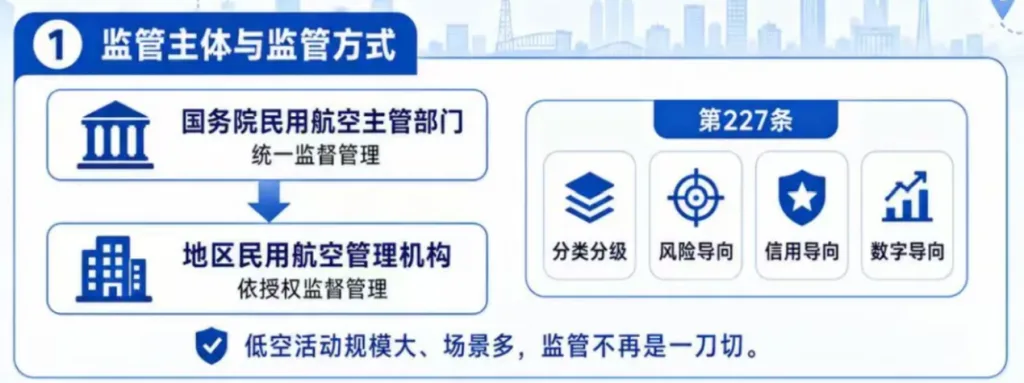
Recognizing the high volume and complex operational scenarios of low-altitude activities, the law equips civil aviation administrative authorities with enhanced enforcement mechanisms.

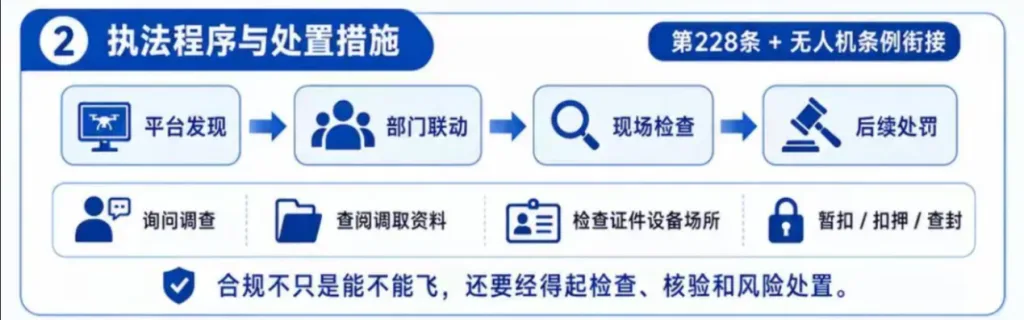
  • Core Statutory Provisions (Articles 61 & 228): Authorities are granted explicit powers for on-site inspections, data retrieval, asset impoundment, and temporary seizures. Additionally, civil airports are required to delineate designated drone control zones and equip them with detection and anti-drone countermeasure systems.
  • Legal Impact: Compliance for commercial low-altitude operators shifts from a one-time permit to continuous operational logging. Enterprises must maintain verifiable flight logs, real-time telemetry reporting, and audit trails to handle random dynamic inspections.

(source: Civil Aviation Administration of China)

IV. Urban Airspace Operational Restrictions

The law reinforces strict boundaries regarding flight paths over densely populated urban areas.

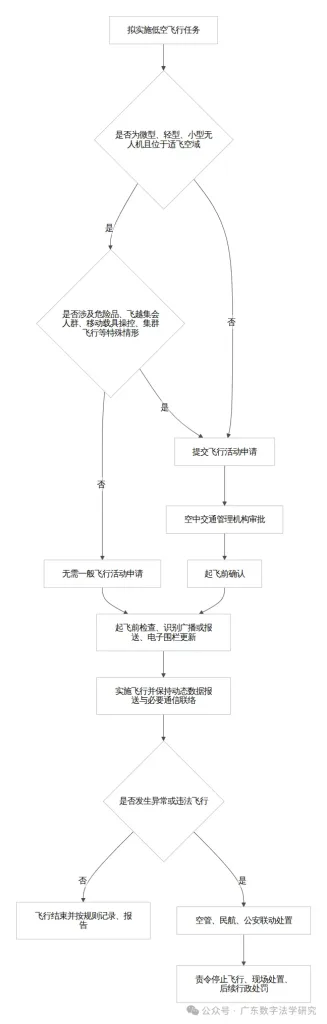
  • Core Statutory Provision (Article 83): Preserves the strict restriction that civil aircraft shall not fly over urban areas, unless strictly required for takeoff, landing, or designated flight corridors, maintaining altitudes sufficient to exit urban airspace in an emergency without endangering ground safety, or operating under special regulatory approval.
  • Legal Impact: Legislative encouragement of the low-altitude economy does not translate to unregulated urban flights. For enterprises planning urban air logistics or intercity eVTOL passenger transport, core competitiveness depends on maintaining superior safety standards, real-time airspace monitoring, and coordination with local air traffic control to secure special route permits.
(Source: Guangdong Digital Jurisprudence Society)

V. Data Privacy & Cross-Border Data Compliance

As aerial photography, infrastructure inspection, and geographic surveying become widespread, data privacy and national security controls have intensified.

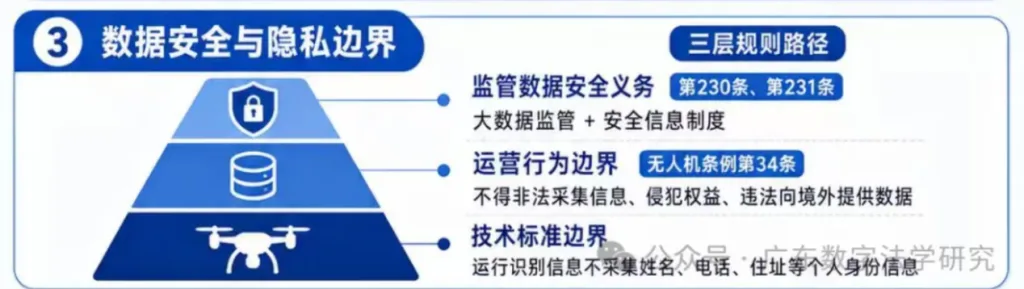
  • Core Statutory Provisions (Articles 230 & 231): While encouraging the use of big data technologies for oversight, civil aviation authorities are legally bound to protect data security. In tandem with the Interim Regulations on the Flight Management of Unmanned Aircraft, the law strictly prohibits illegal data collection, infringement of individual privacy rights, and unauthorized cross-border data transfers.
  • Legal Impact: Enterprises utilizing drones for geographic mapping, industrial inspection, or high-definition surveying must implement strict data residency and access controls. Capturing sensitive geographic data or transferring flight telemetry abroad without security assessments triggers severe administrative and data privacy liabilities.
(Guangdong Digital Jurisprudence Society))

Conclusion

The implementation of the amended Civil Aviation Law reshapes legal predictability across the low-altitude sector, bringing an end to unregulated growth. Future market leaders will be those who seamlessly integrate airworthiness certification, data security protocols, and operational compliance into their core commercial architecture.
(Guangdong Digital Jurisprudence Society))

Disclaimer & Copyright: This article is co-authored by Mandy Wu and Yu Yuting. The insights shared are for general compliance trends only and do not constitute formal legal advice.As a specialized cross-border legal institution, Neo-Ark Law Firm provides comprehensive global compliance and rights-protection support for expanding enterprises. For more international legal updates, please visit the Neo-Ark Law Firm Official Websites (https://www.neoarklawyers.com/news).

Recommend
Private Equity Compliance | Reconstructing China's PE Regulatory Framework: Executive Roadmap for State Council Decree No. 54

On June 5, 2026, the General Office of the State Council issued the Guiding Opinions on Strengthening Supervision, Preventing Risks, and Promoting High-Quality Development of Private Equity Investment Funds (State Council Letter [2026] No. 54, hereinafter referred to as "Decree 54").

As the top-level charter governing China's "1+N+X" private equity regulatory framework, Decree 54 marks the end of wild expansion and ushers in an era of stringent, high-quality institutional compliance.

Core Structural Shifts at a Glance:

  • Market Entry Control: Prequalification screening by provincial regulators is now a mandatory prerequisite prior to corporate registration.
  • Mandatory Custody: Mandatory fund custody rules expand significantly, systematically eliminating "self-custody" loopholes.
  • Valuation Adjustment Mechanism (VAM) Governance: Introduces the first-ever top-level regulatory restriction on VAM and Earn-out agreements, cracking down on disguised debt and rigid redemptions.
  • State Capital Scrutiny: Strictly bans county-level governments from establishing redundant new government funds, prohibiting state-owned enterprises (SOEs) from off-spectrum cross-industry investments.

(source:CCTV 13)

I. Regulatory Restructuring: Rebalancing Administrative Enforcement and Self-Regulation

Decree 54 establishes a dual-tier governance system that explicitly segregates administrative enforcement from industry self-regulation:

  • Legacy Model: Heavy reliance on Asset Management Association of China (AMAC) self-regulation, resulting in limited deterrence over unregistered entities.
  • Decree 54 Model: China Securities Regulatory Commission (CSRC) and its regional offices act as administrative gatekeepers for entry checks, investigations, and penalties, supported by AMAC for frontline daily monitoring, filings, and self-disciplinary reviews.

By placing administrative oversight at the forefront, compliance obligations transition from mere industry association rules to binding statutory duties. Continued compliance is now the absolute legal precondition for fund managers to operate in mainland China.

Attorney's Compliance Note:

Existing fund managers should establish a dual-line compliance protocol connecting both the CSRC and AMAC. Shift internal compliance priorities from formality-based initial filing reviews to full-lifecycle ongoing operational control. Fund managers should proactively build audit-response mechanisms for sudden regulatory inquiries and on-site inspections.

(Official release and regulatory bulletin on private equity oversight guidelines issued by the China Securities Regulatory Commission. Source: CSRC)

II. Gatekeeping at Market Entry: Mandatory Joint Prequalification Screening

Under Section II of Decree 54, any entity seeking to register as a private equity fund manager—or planning to include private equity or venture capital terminology in its corporate name or business scope—must complete a joint prequalification screening by the provincial financial regulatory authority and local CSRC office before applying for market regulation registration.

Registration Procedure Framework:

  1. Apply for Joint Prequalification Screening through the Provincial Authority and Local CSRC.
  2. Upon prequalification approval, proceed to Market Regulation Corporate Registration.
  3. Complete official AMAC Fund Manager Registration.
Entity TypeCorporate Name / Scope FeatureTrigger Prequalification?Required Registration Path
Licensed PE/VC ManagerContains "Private Equity", "VCF", etc.Yes (Mandatory)Prequalification Screening -> Corporate Registration -> AMAC Filing
Standard Investment FirmGeneral "Investment Management", "Asset Management"NoStandard Market Regulation Corporate Registration

Attorney's Compliance Note:

Prospective fund managers must factor in an additional 1 to 3 months for prequalification screening. Applications require complete transparency regarding ultimate beneficial owners (UBOs), actual controllers, capital contribution capabilities, and risk control systems.

III. Custody System Upgrade: Full-Coverage Mandatory Custody Execution

Decree 54 mandates the creation of unified, mandatory fund custody regulations across all PE structures. The regulatory threshold for custody exemptions has shrunk considerably:

  • Contractual Securities Funds: Mandatory custody applies across all structures.
  • Partnership & Corporate Securities Funds (Issued post-Aug 2024): Mandatory custody required without exception.
  • PE & VC Funds: Mandatory custody applies to all contractual structures, Special Purpose Vehicle (SPV) investments, and fund expansion products.

Attorney's Compliance Note:

Audit all active non-custodial funds within your portfolio immediately. Distinguish between legally exempted products and non-compliant structures requiring remediation. For newly established funds, embed qualified custodian institutions during the initial structural design phase to establish unambiguous cash-sweep and oversight covenants.

IV. Refining Equity Investments: Dual Regulation of VAM Agreements

For the first time, a State Council policy explicitly mandates the creation of specialized regulatory rules governing Valuation Adjustment Mechanisms (VAM / Earn-out agreements).

Going forward, VAM terms in PE/VC deals will be governed by two independent, parallel legal frameworks:

  1. Civil & Judicial Review: Governed by Supreme People's Court judicial guidelines evaluating corporate law feasibility and capital maintenance principles.
  2. Administrative Regulation (Decree 54): Strictly prohibiting VAMs structured to guarantee returns ("rigid redemption"), disguise debt as equity, or bypass leverage limits.

Attorney's Compliance Note:

Review all existing portfolio VAM provisions and classify them into strategic remediation categories:

  • Maintain: Commercial performance adjustments and legitimate shareholder-level compensation arrangements that comply with capital maintenance.
  • Amend or Excise: Unenforceable target-company buybacks, guaranteed return provisions, and rigid repurchase clauses that risk being recharacterized as illegal debt disguised as equity.

(CSRC Chairman Wu Qing delivering an opening address at the 4th Member Representative Congress of the Asset Management Association of China. Source: CSRC)

V. Tightening State-Owned and Government Fund Participation

Decree 54 imposes strict parameters on state-backed capital commitments:

  1. Government Investment Funds: County and district-level governments are principally prohibited from launching new government investment funds. Exceptions require approval from higher-level municipal or provincial governments. Functional overlaps across funds are eliminated, and disguised debt raising or guaranteed returns are strictly illegal.
  2. State-Owned Enterprise (SOE) Capital: SOE fund investments must align tightly with the enterprise's core operational mandate. SOEs are barred from cross-industry non-core investments, pure conduit operations, and non-compliant real estate funding.

Attorney's Compliance Note:

Shift fundraising priorities toward established provincial and municipal guidance funds. When partnering with SOE capital, conduct formal core business alignment reviews beforehand to ensure all transaction documents are stripped of guaranteed return terms.

VI. Closed-Loop Risk Cleanup & Digital Supervision

Decree 54 institutes a centralized digital monitoring platform that aggregates data across corporate registries, fund filings, bank custody, and judicial records to enable full-scope look-through enforcement:

  • Fund Manager Phase-Out: Entities involved in major illegalities will have their registrations revoked directly. Dormant ("shell"), abnormal, or untraceable managers will face strict time-bound rectification or cancellation.
  • Commercial Entity Phase-Out: Entities holding private equity designations in their business scope without actual operational capacity will have their business licenses revoked by market regulation authorities.

Conclusion & Strategic Action Plan

With the release of Decree 54, detailed departmental rules addressing information disclosure, fundraising, custody, VAM terms, and state capital will be rolled out rapidly. Compliance is no longer an operational cost—it is the foundational license to operate. Fund managers and institutional investors should immediately initiate comprehensive internal compliance audits to navigate this regulatory transition safely.

(Official data presentation from the State Council press conference detailing the implementation metrics and timeline for Decree No. 54. Source: CSRC Press Briefing)

Disclaimer & Copyright: This article is co-authored by Mandy Wu and Yu Yuting. The insights shared are for general compliance trends only and do not constitute formal legal advice.As a specialized cross-border legal institution, Neo-Ark Law Firm provides comprehensive global compliance and rights-protection support for expanding enterprises. For more international legal updates, please visit the Neo-Ark Law Firm Official Websites (https://www.neoarklawyers.com/news).
2026-06-30

Outbound Compliance | Effective July 1! Key Takeaways from China’s New Outbound Investment Regulations

On June 1, 2026, the State Council officially promulgated the Regulations on Outbound Investment (State Council Decree No. 837, hereinafter referred to as the "Regulations"), which will take effect on July 1, 2026.

(A view of the State Council administrative updates. Source: Beijing Web TV)

As the first systematic administrative regulation enacted by the State Council in the field of outbound direct investment (ODI), this landmark regulation consolidates previously scattered departmental rules from the National Development and Reform Commission (NDRC), the Ministry of Commerce (MOFCOM), and other authorities. It establishes a comprehensive framework covering outbound investment services, administration, and protection, marking a milestone in the development of China’s outbound investment regime.

Previously, outbound investments were governed by NDRC's "Decree No. 11" and various foreign exchange regulations under the State Administration of Foreign Exchange (SAFE). How does this new framework differ? This article analyzes the core shifts, compliance priorities, and practical impact on cross-border business based on the official text and practical experience.

(The official release portal of the Central People's Government of the People's Republic of China. Source: gov.cn)

I. Regulatory Shifts: 6 Key Upgrades Under the New Framework

1. Individual Investors Officially Regulated

Individual investors who hold overseas assets through Special Purpose Vehicles (SPVs) or nominee holding structures (trust arrangements) are now officially brought under unified regulatory supervision.

Attorney’s Note: While detailed implementation guidelines are pending, individuals holding overseas assets should closely monitor regulatory updates and evaluate whether their existing offshore holding structures require compliance adjustments.

2. Dual Oversight Expands to Quadruple Supervision

The old approval process primarily focused on NDRC and MOFCOM filings. The new framework introduces a comprehensive four-pronged oversight mechanism:

  1. Macro-Advisory Filings & Approvals (NDRC & MOFCOM)
  2. Cross-Border Capital Checks (Foreign Exchange/SAFE & Commercial Banks)
  3. National Security Reviews (Multilateral security screening on strategic assets)
  4. Information Reporting & Joint Disclosures (Post-investment compliance monitoring)

Attorney’s Note: The National Security Review is an independent screening procedure. It does not rely on, nor is it bypassed by, standard NDRC or MOFCOM filings. Involved entities and individuals are legally obligated to cooperate and must not block or reject official inquiries.

3. Clear Boundaries for Export Control and Data Compliance

For the first time, outbound investment regulations explicitly mandate export control compliance.

Attorney’s Note: Enterprises deploying staff abroad, sharing proprietary technology, or engaging in transnational training must conduct dual-compliance reviews under the Export Control Law and the Regulations on Export Control of Dual-Use Items. While the "Sensitive Industry Directory" awaits updates, emerging sectors like AI infrastructure, quantum computing, 6G communications, biometrics, and strategic minerals are heavily scrutinized in practice. Projects in these areas require comprehensive risk assessments regardless of transaction size.

4. Strict Penalties for Unapproved Outbound Investments

The regulatory cost of non-compliance has escalated dramatically.

Practical Example: For an outbound investment of RMB 100 million, failure to complete timely filing procedures can lead to a confiscation of illegal gains and administrative fines ranging from RMB 100,000 to RMB 500,000. For severe violations, the fine ceiling reaches RMB 1 million, accompanied by a ban on processing new applications or participating in outbound investments for 1 to 3 years.

5. Personal Accountability: The Dual-Punishment System

Corporate violations now carry personal consequences. Regulatory penalties will target both the corporate entity and the responsible decision-makers.

Attorney’s Note: Signing directors, Chief Financial Officers (CFOs), and General Counsels can face direct personal administrative liability if an enterprise violates these regulations. Executives must proactively verify outbound compliance before authorizing transactions.

6. Crackdown on Fraudulent Filings and Illegal Activities

The Regulations strictly prohibit using fraudulent documentation to obtain approvals, or using outbound investments to facilitate illegal capital flight, tax evasion, or money laundering.

Attorney’s Note: If an outbound project is found to be a sham structured to move domestic capital offshore, the ODI Certificate will be revoked, exposing the parties to civil, tax, and criminal liabilities. The cross-departmental coordination between this regulation, anti-money laundering (AML) frameworks, and the Common Reporting Standard (CRS) should be carefully monitored.

(Outbound investment and trade developments driving global industrial growth and bilateral partnerships. Source: Xinhua News Agency)

II. High-Risk Areas and Most Affected Business Categories

1. High-Priority Corporate Categories
  • Existing Outbound Enterprises: Companies with existing offshore entities, active overseas operations, or foreign equity investments.
  • Prospective Outbound Enterprises: Businesses planning offshore acquisitions, capital increases, or establishing new foreign entities in the second half of 2026.
  • Sensitive Sector Enterprises: Entities operating in high-risk jurisdictions, cross-border finance, advanced technology, or strategic natural resources.
2. High-Risk Business Activities
  • Retroactive Filings ("Invest First, File Later"): Formerly a common workaround, this practice is now prohibited and subject to immediate administrative penalties.
  • Non-Core Large-Scale Investments: Transnational financial investments or cross-industry acquisitions unrelated to the company's core business will face strict scrutiny.
  • Incomplete Portfolios for Existing Projects: Active overseas projects with missing corporate records, outdated financials, or incomplete risk reporting.
  • Investments in Sensitive Regions/Industries: Proposed projects in high-risk jurisdictions or restricted sectors will experience lower approval rates and prolonged review cycles.
3. Common Compliance Pitfalls
  • Individual Offshore Holdings: Founders holding overseas assets through offshore SPVs or proxy structures risk triggering compliance audits.
  • High-Tech Enterprises: Cross-border research centers, technology licensing, and global data transfers are subject to overlapping export control and data security reviews.
  • Unreported Tier-2 Reinvestments: Making down-stream investments via existing offshore subsidiaries without completing corresponding filing procedures can lead to retroactive penalties.
  • Cross-Border Litigation Data Risks: Transferring internal corporate data or documents abroad for foreign litigation or arbitration without verifying data residency can violate domestic confidentiality laws.

III. The Essential Outbound Compliance Checklist

1. Action Items for Enterprises
  1. Structure Audit: Map out all existing offshore investment structures (including indirect holdings through SPVs or VIE structures) to ensure all projects are fully registered and approved.
  2. Export & Data Audit: Review international business operations for controlled technologies or sensitive data transfers, and evaluate compliance with current export control regulations.
  3. Directory Tracking: Monitor upcoming releases of the "Encouraged, Restricted, and Prohibited Outbound Investment Directory" by the NDRC and MOFCOM to evaluate project feasibility.
  4. Internal Controls: Upgrade corporate governance policies, establish clear authorization limits for outbound investments, and define liability lines to safeguard executives.
2. Action Items for Individual Investors
  1. Asset Structuring: Assess current personal holdings of foreign equity, real estate, and financial portfolios to evaluate whether supplementary disclosures or structural modifications are necessary.
  2. Offshore SPV Reviews: Closely track the forthcoming implementation details concerning individual ownership of overseas assets through SPVs.
  3. Immigration and Real Estate Planning: Re-align cross-border wealth management, immigration setups, and global property acquisitions with the new compliance standards.

IV. Crucial Provisions for Outbound Enterprises

  • Applicability to Hong Kong, Macao, and Taiwan: Investments in Hong Kong, Macao, and Taiwan are managed with reference to these Regulations. This explicitly includes structures established for Hong Kong IPOs or holding platforms set up in Hong Kong.
  • Indirect Outbound Investment Cover: The Regulations cover "indirectly acquiring ownership or control of enterprises or assets in other countries or regions." Investments routed through multi-layered overseas subsidiaries remain subject to domestic regulation.
  • Financing and Guarantees Classified as ODI: Providing financial assistance or guarantees to offshore entities is officially categorized as outbound investment. Issuing shareholder loans or corporate guarantees to overseas affiliates without proper regulatory filings constitutes a compliance violation.
  • Diplomatic and Consular Protection: Article 20 outlines the consular protection responsibilities of overseas diplomatic missions, and Article 23 establishes a mechanism to counter foreign investment barriers, offering compliant enterprises a reliable legal shield abroad.

Conclusion

A robust rule-of-law framework is the foundation of a healthy business environment. High-standard administrative regulations impose strict compliance duties, but they also provide a safer, more predictable landscape for outbound businesses. If you are advancing an overseas investment or planning global expansion, we recommend using the pre-implementation transition window to audit your processes, mitigate compliance risks, and secure long-term operational stability.

Disclaimer & Copyright: This article is co-authored by Mandy Wu and Yu Yuting. The insights shared are for general compliance trends only and do not constitute formal legal advice.As a specialized cross-border legal institution, Neo-Ark Law Firm provides comprehensive global compliance and rights-protection support for expanding enterprises. For more international legal updates, please visit the Neo-Ark Law Firm Official Websites (https://www.neoarklawyers.com/news).
2026-06-26

Reappointed! Attorney Yu Yuting Selected as Council Director of the 3rd Guangdong Digital Jurisprudence Society

On June 13, 2026, the Guangdong Digital Jurisprudence Society successfully completed its leadership transition and election process.

Leveraging her deep professional expertise in data compliance and digital law alongside her exceptional clinical legal practice, Attorney Yu Yuting of our firm has been officially reappointed as a Council Director to the 3rd Council of the Guangdong Digital Jurisprudence Society.

I. Embracing the Digital Era: Advancing Frontier Compliance

As the global digital economy continues to expand, frontier legal issues such as data security, cross-border data flows, and artificial intelligence regulations are becoming increasingly critical.

The Guangdong Digital Jurisprudence Society serves as the province's premier platform for theoretical digital law research and practical innovation, bringing together top-tier academic experts, scholars, and leading legal practitioners from across China.

II. Translating Digital Legal Theory into Business Solutions

Since her initial appointment as Council Director, Attorney Yu Yuting has consistently worked at the intersection of digital legal research and practical client services.

During her tenure, she has remained at the forefront of digital transformation:

  • Actively participating in high-level academic symposiums.
  • Conducting in-depth research on corporate digital governance.
  • Pioneering practical legal strategies for cross-border data compliance and the financial assetization of intellectual property.
  • Devoting her practice to translating academic theories into practical, risk-mitigating compliance solutions for enterprise clients.

III. Looking to the Future of Digital Law

This reappointment represents both a prestigious professional recognition and a renewed commitment to the field.

Attorney Yu Yuting stated that she will continue to bridge the gap between academic theory and practical legal application. Leveraging NEO-ARK Law Firm's integrated platform, she plans to focus on the localization and system innovation of digital law, contributing her expertise to the growth of the Society and the advancement of digital rule-of-law initiatives in Guangdong.

Disclaimer & Copyright: This article is co-authored by Mandy Wu and Yu Yuting. The insights shared are for general compliance trends only and do not constitute formal legal advice.As a specialized cross-border legal institution, Neo-Ark Law Firm provides comprehensive global compliance and rights-protection support for expanding enterprises. For more international legal updates, please visit the Neo-Ark Law Firm Official Websites (https://www.neoarklawyers.com/news).
2026-06-25

International Divorce in China: A Legal Guide to Jurisdictions and Procedures (Part 2)

I. Rules for Asset Division and Cross-Border Debt Under Chinese Jurisdiction

1. Jurisdiction and Practical Limits on Overseas Property Division

When handling international asset division, if a Chinese court applies Chinese law to resolve marital property disputes, it holds broad adjudicative authority. However, there are strict limits regarding what can realistically be enforced abroad due to conflict of laws, burden of proof, and sovereignty:

(Following multiple rounds of cross-border coordination, the defendant Yu Xiaodong appeared via video link from a Thai prison, and the Chinese court granted the divorce in the first-instance trial. Source: Chinanews.com)

  • Moveable vs. Immoveable Assets: For overseas moveable property (e.g., bank deposits, financial portfolios, corporate equity, vehicles), Chinese courts can directly adjudicate the split, ownership, or cash compensation—provided the parties supply sufficient evidence or reach a mutual agreement in court. Conversely, under Article 36 of the Law on the Application of Laws to Foreign-Related Civil Relations, real estate is governed by the lex situs (law of the place where the property is located). Consequently, mainstream Chinese judicial practice avoids directly splitting ownership of overseas real estate. Courts generally decline to adjust or process the physical title of foreign real property, choosing instead to determine equity shares, award cash compensation, or divide actual proceeds from a sale. If the status and valuation of the asset cannot be verified, courts typically decline to make a ruling.
  • Burden of Proof: Chinese courts do not have cross-border investigative powers. The existence, ownership, acquisition date, and market value of all overseas assets must be proved entirely by the parties themselves. Any document generated abroad (e.g., property deeds, bank statements, investment receipts) must be officially notarized locally, authenticated by the competent Chinese embassy or consulate, and accompanied by certified Chinese translations to be admissible.
  • Enforcement Constraints: A domestic court order dividing overseas assets is legally effective only within China. It cannot be directly executed by foreign authorities. Enforcement depends on bilateral treaties or mutual reciprocity with the destination state, which often involves procedural hurdles. If the destination state does not recognize the Chinese decree, parties must file a separate property division lawsuit in that local jurisdiction.

Key Takeaway on Property: Moveable property is dividable if verifiable or agreed upon; overseas real estate is subject to the principle of "no direct title division, compensation only". Strategically, you should resolve domestic assets first within the main divorce proceeding, handle overseas real property through offset compensations, and reserve unresolved foreign assets for separate local actions.

(The husband lost contact after going to the United States for work 8 years ago. The wife filed for divorce, and the court successfully resolved the case through online mediation via the smart court system. Source: China Peace Grid)

2. Strategic Management of Cross-Border Debt Risks
  • The Marital Status Loophole: An overseas divorce decree that has not been formally recognized by a Chinese court holds no legal effect inside mainland China. Legally, the parties remain married domestically. Consequently, newly acquired loans, mortgages, or credit liabilities may still be deemed community debt if they meet joint-liability standards.
  • Joint Debt Standards: Under Article 1064 of the Civil Code, joint marital debt requires joint signature, subsequent ratification, or proof that the funds were used for daily family needs. Unilateral, large-scale borrowing not used for family life or joint business remains personal debt.
  • Risk Warning: Do not take on substantial loans or act as a joint guarantor before an overseas divorce is officially recognized in China. Doing so risks exposing you to unexpected joint liability.

II. Recognition and Enforcement of Chinese Divorce Decrees Abroad

Once a Chinese court issues a divorce judgment or mediation decree, using it abroad (to divide foreign assets or to remarry) requires navigating the foreign jurisdiction's recognition and enforcement procedures.

The difficulty varies significantly by country. Monetary divisions (e.g., splitting savings or compensation) are widely recognized in jurisdictions like Canada, Australia, and Singapore. However, custody and visitation provisions often require a local de novo trial, as foreign courts exercise extreme caution regarding child welfare.

Core Principle: Recognition ≠ Enforcement

  • Recognition: The local foreign court formally acknowledges the legal status of the Chinese judgment (specifically, the fact that the marriage is dissolved).
  • Enforcement: The local court uses compulsory state measures (e.g., seizing bank accounts or real property) to execute the specific terms of the judgment.

III. Application Process for Foreign Recognition

Step 1: Document Preparation
  • The original Chinese divorce judgment or mediation decree.
  • An official certificate of effective judgment (proving the decree is final and binding).
  • An official translation of the documents into the official language of the executing country.
  • A formal application/petition for enforcement.
Step 2: Petition the Competent Foreign Court

File the petition with the local court where the assets or children are located. The foreign court will review the Chinese decree to ensure it does not violate local public policy or fundamental legal principles.

Step 3: Execute the Order

Once recognized, the foreign court will initiate enforcement actions, such as frozen bank assets or real estate foreclosures.

IV. Practical Legal Advice for Cross-Border Litigants

  • Coordinate Global Language Early: Inform your legal team immediately if your court documents need to be used overseas. This allows your attorneys to draft the settlement or proposed judgment with highly enforceable, clear-cut language (such as "a lump-sum offset of X Amount" rather than vague, ongoing custody and visitation terminology).
  • Budget Your Timeline: Expect the overseas recognition and enforcement process to take at least 6 months. Notarization, translation, legalization, and local judicial reviews take time.
  • Address Jurisdictional Discrepancies: Because countries apply different standards to property, debts, and child custody, any issues left unaddressed by your Chinese decree should be raised immediately with counsel in the foreign jurisdiction. This is particularly true for unallocated foreign assets, local child welfare benefits, or religious matrimonial requirements.

Conclusion

Cross-border divorces sit at the intersection of domestic family law, foreign civil procedures, and international judicial assistance. Because jurisdiction, service, global assets, and enforcement present highly technical hurdles, we recommend evaluating your domestic jurisdictional standing first. Secure your domestic assets and child custody arrangements within China, and systematically prepare your documents for foreign recognition to protect your global interests.

Disclaimer & Copyright: This article is co-authored by Mandy Wu and Yu Yuting. The insights shared are for general compliance trends only and do not constitute formal legal advice.As a specialized cross-border legal institution, Neo-Ark Law Firm provides comprehensive global compliance and rights-protection support for expanding enterprises. For more international legal updates, please visit the Neo-Ark Law Firm Official Websites (https://www.neoarklawyers.com/news).

2026-06-24

Scroll to Top

+86 13503030053

BackToTop

Inquiry Inquiry Email Email Tel Tel

Request A Quote

×
Please enable JavaScript in your browser to complete this form.