...

News

China Micro-Short Drama Regulation: Key Compliance and Global Expansion Issues for AI Short Drama Companies

On July 31, 2026, the National Radio and Television Administration (NRTA) officially issued Order No. 16, the Measures for the Administration of the Development of Micro-Short Dramas, which takes effect on September 1, 2026. This is China’s first departmental regulation dedicated specifically to micro-short dramas. The new rules set out requirements for classified management, filing and public announcement, distribution licensing, content review, broadcasting management, labeling of AI-generated content, and overseas broadcasting.

This article examines the key issues that AI short drama companies should focus on under the new regulation.
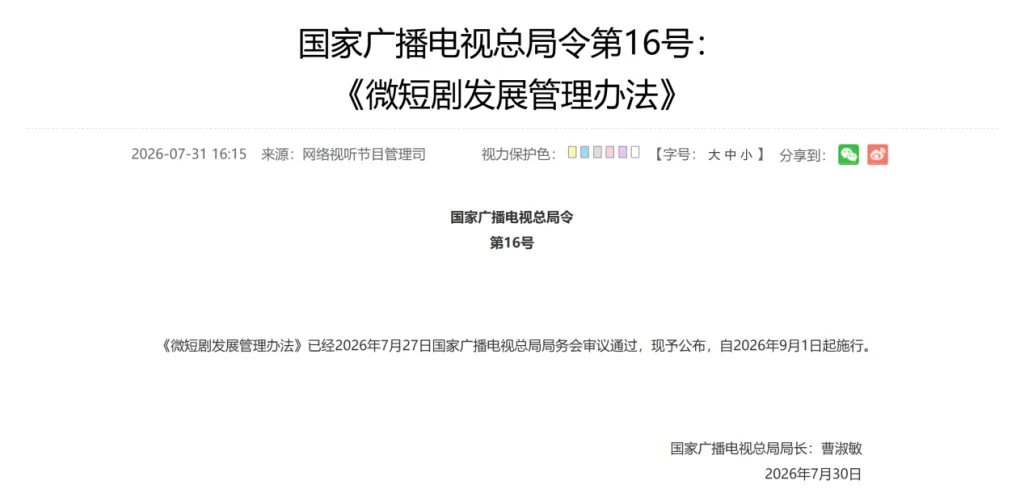
(Source: National Radio and Television Administration (NRTA))


I. Three-Tier Classified Management: How Should AI Short Dramas Be Categorized?

The new regulation divides micro-short dramas into three categories based on investment amount and subject matter, applying differentiated regulation:

CategoryCriteriaRegulatory Requirements
Category IRelatively large investment amount, or involving special subject matters such as politics, military, diplomacy, national security, united front, ethnicity, religion, judiciary, public security, etc.Filing and public announcement + content review + Micro-Short Drama Distribution License
Category IIGeneral subject matter with relatively moderate investmentFiling and public announcement + content review + approval document from provincial radio and TV authorities by reference
Category IIIGeneral subject matter with relatively low investmentPre-broadcast review by the broadcasting entity + program number labeling

AI short drama companies must first clarify their content positioning. At present, most AI-generated short dramas have relatively low production costs, but this does not automatically mean they fall into Category III. Project classification still depends on a concrete assessment of investment amount, subject matter, and other factors. For Category II micro-short dramas, the new regulation also makes clear that provincial radio and TV authorities may formulate local implementation rules by reference to the filing and public announcement system for Category I micro-short dramas.

Legal Recommendations:
Prepare a list of existing and in-production projects, and classify them by investment amount, subject matter, production entity, production location, broadcasting platform, and domestic/overseas broadcasting. This will help identify the compliance path and time cost for each project. For AI short drama projects that plan to bring in foreign capital or involve co-production, it is especially important to clarify the regulatory classification at the project initiation stage, so as to avoid compliance issues that could affect cross-border capital flows or cooperation.


II. Special Rules for AI Short Dramas: Labeling Obligations, Content Red Lines, and Algorithm Governance

1. Labeling obligation: Article 34 of the new regulation expressly provides: “For micro-short dramas generated or produced using artificial intelligence technology, the production entity and the broadcasting entity shall comply with relevant national provisions and, in accordance with relevant rules, add a conspicuous notice label in each episode.”

2. Content red lines: Article 25 lists 11 prohibited categories. Micro-short dramas may not contain content that endangers national security or national unity, incites ethnic hatred, denigrates China’s excellent traditional culture, incites disruption of national religious policy, infringes on the lawful rights and interests or physical and mental health of minors, damages ecological and environmental protection, promotes obscenity, gambling, drug use, money worship, or extravagance, or depicts violence and terror.

3. Algorithm governance: “Addictive” features have also become a regulatory focus. Article 37 requires broadcasting entities to “regularly review, evaluate, and verify algorithm mechanisms,” give priority to recommending high-quality content, and refrain from using algorithm models that induce addiction or excessive consumption.

AI short dramas face “dual compliance” pressure: they must meet the general content standards for micro-short dramas and also satisfy the special disclosure requirements for AI-generated content. In practice, AI-generated historical figures and fictional plots can easily cross red lines such as “distorting history” or “desecrating heroes and martyrs.” Companies need to establish an AI content pre-review mechanism and cannot rely solely on technical review.

Legal Recommendations:

  1. Embed an “AI-generated” watermark or label during the final production stage to ensure the label is conspicuous.
  2. Establish a dual human + AI content review process, focusing on sensitive scenes involving history, ethnicity, religion, and minors.
  3. Retain full-chain evidence, including AI training data sources, generation parameters, and human modification records, for regulatory inspection.

(Source: Online Audio-Visual Program Review System)

III. Heavier Platform Responsibility: Stricter Review by Broadcasting Entities and Higher Market Entry Thresholds

The new regulation imposes strict primary responsibility on broadcasting entities:

  1. Before broadcasting Category I and Category II micro-short dramas, they must verify the Micro-Short Drama Distribution License or approval document.
  2. For Category III micro-short dramas, the broadcasting entity must perform content management duties, conduct pre-broadcast review, and label the program number.
  3. Establish an editor-in-chief content responsibility system and a full-process accountability and traceability mechanism for content safety.
  4. Establish a credit evaluation system for key accounts that disseminate micro-short dramas and subject them to focused management.

Due to the special nature of AI content generation, AI short dramas may face stricter requirements in the future regarding copyright proof, AI labeling, licenses, material authorization, and manual re-review. This may lead to longer review cycles, more supplementary document requests, and an increased risk of temporary removal. This means that content compliance costs for AI short drama companies will rise significantly.

Legal Recommendations:

  1. Communicate with major broadcasting platforms in advance to understand their internal review rules and special requirements for AI content.
  2. Introduce compliance assessment at the project planning stage to avoid sunk costs caused by failed review after production is completed.
  3. Consider voluntarily applying for Category I or Category II standards for some projects. Obtaining formal permission may actually give the project priority in platform recommendations.

IV. Intellectual Property and Data Compliance: Legal Risks in AI Short Drama Content

Article 10 of the new regulation clearly states that “intellectual property related to micro-short dramas is protected by law” and that “organizations and individuals engaged in micro-short drama activities shall enhance their awareness of intellectual property.”

AI short dramas face three major legal risks in this area:

  1. Training data compliance: Have the film and television materials, scripts, novels, images, and music used in AI model training been authorized?
  2. Ownership of generated content: Who owns the copyright in AI-generated scripts, characters, and images? For example, directly uploading screenshots of popular TV dramas, celebrity photos, or anime character images and asking AI to “generate by reference.” Even if the final result is not the original image, copyright and portrait rights risks cannot be excluded.
  3. Infringement of personality rights: If AI-generated character images or voices resemble real natural persons, this may trigger infringement of portrait rights or voice rights.

Legal Recommendations:

  1. Establish a mechanism for reviewing the lawful source of training data and retain evidence of the authorization chain.
  2. Conduct a “significant difference” review of AI-generated content to avoid high similarity with real persons or existing IP.
  3. Clearly agree with AI technology suppliers on the ownership of intellectual property in generated content and the allocation of liability for infringement.

V. Global Expansion Compliance: The “Dual Threshold” of Domestic Production and Overseas Broadcasting, and Global Layout

Article 8 of the new regulation states that China “supports the creation, production, and dissemination of export-oriented micro-short dramas, facilitates the participation of overseas principal creators in the creation of micro-short dramas, and supports the simultaneous domestic and overseas broadcasting of excellent micro-short dramas.” Article 52 provides that “micro-short dramas filmed within China for overseas broadcasting shall be subject to the relevant provisions of these Measures on filing and public announcement, review, and licensing.”

This legislative attitude of “supporting global expansion but requiring compliance first” deserves close attention. Although global expansion of AI short dramas is an industry hotspot, “domestic production and overseas broadcasting” still requires domestic filing and review procedures. Content that has not obtained domestic permission may face regulatory tracing even if it is broadcast only on overseas platforms.

A deeper issue is that different jurisdictions have vastly different regulatory frameworks for AI-generated content:

JurisdictionKey Regulatory RequirementsImpact on AI Short Dramas
European UnionThe AI Act classifies AI-generated content as subject to limited transparency obligations, requiring clear labeling of AI generationAI system compliance assessment required
United StatesSome states have enacted laws requiring AI content disclosure; at the federal level, rules mainly involve consumer protection, advertising, and misleading promotionClear AI-generated labeling in content to avoid misleading consumers
Southeast AsiaStandards vary by country; some countries have no dedicated legislation, but content review is tighteningCountry-by-country assessment required; domestic version cannot simply be copied
Middle EastStrict review of religious and cultural content; AI-generated content may receive additional scrutinyLocal cultural compliance review must be conducted in advance

If companies produce content only according to domestic standards, they may face secondary compliance or even removal risks after going overseas. In particular, the “AI-generated labeling” required by the new domestic rules is converging in direction with the transparency obligations of the EU AI Act and the disclosure requirements of some U.S. states, but there may be differences in label placement, wording, and technical implementation. A direct translation of the domestic version may not satisfy overseas requirements.

Legal Recommendations:

  1. Incorporate the AI content regulatory requirements of target markets into the script and production stages, rather than simply adding labels later.
  2. After completing domestic compliance review and obtaining permission, make localized compliance adjustments for different markets, rather than releasing one version globally.
  3. For companies planning to operate overseas businesses, it is necessary to simultaneously monitor the connection between the new domestic rules and overseas investment regulatory requirements.
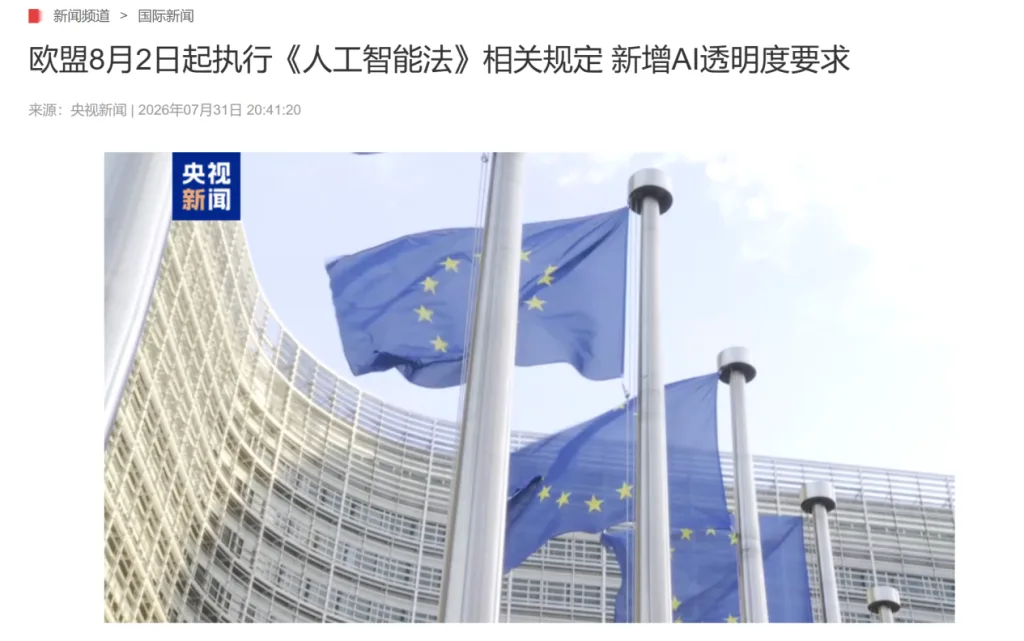
(SourceCCTV.com

Conclusion

The implementation of the Measures for the Administration of the Development of Micro-Short Dramas presents both difficulties and opportunities for AI short drama companies. The difficulties lie in rising compliance costs, stricter content review, and intensified algorithm governance; the extensive growth model will be difficult to sustain. The opportunities lie in the fact that compliant companies will obtain the “credit endorsement” of formal permission and gain a first-mover advantage in platform recommendations, capital connections, and global expansion.

For AI short drama companies intending to enter overseas markets, domestic compliance permission is not only a “passport” but may also become the credit foundation for negotiating with overseas platforms and obtaining copyright procurement or co-production opportunities. Only by front-loading compliance, actively adapting, and establishing a dual-track risk control system at home and abroad can AI short drama companies stand out in the industry’s development.

About the Author

Yu Yuting
Partner | NEO-ARK Law Firm

Lawyer Yu focuses on foreign-related litigation, cross-border disputes, commercial matters, and legal services for overseas individuals and businesses in China.

Email: [email protected]

About NEO-ARK Law Firm

NEO-ARK Law Firm provides legal services in foreign-related litigation, commercial disputes, family law, and cross-border legal matters, assisting both international and domestic clients throughout China.
Recommend
Can an Employee Claim Wrongful Termination After Voluntarily Resigning? A China Work Injury Employment Dispute

Overview

A human resources service company and a related HR service entity faced a labour dispute brought by an employee who had suffered a work-related injury and was later assessed as having a Grade 9 disability.

The employee claimed that the employment relationship had been unlawfully terminated and sought compensation for alleged wrongful termination, unpaid wages, statutory work injury benefits, and an employment separation certificate.

The dispute involved an important question frequently encountered in China employment litigation: where an employee has formally submitted a resignation, can the employee subsequently claim that the employer unlawfully terminated the employment relationship?

Representing the companies, Yu Yuting, Attorney at NEO-ARK Law Firm, focused on the circumstances of the employee's departure, the distinction between termination and voluntary resignation, and the allocation of statutory work injury liabilities between the companies involved.

The court ultimately found that the employee had resigned for personal reasons rather than being unlawfully dismissed. The employee's claims for wrongful termination compensation and subsequent wages were therefore rejected.

Case Snapshot

ItemDetails
Practice AreaEmployment & Labour Law
Case TypeEmployment and Work Injury Dispute
JurisdictionShenzhen, China
ClientHuman Resources Service Companies
Core IssuesVoluntary Resignation, Wrongful Termination, Work Injury Benefits, Employer Liability
Dispute ValueApproximately RMB 90,000
CourtShenzhen Longgang District People's Court
Key OutcomeWrongful Termination and Subsequent Wage Claims Rejected
Lead LawyerYu Yuting / Sun Jianhui
Law FirmNEO-ARK Law Firm

Client's Situation

1. Employment and Work Injury

The employee joined a Shenzhen human resources service company in May 2021 as a sales employee and entered into a written employment contract.

In July 2021, the employee was injured in a traffic accident while commuting to work.

The Shenzhen Human Resources and Social Security Bureau subsequently recognised the injury as a work-related injury. A labour capacity assessment later determined that the employee had a Grade 9 disability.


2. The Employee Subsequently Resigned

In January 2022, the employee signed a resignation application and stated that the resignation was for personal reasons.

The employee later took the position that the employer had unlawfully terminated the employment relationship.

This created a central factual and legal issue: whether the employment relationship ended through the employee's voluntary resignation or through an employer-initiated termination.


Legal Strategy

Legal IssueLegal Strategy
Nature of employment terminationEstablish that the employee voluntarily resigned rather than being dismissed
Wrongful termination compensationChallenge the legal basis for treating the resignation as an unlawful employer termination
Subsequent wage claimEstablish that wages could not be claimed on the basis of an employment relationship that had already ended through resignation
Work injury benefitsDistinguish different statutory work injury benefits and their respective payment mechanisms
Liability between companiesClarify the respective legal responsibilities of A Company and B Company
Medical benefitDistinguish the benefit subject to the social insurance procedure from claims properly determined in the employment litigation

Outcome

The Shenzhen Longgang District People's Court confirmed that the employee had voluntarily resigned for personal reasons.

As a result, the court rejected the employee's claims for:

  • Compensation for alleged wrongful termination;
  • The claimed subsequent wages.

The court also determined that the one-off disability employment benefit was payable by B Company, with A Company bearing joint and several liability.

The claim for the one-off work injury medical benefit was not dealt with as a direct payment obligation in the case because it was subject to the applicable social insurance procedure.

Overall, the court's decision substantially limited the companies' exposure by rejecting the employee's principal claims concerning alleged unlawful termination and subsequent wages.


Why This Case Matters

Work injury disputes can become significantly more complicated when an employee later challenges the circumstances in which the employment relationship ended.

For employers and human resources service companies, it is important to distinguish between:

  • A genuine employer-initiated termination;
  • A voluntary resignation by the employee;
  • Statutory work injury benefits;
  • Benefits processed through social insurance;
  • Liabilities arising between multiple companies involved in the employment arrangement.

This case illustrates that a recognised work injury does not, by itself, establish that an employer unlawfully terminated the employment relationship.

The circumstances and documentation surrounding the employee's departure remain critical to determining the nature of the termination and the resulting legal liabilities.


Frequently Asked Questions

Can an employee claim wrongful termination after submitting a resignation?

Not automatically.

If the court determines that the employee voluntarily resigned rather than being dismissed by the employer, a claim for statutory compensation for unlawful termination may not be supported.

Does a work injury automatically make an employer liable for wrongful termination?

No.

Work injury liability and termination liability are separate legal issues. The existence of a work injury does not by itself establish that the employer unlawfully terminated the employment relationship.

Can different companies be responsible for different work injury benefits?

Yes.

Where multiple companies are involved, the applicable employment relationship, work injury insurance arrangements and statutory responsibilities must be examined to determine which entity bears each obligation.

How should employers handle a resignation after a work injury?

Employers should carefully document the employee's resignation, the stated reason for departure, relevant employment records, and the handling of statutory work injury benefits.

The legal consequences depend on the specific circumstances and applicable law.


Key Takeaways

  • A voluntary resignation can be decisive when defending a subsequent wrongful termination claim.
  • Work injury status and unlawful termination are separate legal questions.
  • Different work injury benefits may have different responsible parties and payment procedures.
  • HR service companies should carefully document employee departures and work injury arrangements.
  • Where multiple companies are involved, liability should be analysed separately rather than assumed to be joint.

About the Author

Yu Yuting
Partner | NEO-ARK Law Firm

Lawyer Yu focuses on foreign-related litigation, cross-border disputes, commercial matters, and legal services for overseas individuals and businesses in China.

Email: [email protected]

About NEO-ARK Law Firm

NEO-ARK Law Firm provides legal services in foreign-related litigation, commercial disputes, family law, and cross-border legal matters, assisting both international and domestic clients throughout China.
2026-08-15

Can a Guarantee Cover Increased Costs in an Overseas Construction Project? A Cambodia Construction Dispute Case

Overview

A Chinese company became involved in a dispute arising from a large-scale sugar factory construction project in Cambodia.

The construction contractor claimed substantial unpaid project fees from the project owner and also sought to hold a Chinese corporate guarantor responsible under a previously issued performance guarantee.

The central issue was whether the guarantor's liability extended beyond the original fixed contract price after the project parties subsequently increased the contract value through supplemental agreements and a final settlement agreement.

Representing the corporate guarantor, Yu Yuting, Attorney at NEO-ARK Law Firm, challenged the extension of the guarantee to the increased project amount and argued that the guarantor had not consented to the subsequent increase in the underlying debt.

Case Snapshot

ItemDetails
Practice AreaCross-Border Commercial Litigation
Case TypeConstruction & Guarantee Dispute
Project LocationCambodia
ClientChinese Corporate Guarantor
IndustrySugar & Industrial Construction
Core Legal IssueScope of Guarantee Following Changes to the Main Contract
Project ContractFixed-Price Construction Contract
Dispute ValueApproximately RMB 27 Million
ResolutionMulti-Stage Litigation
Lead LawyerYu Yuting / Sun Jianhui
Law FirmNEO-ARK Law Firm

Client's Situation

1. Overseas Construction Project


2. Contract Value Increased


3. Guarantee Dispute


Legal Strategy

FocusObjective
Scope of guaranteeEstablish the amount and obligations originally covered by the guarantee
Contract amendmentsDetermine whether later increases in the project debt expanded the guarantor's liability
Guarantor consentChallenge liability for increased obligations not expressly approved by the guarantor
Guarantee periodExamine whether the claim was brought within the applicable guarantee period
Underlying contractConsider potential issues concerning the validity and enforceability of the overseas construction contract

Court Proceedings and Outcome

At first instance, the court accepted the client's position concerning the scope of the guarantee.

The court held that the guarantee was limited to the original contractual amount and that the client was not liable for the increased amount created through subsequent arrangements to which the client had not consented.

The contractor appealed.

At the appellate stage, the parties continued to dispute whether the guarantee extended to the increased project amount. The appellate court took a different view from the first-instance court on the scope of the guarantee.

The case demonstrates the importance of carefully examining the wording of a guarantee, subsequent amendments to the underlying contract, and whether the guarantor expressly agreed to assume additional obligations.


Why This Case Matters

For companies providing guarantees in connection with overseas construction or investment projects, the financial exposure of a guarantee can become significantly greater if the underlying contract is later amended.

A company may initially agree to guarantee a clearly defined amount. If the project parties subsequently increase the contract value, add new works, or restructure their payment obligations, an important question arises:

Does the original guarantee continue to apply, and if so, to what extent?

This case highlights why corporate guarantors should carefully review:

  • The exact wording of the guarantee;
  • The guaranteed amount;
  • Subsequent amendments to the underlying contract;
  • Additional works and settlement agreements;
  • Whether the guarantor has expressly consented to increased liabilities;
  • Applicable guarantee periods.

For large overseas projects, these issues should ideally be addressed before a guarantee is issued or amended.


Frequently Asked Questions

Can a guarantor's liability automatically increase when a construction contract increases in value?

Not necessarily.

Whether the guarantee extends to additional obligations depends on the wording of the guarantee, the nature of the subsequent changes, applicable law, and whether the guarantor consented to the increased obligations.


What happens if the construction parties sign a new settlement agreement after a guarantee has been issued?

The new agreement may affect the scope of the guarantor's obligations, but it does not necessarily mean that the guarantor automatically assumes every increased liability.

The guarantee documents and subsequent agreements should be reviewed together.


Why is guarantor consent important when a project value increases?

A guarantee creates a separate liability for the guarantor. If the underlying debt becomes substantially larger, the question of whether the guarantor agreed to assume the additional exposure can become critical.


Does an overseas construction project make guarantee disputes more complicated?

It can.

An overseas project may involve different jurisdictions, governing-law provisions, project regulations, corporate structures, and enforcement considerations.

The underlying construction contract and the guarantee should therefore be analysed together from a cross-border perspective.

Key Takeaways

  • A guarantee should be reviewed by reference to its precise wording and scope.
  • An increase in the underlying construction debt does not necessarily mean an automatic increase in guarantee liability.
  • Supplemental agreements and final settlement agreements can materially affect guarantee disputes.
  • Guarantor consent may become a critical issue when the principal obligation increases.
  • Overseas construction guarantees require careful cross-border legal risk assessment.

About the Author

Yu Yuting
Partner | NEO-ARK Law Firm

Lawyer Yu focuses on foreign-related litigation, cross-border disputes, commercial matters, and legal services for overseas individuals and businesses in China.

Email: [email protected]

About NEO-ARK Law Firm

NEO-ARK Law Firm provides legal services in foreign-related litigation, commercial disputes, family law, and cross-border legal matters, assisting both international and domestic clients throughout China.
2026-08-13

China R Visa Guide: A Practical Guide for Foreign High-Level Talent

For foreign high-level talents intending to come to China for scientific research cooperation, business operations, investment, entrepreneurship, or professional development in various fields, the R visa represents a key institutional arrangement for obtaining long-term entry eligibility. This visa category is designed for foreign nationals who meet China’s talent recognition standards and can be issued with a validity of up to 10 years. This article provides a complete overview of the application process and critical practical considerations from a legal perspective.

(R visa sample – Source: China Association for International Exchange of Personnel )


I. Overview of the R Visa

The R visa is specifically established for foreign high-level talents and urgently needed professionals that serve China’s national socioeconomic development. Once approved, the R visa is valid for 5 to 10 years, allows multiple entries, and permits a single stay of up to 180 days. The spouse and minor children of the visa holder may apply for corresponding visas of the same validity and multiple-entry privileges.


II. Eligibility Requirements

To apply for an R visa, the applicant must first be recognized as a foreign high‑level talent (Category A). According to the Classification Criteria for Foreigners Working in China (Trial), individuals falling into any of the following six major categories may apply if they meet the respective criteria:

1. Selected into relevant Chinese talent introduction programs
Individuals who have been selected into talent introduction programs recognized by talent authorities at or above the deputy provincial level, as approved or filed by the Organization Department of the CPC Central Committee, the Ministry of Human Resources and Social Security, or the State Administration of Foreign Experts Affairs.

2. Meeting internationally recognized professional achievement standards
(1) Top awards: Recipients of internationally renowned awards such as the Nobel Prize, Turing Award, Fields Medal, Pritzker Architecture Prize, etc.
(2) Authoritative status: Members of national academies of sciences or engineering; key members of internationally renowned academic institutions or international organizations.
(3) Research leadership: Directors of national research institutes or national laboratories; editors‑in‑chief or deputy editors of high‑impact scientific journals (JCR Q1 and Q2), or authors of core papers in such journals.
(4) Cultural and sports figures: Professors at renowned music or art academies; chief conductors or principal performers of leading orchestras; top‑eight athletes and head coaches in Olympic Games or World Championships.

For the complete list of 18 recognition criteria, please refer to:
https://fuwu.most.gov.cn/r/cms/zwpt/web/pdf/wgrlhzq/20180731103648_983.pdf

3. Meeting market‑oriented encouraged job positions
(1) Personnel with senior management or technical positions employed by central government‑owned enterprises and their secondary subsidiaries, global or regional headquarters of Fortune 500 companies, national high‑tech enterprises, or large‑scale enterprises.
(2) Personnel with senior management or technical positions working at nationally recognized enterprise engineering research centers, engineering laboratories, engineering technology research centers, enterprise technology centers, or local technological innovation service platforms.
(3) Personnel with senior management or technical positions employed by medium‑sized domestic or foreign enterprises, or chairpersons, legal representatives, general managers, or chief technical experts of small foreign‑invested enterprises that fall under the encouraged industry categories of the Catalogue of Industries for Guiding Foreign Investment or the Catalogue of Superior Industries for Foreign Investment in Central and Western Regions.
(4) Personnel appointed to senior management positions at higher education institutions or research institutes, or to associate professor, associate researcher, senior lecturer, or senior internship instructor positions at vocational colleges.
(5) Personnel appointed to senior management or senior professional technical positions (deputy senior or above) at top‑tier general hospitals in China, specialized hospitals at or above the deputy provincial city level, or foreign‑invested hospitals.
(6) Chief conductors, artistic directors, and principal performers employed by leading domestic orchestras and other arts groups.
(7) Personnel with senior management or technical positions such as editors‑in‑chief, deputy editors‑in‑chief, chief broadcasters, senior hosts, planning directors, and layout design directors employed by central or local mainstream media.
(8) Key athletes, head coaches, or core coaching team members employed by national or provincial sports teams or clubs.
(9) Foreign talents whose average salary income is no less than six times the previous year’s average social salary in the local region.

4. Innovative and entrepreneurial talents
(1) Founders of enterprises who have contributed major technological inventions, patents, or other proprietary intellectual property or know‑how as capital, with stable investment over three consecutive years, cumulative actual investment of no less than USD 500,000, and personal shareholding of no less than 30%.
(2) Chairpersons, legal representatives, general managers, or chief technical experts of enterprises with annual sales of RMB 10 million or above, or annual tax payments of RMB 1 million or above for three consecutive years, where the enterprise’s core assets include major technological inventions, patents, or proprietary intellectual property.
(3) Personnel with senior management or technical positions employed by units included in innovation enterprise lists or science and technology innovation occupation lists formulated by relevant provincial authorities.

5. Outstanding young talents
Young talents under the age of 40 who have completed postdoctoral research at high‑level overseas universities or domestic institutions in China.

6. Scoring 85 points or above in the points‑based system
Based on the points calculation table that evaluates factors such as annual salary, education level, work experience, Chinese language proficiency, and age, applicants with a total score of 85 or higher qualify.

For the complete points table, please refer to:
https://fuwu.most.gov.cn/r/cms/zwpt/web/pdf/wgrlhzq/20180731103648_983.pdf

Detailed standards are set out in the Classification Criteria for Foreigners Working in China (Trial).

(Government service platform – Source: Ministry of Science and Technology of the People's Republic of China (Administrative Service Platform))


III. Application Process

Step 1: The inviting entity in China applies for the Confirmation Letter for Foreign High‑Level Talents
The inviting entity (employer) submits an application to the provincial‑level foreign experts work administration department where it is located. The application, including the online form, an invitation letter from the Chinese entity, and supporting documents evidencing that the applicant meets the R‑visa talent criteria, must be submitted online.

If the applicant meets the high‑level talent standards, the provincial‑level authority will issue the Confirmation Letter for Foreign High‑Level Talents online within the prescribed timeframe and share the information with the Chinese embassy or consulate in the applicant’s home country (or region).

Step 2: Apply for the R visa at the overseas Chinese embassy or consulate
The applicant submits the following materials to the Chinese embassy or consulate (or other overseas institutions authorized by the Ministry of Foreign Affairs) to apply for the R visa:
(1) Visa application form
(2) Passport (valid for at least 6 months) and compliant photos
(3) Printed copy of the Confirmation Letter for Foreign High‑Level Talents
(4) Other materials required by the embassy or consulate

If eligible, the embassy or consulate will issue an R visa with a validity of 5 to 10 years and multiple entries.

Step 3: Apply for the work permit after entry
Foreigners working in China with an R visa must apply for a Foreigner’s Work Permit from the local foreign experts work administration department in the place where the employer is located. The application can be submitted online, including documents such as the employment contract or certificate of appointment, medical examination certificate, R visa endorsement page, and passport information page. The specific processing method and timeline are subject to the requirements of the local authority.

Certain documents may be submitted under a “commitment system” (i.e., a self‑declaration in lieu of original certificates):
(1) For Category A talents falling under (1) selected into talent programs, (2) meeting internationally recognized professional achievement standards, (3) meeting market‑oriented encouraged job positions, or (4) innovative and entrepreneurial talents, the highest degree/diploma certificate may be submitted under a commitment system under prescribed conditions.
(2) For Category A talents falling under (1) and (2), proof of work experience and certificate of no criminal record may also be submitted under the commitment system under certain conditions.

Step 4: Apply for a work‑type residence permit
After obtaining the Foreigner’s Work Permit, the applicant must apply for a work‑type residence permit from the exit‑entry administration department of the public security authority. Once issued, the holder may enter and exit China multiple times with the residence permit within its validity period.

(Application process flowchart – Source: National Human Resources and Social Security Administrative Service Platform)


IV. Key Considerations

  1. Meeting the Category A talent criteria under the Classification Criteria for Foreigners Working in China (Trial) is a prerequisite for obtaining the R visa. Employers and applicants are advised to self‑assess against the criteria in advance and prepare the necessary supporting documents.
  2. The R visa is an entry visa and is not equivalent to a work permit. If the R‑visa holder plans to work in China or engage in activities that legally require a work permit, they must apply for the Foreigner’s Work Permit and complete the relevant residence formalities in accordance with the regulations.
  3. Certain Category A talents may benefit from “flexible document submission” and the “commitment system.” For items processed under the commitment system, applicants are advised to keep the original supporting documents properly for future renewal or change procedures.
  4. If changing employers within China, the new employer should, in principle, apply for the work permit modification and, depending on the actual circumstances, update the relevant residence permit. Whether the R visa needs to be re‑applied for depends on the specific visa and residence permit status.

Conclusion

For foreign high‑level talents, the R visa offers a long validity period and significant entry facilitation, making it a premium channel for developing a career in China. Seizing this policy opportunity is a strategic first choice for entering the Chinese market.

About the Author

Yu Yuting
Partner | NEO-ARK Law Firm

Lawyer Yu focuses on foreign-related litigation, cross-border disputes, commercial matters, and legal services for overseas individuals and businesses in China.

Email: [email protected]

About NEO-ARK Law Firm

NEO-ARK Law Firm provides legal services in foreign-related litigation, commercial disputes, family law, and cross-border legal matters, assisting both international and domestic clients throughout China.
2026-08-10

Guidelines for International Lawyers on Researching Foreign Civil and Commercial Law

With the implementation of the Provisions of the State Council on Outbound Investment in July 2026, compliance requirements for companies expanding overseas have been heightened. This article covers key jurisdictions with the closest economic and trade ties to China, organized according to both legal systems and regions. It balances the use of research tools with practical considerations to help cross-border lawyers identify relevant laws and prepare preliminary legal assessments.


指南|涉外律师域外民商事法律检索指引 Guidelines for International Lawyers on Researching Foreign Civil and Commercial Law

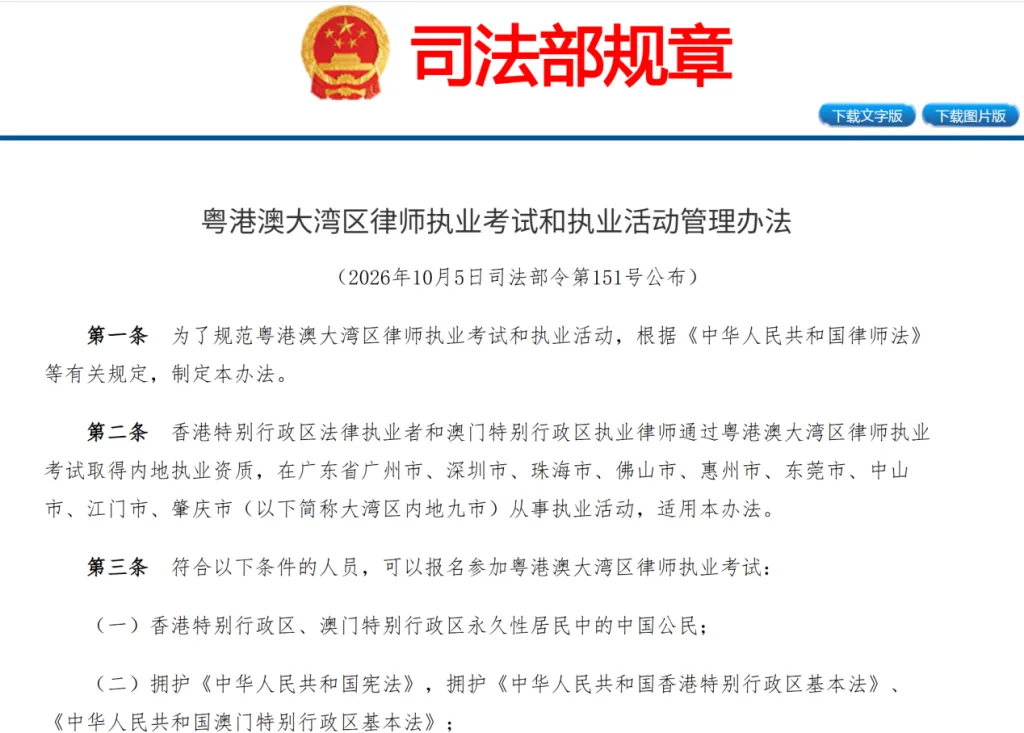
(Source: Ministry of Commerce of the People's Republic of China (for the screenshot of the official notice)

I. Common Law Systems: the United States, Canada, and Singapore

1. United States: Laws vary significantly across the 50 states; federal and state laws coexist
(1) Key Laws: Foreign Investment Risk Review Modernization Act of 2018 (FIRRMA)Export Administration Regulations (EAR)Foreign Corrupt Practices Act (FCPA)
(2) Search Resources: Justia, Congress.gov, Federal Register, etc.
(3) Practical Tips: U.S. case law evolves rapidly; it is recommended to use “Shepard’s Citations” to verify that a case is still in force.

2. Canada: Common Law and the Civil Code of Québec coexist
(1) Key Laws: Investment Canada Act (ICA)Civil Code of Québec
(2) Search Resources: CanLII, Justice Laws Website, etc.
(3) Practical Tips: Investments in critical minerals require special attention to the new regulations taking effect in 2024.

3. Singapore: The Asian Arbitration Hub
(1) Key Laws: Companies ActPersonal Data Protection Act (PDPA)Limited Liability Partnership Act
(2) Search Resources: Singapore Statutes Online, etc.
(3) Practical Tips: Singapore serves as a “gateway” for researching ASEAN laws; English translations of many Thai and Indonesian laws can be found in Singaporean databases.


II. Civil Law Systems: Germany, France, Japan, South Korea, Russia, Thailand

1. Germany: A federal civil law system centered on the Civil Code
(1) Key Laws: German Civil Code (BGB)Foreign Trade and Payments Ordinance (AWV)Supply Chain Due Diligence Act (LkSG)General Data Protection Regulation (GDPR)
(2) Search Resources: Gesetze im Internet, EUR-Lex (EU law), Beck-Online, etc.
(3) Practical Tips: German laws are frequently amended; be sure to verify the version date.

2. France: Unitary Civil Law System
(1) Key Laws: French Monetary and Financial CodeFrench Labor CodeGeneral Data Protection Regulation (GDPR)
(2) Search Resources: Légifrance, EUR-Lex (EU law), etc.
(3) Practical Tips: Case law from the French Council of State (Conseil d’État) is crucial for understanding the application of the law.

3. Japan: Civil Law System + Local Characteristics
(1) Key Laws: Foreign Exchange and Foreign Trade ActCompanies ActAct on the Protection of Personal InformationEconomic Security Promotion ActCivil Rehabilitation Act
(2) Search Resources: e-Gov Legislation Search, JETRO Investment Guide, etc.
(3) Practical Tips: Starting in 2024, Japan will tighten export controls on semiconductors to China, and the Foreign Exchange and Foreign Trade Act is frequently amended; it is recommended to subscribe to METI email notifications.

4. South Korea: Civil Law System
(1) Key Laws: Foreign Investment Promotion Act (FIPA)Monopoly Regulation and Fair Trade ActPersonal Information Protection Act (PIPA)Commercial Act
(2) Search Resources: Korea Law Information Center, The Supreme Court of Korea, etc.
(3) Practical Tips: South Korea has recently made a series of significant adjustments to its foreign exchange regulations; it is recommended to stay informed about updates to these regulations.

5. Russia: Civil law system, influenced by Soviet law
(1) Key Laws: Foreign Investment LawLaw on Foreign Investment in Strategic EntitiesRussian Personal Data Law (152-FZ)Civil Code of the Russian Federation, Part Four (intellectual property)
(2) Search Resources: GARANT, ConsultantPlus, Russian Agency of Legal and Judicial Information (RAPSI), etc.
(3) Practical Tips: Due to the international situation, legal information updates may be delayed; it is recommended to verify information through a local partner law firm.

6. Thailand: Civil Law System
(1) Key Laws: Foreign Business Act (FBA 1999)Investment Promotion Act, B.E. 2542 (1999)Land Code
(2) Search Resources: Royal Thai Government Gazette, BOI official website, etc.
(3) Practical Tips: On June 30, 2026, Thailand deposited its instrument of accession to the Hague Apostille Convention with the Dutch Ministry of Foreign Affairs, pending official confirmation of the specific date of accession by the Hague Conference on Private International Law.

(World Legal Systems Map – Source: Juriglobe)


III. “Graded Search” for Cross-Legal System Investments: The Middle East and Africa

1. Middle East: A hybrid of Sharia law and civil/common law
(1) Key Laws: Investment Law of the Kingdom of Saudi Arabia (revised 2025); Commercial Companies Law (UAE)Foreign Investment Promotion and Protection Act (FIPPA, Iran)
(2) Search Resources: The Ministry of Justice (Saudi Arabia), Thomson Reuters Practical Law, national investment ministries, etc.
(3) Practical Tips: In the commercial sphere, modern codified investment laws predominate, while Islamic law primarily influences family law, security interests, contract interpretation, and Islamic finance. Some Middle Eastern countries have implemented separate legal systems in specific regions to attract foreign investment; therefore, it is necessary to conduct separate searches for these region‑specific legal frameworks.

2. Africa: A mix of customary law and colonial law
(1) Key Countries: Egypt (Civil Law), Nigeria (Common Law), South Africa (Mixed Legal System)
(2) Key Laws: Investment Law No.72 of 2017 (Egypt)Nigerian Investment Promotion Commission ActInvestment Proclamation No.1180/2020 (Ethiopia)
(3) Search Resources: AfricanLII, African Union (AU), national official gazettes, etc.
(4) Practical Tips: Given Africa’s weak legal infrastructure, it is recommended to consult with local law firms.


IV. Commonly Used Research Resources

(World Legal Systems Map – Source: Juriglobe)


Conclusion
Cross-border lawyers with the ability to conduct cross‑jurisdictional research can help companies expanding overseas clarify the boundaries of applicable law in their target countries and make preliminary legal assessments. It is important to note that legal services in every country are subject to territorial practice restrictions, and core issues such as the extraterritorial application of laws and the practical details of local legal procedures are highly specific to each jurisdiction. Therefore, during the implementation phase of cross‑border legal services, the final legal framework and practical recommendations must still be based on the professional advice of local licensed attorneys.

About the Author

Yu Yuting
Partner | NEO-ARK Law Firm

Lawyer Yu focuses on foreign-related litigation, cross-border disputes, commercial matters, and legal services for overseas individuals and businesses in China.

Email: [email protected]

About NEO-ARK Law Firm

NEO-ARK Law Firm provides legal services in foreign-related litigation, commercial disputes, family law, and cross-border legal matters, assisting both international and domestic clients throughout China.
2026-08-05

Scroll to Top

+86 13503030053

BackToTop

Inquiry Inquiry Email Email Tel Tel

Request A Quote

×
Please enable JavaScript in your browser to complete this form.