...

News

Outbound Compliance | Effective July 1! Key Takeaways from China’s New Outbound Investment Regulations

On June 1, 2026, the State Council officially promulgated the Regulations on Outbound Investment (State Council Decree No. 837, hereinafter referred to as the "Regulations"), which will take effect on July 1, 2026.

(A view of the State Council administrative updates. Source: Beijing Web TV)

As the first systematic administrative regulation enacted by the State Council in the field of outbound direct investment (ODI), this landmark regulation consolidates previously scattered departmental rules from the National Development and Reform Commission (NDRC), the Ministry of Commerce (MOFCOM), and other authorities. It establishes a comprehensive framework covering outbound investment services, administration, and protection, marking a milestone in the development of China’s outbound investment regime.

Previously, outbound investments were governed by NDRC's "Decree No. 11" and various foreign exchange regulations under the State Administration of Foreign Exchange (SAFE). How does this new framework differ? This article analyzes the core shifts, compliance priorities, and practical impact on cross-border business based on the official text and practical experience.
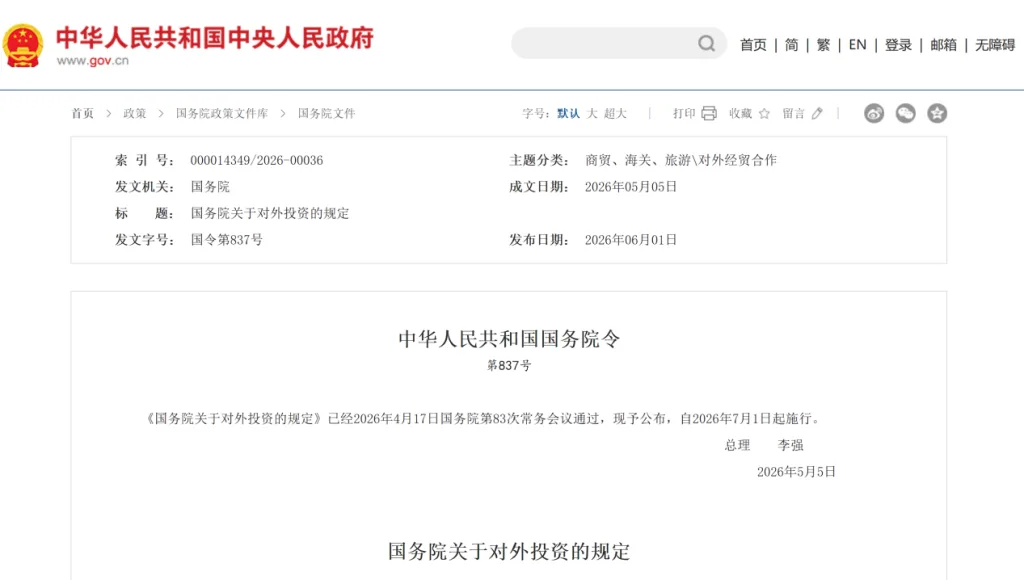
(The official release portal of the Central People's Government of the People's Republic of China. Source: gov.cn)

I. Regulatory Shifts: 6 Key Upgrades Under the New Framework

1. Individual Investors Officially Regulated

Individual investors who hold overseas assets through Special Purpose Vehicles (SPVs) or nominee holding structures (trust arrangements) are now officially brought under unified regulatory supervision.

Attorney’s Note: While detailed implementation guidelines are pending, individuals holding overseas assets should closely monitor regulatory updates and evaluate whether their existing offshore holding structures require compliance adjustments.

2. Dual Oversight Expands to Quadruple Supervision

The old approval process primarily focused on NDRC and MOFCOM filings. The new framework introduces a comprehensive four-pronged oversight mechanism:

  1. Macro-Advisory Filings & Approvals (NDRC & MOFCOM)
  2. Cross-Border Capital Checks (Foreign Exchange/SAFE & Commercial Banks)
  3. National Security Reviews (Multilateral security screening on strategic assets)
  4. Information Reporting & Joint Disclosures (Post-investment compliance monitoring)

Attorney’s Note: The National Security Review is an independent screening procedure. It does not rely on, nor is it bypassed by, standard NDRC or MOFCOM filings. Involved entities and individuals are legally obligated to cooperate and must not block or reject official inquiries.

3. Clear Boundaries for Export Control and Data Compliance

For the first time, outbound investment regulations explicitly mandate export control compliance.

Attorney’s Note: Enterprises deploying staff abroad, sharing proprietary technology, or engaging in transnational training must conduct dual-compliance reviews under the Export Control Law and the Regulations on Export Control of Dual-Use Items. While the "Sensitive Industry Directory" awaits updates, emerging sectors like AI infrastructure, quantum computing, 6G communications, biometrics, and strategic minerals are heavily scrutinized in practice. Projects in these areas require comprehensive risk assessments regardless of transaction size.

4. Strict Penalties for Unapproved Outbound Investments

The regulatory cost of non-compliance has escalated dramatically.

Practical Example: For an outbound investment of RMB 100 million, failure to complete timely filing procedures can lead to a confiscation of illegal gains and administrative fines ranging from RMB 100,000 to RMB 500,000. For severe violations, the fine ceiling reaches RMB 1 million, accompanied by a ban on processing new applications or participating in outbound investments for 1 to 3 years.

5. Personal Accountability: The Dual-Punishment System

Corporate violations now carry personal consequences. Regulatory penalties will target both the corporate entity and the responsible decision-makers.

Attorney’s Note: Signing directors, Chief Financial Officers (CFOs), and General Counsels can face direct personal administrative liability if an enterprise violates these regulations. Executives must proactively verify outbound compliance before authorizing transactions.

6. Crackdown on Fraudulent Filings and Illegal Activities

The Regulations strictly prohibit using fraudulent documentation to obtain approvals, or using outbound investments to facilitate illegal capital flight, tax evasion, or money laundering.

Attorney’s Note: If an outbound project is found to be a sham structured to move domestic capital offshore, the ODI Certificate will be revoked, exposing the parties to civil, tax, and criminal liabilities. The cross-departmental coordination between this regulation, anti-money laundering (AML) frameworks, and the Common Reporting Standard (CRS) should be carefully monitored.
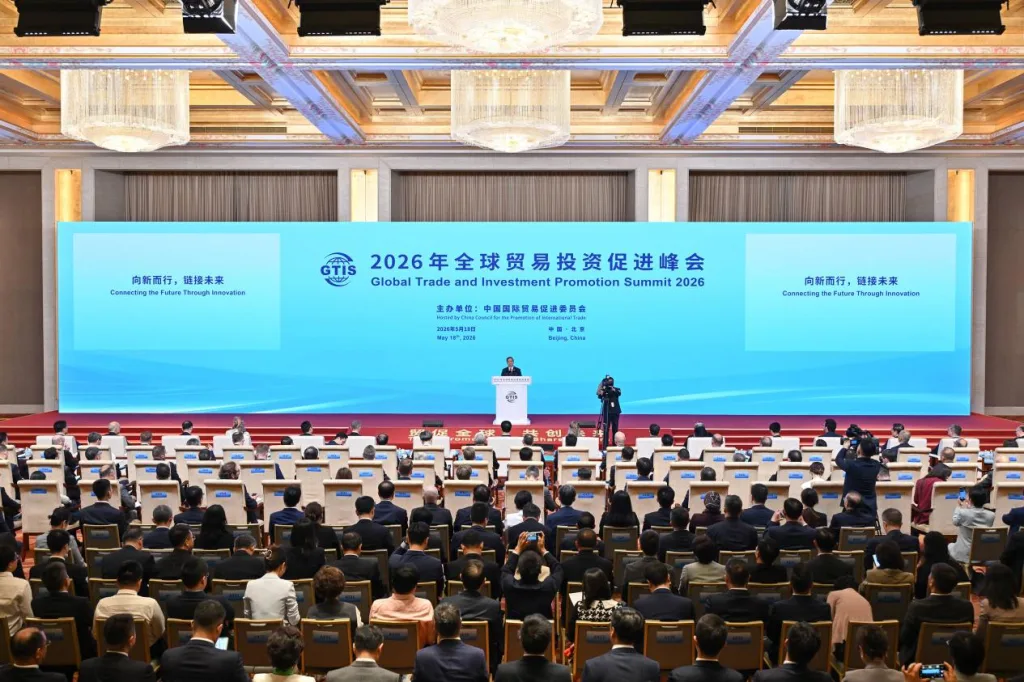
(Outbound investment and trade developments driving global industrial growth and bilateral partnerships. Source: Xinhua News Agency)

II. High-Risk Areas and Most Affected Business Categories

1. High-Priority Corporate Categories
  • Existing Outbound Enterprises: Companies with existing offshore entities, active overseas operations, or foreign equity investments.
  • Prospective Outbound Enterprises: Businesses planning offshore acquisitions, capital increases, or establishing new foreign entities in the second half of 2026.
  • Sensitive Sector Enterprises: Entities operating in high-risk jurisdictions, cross-border finance, advanced technology, or strategic natural resources.
2. High-Risk Business Activities
  • Retroactive Filings ("Invest First, File Later"): Formerly a common workaround, this practice is now prohibited and subject to immediate administrative penalties.
  • Non-Core Large-Scale Investments: Transnational financial investments or cross-industry acquisitions unrelated to the company's core business will face strict scrutiny.
  • Incomplete Portfolios for Existing Projects: Active overseas projects with missing corporate records, outdated financials, or incomplete risk reporting.
  • Investments in Sensitive Regions/Industries: Proposed projects in high-risk jurisdictions or restricted sectors will experience lower approval rates and prolonged review cycles.
3. Common Compliance Pitfalls
  • Individual Offshore Holdings: Founders holding overseas assets through offshore SPVs or proxy structures risk triggering compliance audits.
  • High-Tech Enterprises: Cross-border research centers, technology licensing, and global data transfers are subject to overlapping export control and data security reviews.
  • Unreported Tier-2 Reinvestments: Making down-stream investments via existing offshore subsidiaries without completing corresponding filing procedures can lead to retroactive penalties.
  • Cross-Border Litigation Data Risks: Transferring internal corporate data or documents abroad for foreign litigation or arbitration without verifying data residency can violate domestic confidentiality laws.

III. The Essential Outbound Compliance Checklist

1. Action Items for Enterprises
  1. Structure Audit: Map out all existing offshore investment structures (including indirect holdings through SPVs or VIE structures) to ensure all projects are fully registered and approved.
  2. Export & Data Audit: Review international business operations for controlled technologies or sensitive data transfers, and evaluate compliance with current export control regulations.
  3. Directory Tracking: Monitor upcoming releases of the "Encouraged, Restricted, and Prohibited Outbound Investment Directory" by the NDRC and MOFCOM to evaluate project feasibility.
  4. Internal Controls: Upgrade corporate governance policies, establish clear authorization limits for outbound investments, and define liability lines to safeguard executives.
2. Action Items for Individual Investors
  1. Asset Structuring: Assess current personal holdings of foreign equity, real estate, and financial portfolios to evaluate whether supplementary disclosures or structural modifications are necessary.
  2. Offshore SPV Reviews: Closely track the forthcoming implementation details concerning individual ownership of overseas assets through SPVs.
  3. Immigration and Real Estate Planning: Re-align cross-border wealth management, immigration setups, and global property acquisitions with the new compliance standards.

IV. Crucial Provisions for Outbound Enterprises

  • Applicability to Hong Kong, Macao, and Taiwan: Investments in Hong Kong, Macao, and Taiwan are managed with reference to these Regulations. This explicitly includes structures established for Hong Kong IPOs or holding platforms set up in Hong Kong.
  • Indirect Outbound Investment Cover: The Regulations cover "indirectly acquiring ownership or control of enterprises or assets in other countries or regions." Investments routed through multi-layered overseas subsidiaries remain subject to domestic regulation.
  • Financing and Guarantees Classified as ODI: Providing financial assistance or guarantees to offshore entities is officially categorized as outbound investment. Issuing shareholder loans or corporate guarantees to overseas affiliates without proper regulatory filings constitutes a compliance violation.
  • Diplomatic and Consular Protection: Article 20 outlines the consular protection responsibilities of overseas diplomatic missions, and Article 23 establishes a mechanism to counter foreign investment barriers, offering compliant enterprises a reliable legal shield abroad.

Conclusion

A robust rule-of-law framework is the foundation of a healthy business environment. High-standard administrative regulations impose strict compliance duties, but they also provide a safer, more predictable landscape for outbound businesses. If you are advancing an overseas investment or planning global expansion, we recommend using the pre-implementation transition window to audit your processes, mitigate compliance risks, and secure long-term operational stability.

Disclaimer & Copyright: This article is co-authored by Mandy Wu and Yu Yuting. The insights shared are for general compliance trends only and do not constitute formal legal advice.As a specialized cross-border legal institution, Neo-Ark Law Firm provides comprehensive global compliance and rights-protection support for expanding enterprises. For more international legal updates, please visit the Neo-Ark Law Firm Official Websites (https://www.neoarklawyers.com/news).

Recommend
Reappointed! Attorney Yu Yuting Selected as Council Director of the 3rd Guangdong Digital Jurisprudence Society

On June 13, 2026, the Guangdong Digital Jurisprudence Society successfully completed its leadership transition and election process.

Leveraging her deep professional expertise in data compliance and digital law alongside her exceptional clinical legal practice, Attorney Yu Yuting of our firm has been officially reappointed as a Council Director to the 3rd Council of the Guangdong Digital Jurisprudence Society.

I. Embracing the Digital Era: Advancing Frontier Compliance

As the global digital economy continues to expand, frontier legal issues such as data security, cross-border data flows, and artificial intelligence regulations are becoming increasingly critical.

The Guangdong Digital Jurisprudence Society serves as the province's premier platform for theoretical digital law research and practical innovation, bringing together top-tier academic experts, scholars, and leading legal practitioners from across China.

II. Translating Digital Legal Theory into Business Solutions

Since her initial appointment as Council Director, Attorney Yu Yuting has consistently worked at the intersection of digital legal research and practical client services.

During her tenure, she has remained at the forefront of digital transformation:

  • Actively participating in high-level academic symposiums.
  • Conducting in-depth research on corporate digital governance.
  • Pioneering practical legal strategies for cross-border data compliance and the financial assetization of intellectual property.
  • Devoting her practice to translating academic theories into practical, risk-mitigating compliance solutions for enterprise clients.

III. Looking to the Future of Digital Law

This reappointment represents both a prestigious professional recognition and a renewed commitment to the field.

Attorney Yu Yuting stated that she will continue to bridge the gap between academic theory and practical legal application. Leveraging NEO-ARK Law Firm's integrated platform, she plans to focus on the localization and system innovation of digital law, contributing her expertise to the growth of the Society and the advancement of digital rule-of-law initiatives in Guangdong.

Disclaimer & Copyright: This article is co-authored by Mandy Wu and Yu Yuting. The insights shared are for general compliance trends only and do not constitute formal legal advice.As a specialized cross-border legal institution, Neo-Ark Law Firm provides comprehensive global compliance and rights-protection support for expanding enterprises. For more international legal updates, please visit the Neo-Ark Law Firm Official Websites (https://www.neoarklawyers.com/news).

2026-06-25

International Divorce in China: A Legal Guide to Jurisdictions and Procedures (Part 2)

I. Rules for Asset Division and Cross-Border Debt Under Chinese Jurisdiction

1. Jurisdiction and Practical Limits on Overseas Property Division

When handling international asset division, if a Chinese court applies Chinese law to resolve marital property disputes, it holds broad adjudicative authority. However, there are strict limits regarding what can realistically be enforced abroad due to conflict of laws, burden of proof, and sovereignty:

(Following multiple rounds of cross-border coordination, the defendant Yu Xiaodong appeared via video link from a Thai prison, and the Chinese court granted the divorce in the first-instance trial. Source: Chinanews.com)

  • Moveable vs. Immoveable Assets: For overseas moveable property (e.g., bank deposits, financial portfolios, corporate equity, vehicles), Chinese courts can directly adjudicate the split, ownership, or cash compensation—provided the parties supply sufficient evidence or reach a mutual agreement in court. Conversely, under Article 36 of the Law on the Application of Laws to Foreign-Related Civil Relations, real estate is governed by the lex situs (law of the place where the property is located). Consequently, mainstream Chinese judicial practice avoids directly splitting ownership of overseas real estate. Courts generally decline to adjust or process the physical title of foreign real property, choosing instead to determine equity shares, award cash compensation, or divide actual proceeds from a sale. If the status and valuation of the asset cannot be verified, courts typically decline to make a ruling.
  • Burden of Proof: Chinese courts do not have cross-border investigative powers. The existence, ownership, acquisition date, and market value of all overseas assets must be proved entirely by the parties themselves. Any document generated abroad (e.g., property deeds, bank statements, investment receipts) must be officially notarized locally, authenticated by the competent Chinese embassy or consulate, and accompanied by certified Chinese translations to be admissible.
  • Enforcement Constraints: A domestic court order dividing overseas assets is legally effective only within China. It cannot be directly executed by foreign authorities. Enforcement depends on bilateral treaties or mutual reciprocity with the destination state, which often involves procedural hurdles. If the destination state does not recognize the Chinese decree, parties must file a separate property division lawsuit in that local jurisdiction.

Key Takeaway on Property: Moveable property is dividable if verifiable or agreed upon; overseas real estate is subject to the principle of "no direct title division, compensation only". Strategically, you should resolve domestic assets first within the main divorce proceeding, handle overseas real property through offset compensations, and reserve unresolved foreign assets for separate local actions.

(The husband lost contact after going to the United States for work 8 years ago. The wife filed for divorce, and the court successfully resolved the case through online mediation via the smart court system. Source: China Peace Grid)

2. Strategic Management of Cross-Border Debt Risks
  • The Marital Status Loophole: An overseas divorce decree that has not been formally recognized by a Chinese court holds no legal effect inside mainland China. Legally, the parties remain married domestically. Consequently, newly acquired loans, mortgages, or credit liabilities may still be deemed community debt if they meet joint-liability standards.
  • Joint Debt Standards: Under Article 1064 of the Civil Code, joint marital debt requires joint signature, subsequent ratification, or proof that the funds were used for daily family needs. Unilateral, large-scale borrowing not used for family life or joint business remains personal debt.
  • Risk Warning: Do not take on substantial loans or act as a joint guarantor before an overseas divorce is officially recognized in China. Doing so risks exposing you to unexpected joint liability.

II. Recognition and Enforcement of Chinese Divorce Decrees Abroad

Once a Chinese court issues a divorce judgment or mediation decree, using it abroad (to divide foreign assets or to remarry) requires navigating the foreign jurisdiction's recognition and enforcement procedures.

The difficulty varies significantly by country. Monetary divisions (e.g., splitting savings or compensation) are widely recognized in jurisdictions like Canada, Australia, and Singapore. However, custody and visitation provisions often require a local de novo trial, as foreign courts exercise extreme caution regarding child welfare.

Core Principle: Recognition ≠ Enforcement

  • Recognition: The local foreign court formally acknowledges the legal status of the Chinese judgment (specifically, the fact that the marriage is dissolved).
  • Enforcement: The local court uses compulsory state measures (e.g., seizing bank accounts or real property) to execute the specific terms of the judgment.

III. Application Process for Foreign Recognition

Step 1: Document Preparation
  • The original Chinese divorce judgment or mediation decree.
  • An official certificate of effective judgment (proving the decree is final and binding).
  • An official translation of the documents into the official language of the executing country.
  • A formal application/petition for enforcement.
Step 2: Petition the Competent Foreign Court

File the petition with the local court where the assets or children are located. The foreign court will review the Chinese decree to ensure it does not violate local public policy or fundamental legal principles.

Step 3: Execute the Order

Once recognized, the foreign court will initiate enforcement actions, such as frozen bank assets or real estate foreclosures.

IV. Practical Legal Advice for Cross-Border Litigants

  • Coordinate Global Language Early: Inform your legal team immediately if your court documents need to be used overseas. This allows your attorneys to draft the settlement or proposed judgment with highly enforceable, clear-cut language (such as "a lump-sum offset of X Amount" rather than vague, ongoing custody and visitation terminology).
  • Budget Your Timeline: Expect the overseas recognition and enforcement process to take at least 6 months. Notarization, translation, legalization, and local judicial reviews take time.
  • Address Jurisdictional Discrepancies: Because countries apply different standards to property, debts, and child custody, any issues left unaddressed by your Chinese decree should be raised immediately with counsel in the foreign jurisdiction. This is particularly true for unallocated foreign assets, local child welfare benefits, or religious matrimonial requirements.

Conclusion

Cross-border divorces sit at the intersection of domestic family law, foreign civil procedures, and international judicial assistance. Because jurisdiction, service, global assets, and enforcement present highly technical hurdles, we recommend evaluating your domestic jurisdictional standing first. Secure your domestic assets and child custody arrangements within China, and systematically prepare your documents for foreign recognition to protect your global interests.

Disclaimer & Copyright: This article is co-authored by Mandy Wu and Yu Yuting. The insights shared are for general compliance trends only and do not constitute formal legal advice.As a specialized cross-border legal institution, Neo-Ark Law Firm provides comprehensive global compliance and rights-protection support for expanding enterprises. For more international legal updates, please visit the Neo-Ark Law Firm Official Websites (https://www.neoarklawyers.com/news).
2026-06-24

Cultivating Global Talent: Asia Metropolitan University and NEO-ARK Law Firm Establish Joint Internship and Employment Base

On June 24, 2026, the signing and plaque-unveiling ceremony for the joint Internship and Employment Base between Asia Metropolitan University (AMU) and Guangdong NEO-ARK Law Firm was successfully held.

Distinguished guests from AMU included Datuk Abdul Rashid Bin Mohd Sharif (Chief Regulatory Officer of AMU Group), Dr. Hassan Basri Bin Jahubar Sathik (Vice Chancellor of AMU), Keith Lee Kien Fook (Sales and Marketing Director), Dr. Xu Yanping, and several prominent alumni representatives.

Representing NEO-ARK Law Firm were Attorney Huang Jianqiu (Director and Senior Partner), Attorney Liu Minghong (Executive Director and Senior Partner), Attorney Sun Jianhui (Chairman of the Supervisory Committee and Senior Partner), Attorney Huang Ziran (Secretary-General of the Management Committee and Senior Partner), Attorney Yu Yuting (Head of the International Legal Affairs Department and Partner), Attorney Xie Guizhen, and Intern Attorney Zhu Jia, who hosted the delegation and participated in the strategic dialogue.

I. Introducing NEO-ARK’s International Legal Edge

The event commenced with an introductory presentation by Attorney Yu Yuting. She detailed NEO-ARK Law Firm’s developmental trajectory, personnel scale, core practice areas, and specific strengths in cross-border legal services, showcasing the firm's comprehensive capability and dedicated talent cultivation systems.

II. Fostering Synergies in Transnational Legal Education

AMU Vice Chancellor Dr. Hassan Basri Bin Jahubar Sathik expressed his gratitude for the warm reception and continuous support from NEO-ARK Law Firm.

He emphasized his hope that both institutions would utilize this newly established base to:

  • Deepen the integration of academic and corporate resources.
  • Explore innovative models for cultivating international legal professionals tailored to evolving industry demands.
  • Bridge the gap between academic legal training and practical hands-on legal employment.
  • Achieve a mutually beneficial partnership that guarantees precise talent development.

III. Official Signing and Unveiling Ceremony

Following these exchanges, representatives from both sides officially signed the school-enterprise internship and employment cooperation agreement. In the presence of all attendees, they jointly completed the plaque-unveiling ceremony for the "Asia Metropolitan University Internship and Employment Base".

The establishment of this base represents a significant milestone in NEO-ARK’s efforts to optimize its talent cultivation framework and expand its global school-enterprise partnership network. It also highlights the firm’s commitment to social responsibility and its practical contributions toward building a robust pool of international legal practitioners.

Moving forward, NEO-ARK Law Firm will leverage its extensive practical resources and platform advantages to collaborate deeply with AMU. The partnership will focus on cultivating interdisciplinary, international legal professionals, consistently channeling premium, high-caliber talent into the cross-border legal services sector and global rule-of-law initiatives.

Disclaimer & Copyright: This article is co-authored by Mandy Wu and Yu Yuting. The insights shared are for general compliance trends only and do not constitute formal legal advice.As a specialized cross-border legal institution, Neo-Ark Law Firm provides comprehensive global compliance and rights-protection support for expanding enterprises. For more international legal updates, please visit the Neo-Ark Law Firm Official Websites (https://www.neoarklawyers.com/news).
2026-06-24

International Divorce in China: A Legal Guide to Jurisdictions and Procedures (Part 1)

Cross-border marriages are becoming increasingly common, but the legal issues involved in divorce are far more complex than ordinary divorces.

  • In which country should I get divorced?
  • Can domestic and overseas property be handled together?
  • If I divorce in China, do I still need to handle it in my country of nationality?

This guide unpacks the core procedural questions of cross-border divorce in China and answers them one by one.

(The cross-border divorce case of Li Yang, founder of "Crazy English", involving a Chinese husband and a foreign wife, under the jurisdiction of a Chinese court. Source: Chinanews.com)

I. Eligibility: Can Your Cross-Border Marriage Be Dissolved in China?

China's cross-border divorce system operates on two entirely independent tracks: Divorce by Litigation (Court Proceedings) and Uncontested Divorce (Registration at the Civil Affairs Bureau). Their jurisdictional thresholds and acceptance criteria are completely separate.

1. Divorce by Litigation: When Do Chinese Courts Have Jurisdiction?

Pursuant to Articles 13–16 of the Interpretation of the Civil Procedure Law, a Chinese court assumes jurisdiction if any of the following scenarios apply:

  • Scenario A: One Party Is a Chinese Citizen and the Other Resides AbroadRegardless of which party files the lawsuit first, the basic-level people's court in the place of domicile or habitual residence of the domestic party has jurisdiction. Under the parallel litigation rule, even if the overseas spouse has already filed a lawsuit in a foreign court, the Chinese court can still accept a separate filing by the domestic party.
  • Scenario B: Both Parties Are Chinese Citizens Residing Abroad
    • Registered marriage in China: If the court of the host country refuses to accept the divorce, it falls under the jurisdiction of the Chinese court where the marriage was concluded or the place of the last domestic residence of either party.
    • Registered marriage abroad: If the foreign host country's court declines the case, it is managed by the court where one party's original registered household (Hukou) or last domestic residence is located.
    • Not permanently settled abroad: If either party files a lawsuit, it falls under the jurisdiction of the court in the place of the original domestic domicile of the plaintiff or defendant before going abroad.
  • Scenario C: One Party Is a Foreign National and the Other Is a Chinese Citizen
    • If the foreign spouse has a habitual residence in China (continuous residence for a full 1 year), the court in the place of the defendant's habitual residence holds jurisdiction.
    • If the foreign spouse has no residence in China, the court in the place of the domicile or habitual residence of the Chinese citizen plaintiff can officially file the case (status litigation brought against an overseas natural person falls under the jurisdiction of the plaintiff's local court).
  • Scenario D: Supplementary Blanket JurisdictionIf the marriage was concluded in China, or the main community property is located within China, or the minor children have lived in China for a long time, these all constitute reasonable connecting points for Chinese courts to claim jurisdiction.

Key Takeaway on Jurisdiction: As long as one party to the marriage is a Chinese citizen, OR the marriage registration place is domestic, OR the children/main assets are within China, a Chinese court can generally accept the divorce lawsuit—unrestricted by the other party's nationality or parallel overseas litigation.

(The cross-border divorce lawsuit initiated by a Singaporean male party, where the court completed the online trial in the online mediation zone for foreign-related civil and commercial disputes. Source: China Peace Grid)

2. Uncontested Divorce: Strict Thresholds for Civil Registration

To bypass court litigation and register a mutual divorce at the Civil Affairs Bureau (under Articles 13-14 of the Regulations on Marriage Registration and Article 47 of the Specifications on Marriage Registration Work), all of the following conditions must be met simultaneously:

  1. Marriage Certificate Origin: The certificate must have been issued by a mainland Chinese marriage registration authority or a Chinese embassy/consulate abroad. If the marriage was registered under a foreign government authority, you cannot use the uncontested registration track in China.
  2. Civil Capacity: Both parties must possess full capacity for civil conduct.
  3. Complete Consensus: Both parties must voluntarily divorce, and have a written divorce agreement that outlines a complete consensus on child custody, domestic and foreign asset division, and all liabilities.
  4. No Proxies Allowed: Both parties must apply in person together; you cannot entrust an agent or attorney to stand in your place.
  5. Cooling-off Period: A mandatory 30-day divorce cooling-off period applies. After this period expires, both parties must appear in person together again to officially apply for and collect the divorce certificate.
3. Tactical Benefits: Why Choose China as Your Divorce Jurisdiction?
  • Advantage 1: Clear and Predictable Legal StandardsCore issues such as the legal grounds for divorce and judicial litigation procedures strictly apply Chinese law, meaning the adjudication standards are stable, transparent, and highly predictable.
  • Advantage 2: Cost-Effective Asset Investigation and EnforcementFor domestic assets (real estate, bank deposits, corporate equity, vehicles), the court can directly subpoena banking records, real estate registries, and commercial archives. Effective civil judgments and mediation sheets can be directly enforced by Chinese courts without navigating complex cross-border judicial assistance. If the vast majority of assets are onshore, domestic litigation is your optimal choice.
  • Advantage 3: Seamless Execution of Child Custody and SupportIf the children study and live in China long-term, domestic courts can verify the living, custody, and education status on the spot. Subsequent modifications—such as adjusting child support, changing visitation rights, or initiating compulsory execution for non-payment—can be filed directly in nearby domestic courts without cross-border litigation.

II. Strategic Choice: Uncontested Registration vs. Court Litigation

1. Uncontested Divorce (By Agreement)

  • The Pros: Fast process, low cost, completely private, and avoids the lengthy cross-border service of legal documents.
  • The Cons: Unavailable if you married abroad, if one party cannot physically return to China, or if there is any lingering disagreement regarding property, children, or debts.

2. Divorce by Litigation (Through the Courts)

If your case does not meet the strict criteria for an uncontested divorce, but satisfies the jurisdictional connecting points listed in Section I, your only path forward is litigation. Divorce by litigation can be initiated unilaterally by one party without the cooperation or consent of the other. As long as the Chinese court has jurisdiction, the court can try the case and render a binding judgment even if the spouse is abroad and fails to respond.

(The Chaoyang District People's Court releases the "White Paper on the Adjudication of Foreign-Related Family Cases". Source: Beijing Court Net)

III. Essential Elements of Cross-Border Divorce Litigation

1. Venue: Which Court Has Jurisdiction to File the Case?

In principle, foreign-related divorce cases are handled by basic-level People’s Courts. The filing location is determined by specific circumstances:

  • Defendant lives in China for a full year: Filed at the basic-level court of the defendant's habitual residence.
  • Defendant has no residence in China: Filed at the basic-level court of the plaintiff's registered household or habitual residence.
  • Both parties live abroad without permanent settlement: Filed at the domestic court where the plaintiff or defendant held their registered household before moving abroad.
2. Governing Law: Which Legal Framework Applies to the Merits?

Court jurisdiction and the application of law (governing law) are two entirely different legal concepts. While a Chinese court uses nationality and residence to determine its right to hear a case, it determines the actual rules of the trial based on the Law of the People's Republic of China on the Application of Laws to Foreign-Related Civil Relations.

The application of law in foreign-related divorces involves complex conflicts between jurisdictions. During litigation, parties must assert their governing law claims based on the exact nature of the dispute (e.g., location of property, actual residence of the children) and provide corresponding foreign legal texts or expert evidence for judicial review.

The mainstream application framework used by domestic courts includes:

  • Divorce Conditions & Procedures: Governed strictly by the law of the forum—Chinese law (Article 27).
  • Community Property & Debt Division: Governed by the law chosen by mutual agreement of the parties. In the absence of an agreement, courts apply the law of the closest connection, such as a common habitual residence, common nationality, or primary asset location (Article 24).
  • Child Custody & Support Disputes: Governed by the principle of "protecting the rights and interests of the weaker party." If there is no common habitual residence, the court prioritizes whichever legal framework—between the habitual residence of one parent or the country of nationality—is more favorable to protecting the minor child’s health, growth, and educational resources (Article 25).
3. Documentation: What Evidence Needs to Be Prepared?
  • Identity Profiles: PRC ID cards for Chinese citizens; Passports for foreign citizens; Travel Permits for Hong Kong, Macao, and Taiwan residents.
  • Marriage Proof: Marriage certificates (Foreign certificates require local notarization, an Apostille or consular legalization, and certified Chinese translations).
  • Grounds for Divorce: Evidence of a breakdown of mutual affection (e.g., separation records, domestic violence reports, proof of infidelity).
  • Assets & Liabilities: Bank statements, property deeds, vehicle registries, and corporate equity certificates.
  • Note: Official lawsuit documents can be drafted directly by your appointed legal counsel.
4. Service of Process: Navigating the Main Bottleneck

If a defendant resides outside of China, serving legal documents to them is the most time-consuming phase of cross-border litigation.

  • Hague Service Convention Countries: Service via official convention channels typically takes 2 to 3 months.
  • Non-Convention Countries (e.g., Thailand): Documents must move through formal diplomatic channels, which can stretch the timeline to nearly two years.

(Ai Fukuhara appears at a press conference to announce a settlement with her ex-husband Chiang Hung-chieh. Source: Chinanews.com)

5. Estimated Timeline: How Long to Get a Judgment?
  • Defendant is within China (Normal Service): 3 months under summary procedures; 6 months under ordinary procedures.
  • Defendant is abroad (Hague Service): The overall cycle ranges from 6 to 12 months.
  • Defendant is unreachable (Diplomatic / Public Notice Service): The cycle can take 1 to 2 years. Advance procedural planning is highly recommended.

Conclusion and Next Steps

This article has systematically organized the foundational procedural questions surrounding cross-border divorce: Is a Chinese divorce possible? Should you register or litigate? Which court do you approach? What documents are required, and what is the realistic timeline?

In Part 2 of this guide, we will break down exactly how Chinese courts split onshore versus offshore assets, address cross-border debt liabilities, and outline the precise steps required to have a Chinese divorce decree legally recognized and executed in foreign jurisdictions. Stay tuned.

Disclaimer & Copyright: This article is co-authored by Mandy Wu and Yu Yuting. The insights shared are for general compliance trends only and do not constitute formal legal advice.As a specialized cross-border legal institution, Neo-Ark Law Firm provides comprehensive global compliance and rights-protection support for expanding enterprises. For more international legal updates, please visit the Neo-Ark Law Firm Official Websites (https://www.neoarklawyers.com/news).

2026-06-23

Scroll to Top

+86 13503030053

BackToTop

Inquiry Inquiry Email Email Tel Tel

Request A Quote

×
Please enable JavaScript in your browser to complete this form.