Cross-border marriages are becoming increasingly common, but the legal issues involved in divorce are far more complex than ordinary divorces.
- In which country should I get divorced?
- Can domestic and overseas property be handled together?
- If I divorce in China, do I still need to handle it in my country of nationality?
This guide unpacks the core procedural questions of cross-border divorce in China and answers them one by one.

(The cross-border divorce case of Li Yang, founder of "Crazy English", involving a Chinese husband and a foreign wife, under the jurisdiction of a Chinese court. Source: Chinanews.com)
I. Eligibility: Can Your Cross-Border Marriage Be Dissolved in China?
China's cross-border divorce system operates on two entirely independent tracks: Divorce by Litigation (Court Proceedings) and Uncontested Divorce (Registration at the Civil Affairs Bureau). Their jurisdictional thresholds and acceptance criteria are completely separate.
1. Divorce by Litigation: When Do Chinese Courts Have Jurisdiction?
Pursuant to Articles 13–16 of the Interpretation of the Civil Procedure Law, a Chinese court assumes jurisdiction if any of the following scenarios apply:
- Scenario A: One Party Is a Chinese Citizen and the Other Resides AbroadRegardless of which party files the lawsuit first, the basic-level people's court in the place of domicile or habitual residence of the domestic party has jurisdiction. Under the parallel litigation rule, even if the overseas spouse has already filed a lawsuit in a foreign court, the Chinese court can still accept a separate filing by the domestic party.
- Scenario B: Both Parties Are Chinese Citizens Residing Abroad
- Registered marriage in China: If the court of the host country refuses to accept the divorce, it falls under the jurisdiction of the Chinese court where the marriage was concluded or the place of the last domestic residence of either party.
- Registered marriage abroad: If the foreign host country's court declines the case, it is managed by the court where one party's original registered household (Hukou) or last domestic residence is located.
- Not permanently settled abroad: If either party files a lawsuit, it falls under the jurisdiction of the court in the place of the original domestic domicile of the plaintiff or defendant before going abroad.
- Scenario C: One Party Is a Foreign National and the Other Is a Chinese Citizen
- If the foreign spouse has a habitual residence in China (continuous residence for a full 1 year), the court in the place of the defendant's habitual residence holds jurisdiction.
- If the foreign spouse has no residence in China, the court in the place of the domicile or habitual residence of the Chinese citizen plaintiff can officially file the case (status litigation brought against an overseas natural person falls under the jurisdiction of the plaintiff's local court).
- Scenario D: Supplementary Blanket JurisdictionIf the marriage was concluded in China, or the main community property is located within China, or the minor children have lived in China for a long time, these all constitute reasonable connecting points for Chinese courts to claim jurisdiction.
Key Takeaway on Jurisdiction: As long as one party to the marriage is a Chinese citizen, OR the marriage registration place is domestic, OR the children/main assets are within China, a Chinese court can generally accept the divorce lawsuit—unrestricted by the other party's nationality or parallel overseas litigation.
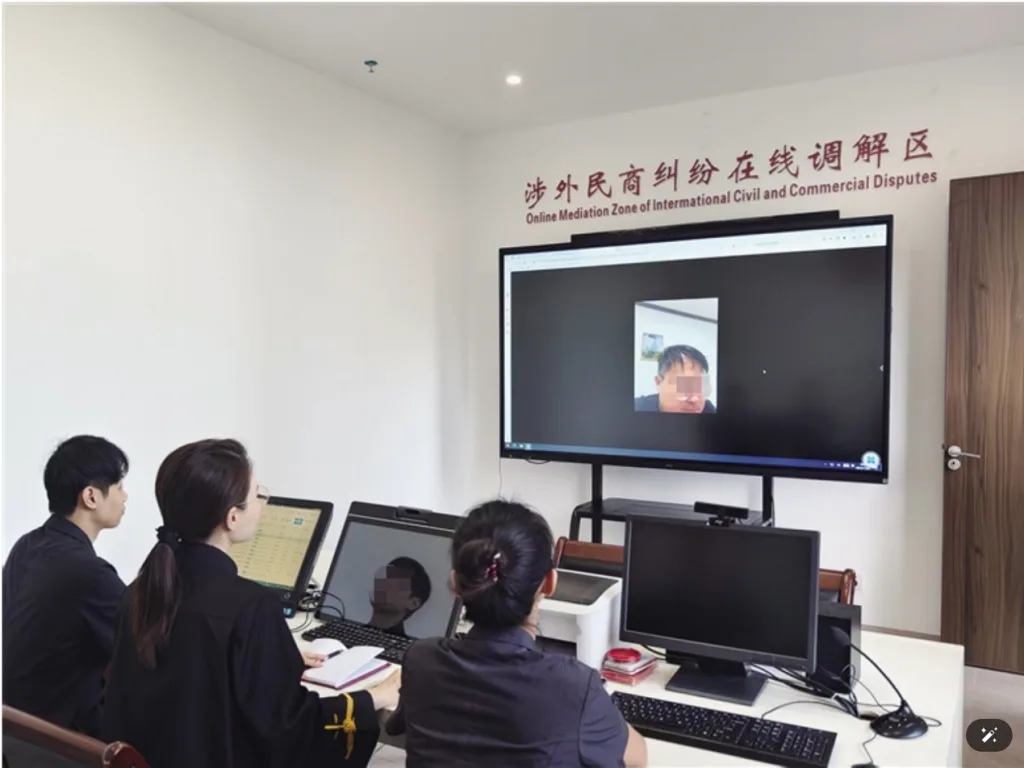
(The cross-border divorce lawsuit initiated by a Singaporean male party, where the court completed the online trial in the online mediation zone for foreign-related civil and commercial disputes. Source: China Peace Grid)
2. Uncontested Divorce: Strict Thresholds for Civil Registration
To bypass court litigation and register a mutual divorce at the Civil Affairs Bureau (under Articles 13-14 of the Regulations on Marriage Registration and Article 47 of the Specifications on Marriage Registration Work), all of the following conditions must be met simultaneously:
- Marriage Certificate Origin: The certificate must have been issued by a mainland Chinese marriage registration authority or a Chinese embassy/consulate abroad. If the marriage was registered under a foreign government authority, you cannot use the uncontested registration track in China.
- Civil Capacity: Both parties must possess full capacity for civil conduct.
- Complete Consensus: Both parties must voluntarily divorce, and have a written divorce agreement that outlines a complete consensus on child custody, domestic and foreign asset division, and all liabilities.
- No Proxies Allowed: Both parties must apply in person together; you cannot entrust an agent or attorney to stand in your place.
- Cooling-off Period: A mandatory 30-day divorce cooling-off period applies. After this period expires, both parties must appear in person together again to officially apply for and collect the divorce certificate.
3. Tactical Benefits: Why Choose China as Your Divorce Jurisdiction?
- Advantage 1: Clear and Predictable Legal StandardsCore issues such as the legal grounds for divorce and judicial litigation procedures strictly apply Chinese law, meaning the adjudication standards are stable, transparent, and highly predictable.
- Advantage 2: Cost-Effective Asset Investigation and EnforcementFor domestic assets (real estate, bank deposits, corporate equity, vehicles), the court can directly subpoena banking records, real estate registries, and commercial archives. Effective civil judgments and mediation sheets can be directly enforced by Chinese courts without navigating complex cross-border judicial assistance. If the vast majority of assets are onshore, domestic litigation is your optimal choice.
- Advantage 3: Seamless Execution of Child Custody and SupportIf the children study and live in China long-term, domestic courts can verify the living, custody, and education status on the spot. Subsequent modifications—such as adjusting child support, changing visitation rights, or initiating compulsory execution for non-payment—can be filed directly in nearby domestic courts without cross-border litigation.
II. Strategic Choice: Uncontested Registration vs. Court Litigation
1. Uncontested Divorce (By Agreement)
- The Pros: Fast process, low cost, completely private, and avoids the lengthy cross-border service of legal documents.
- The Cons: Unavailable if you married abroad, if one party cannot physically return to China, or if there is any lingering disagreement regarding property, children, or debts.
2. Divorce by Litigation (Through the Courts)
If your case does not meet the strict criteria for an uncontested divorce, but satisfies the jurisdictional connecting points listed in Section I, your only path forward is litigation. Divorce by litigation can be initiated unilaterally by one party without the cooperation or consent of the other. As long as the Chinese court has jurisdiction, the court can try the case and render a binding judgment even if the spouse is abroad and fails to respond.
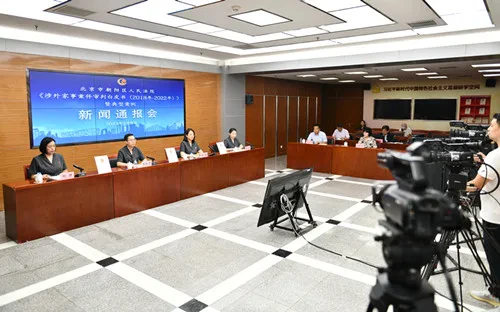
(The Chaoyang District People's Court releases the "White Paper on the Adjudication of Foreign-Related Family Cases". Source: Beijing Court Net)
III. Essential Elements of Cross-Border Divorce Litigation
1. Venue: Which Court Has Jurisdiction to File the Case?
In principle, foreign-related divorce cases are handled by basic-level People’s Courts. The filing location is determined by specific circumstances:
- Defendant lives in China for a full year: Filed at the basic-level court of the defendant's habitual residence.
- Defendant has no residence in China: Filed at the basic-level court of the plaintiff's registered household or habitual residence.
- Both parties live abroad without permanent settlement: Filed at the domestic court where the plaintiff or defendant held their registered household before moving abroad.
2. Governing Law: Which Legal Framework Applies to the Merits?
Court jurisdiction and the application of law (governing law) are two entirely different legal concepts. While a Chinese court uses nationality and residence to determine its right to hear a case, it determines the actual rules of the trial based on the Law of the People's Republic of China on the Application of Laws to Foreign-Related Civil Relations.
The application of law in foreign-related divorces involves complex conflicts between jurisdictions. During litigation, parties must assert their governing law claims based on the exact nature of the dispute (e.g., location of property, actual residence of the children) and provide corresponding foreign legal texts or expert evidence for judicial review.
The mainstream application framework used by domestic courts includes:
- Divorce Conditions & Procedures: Governed strictly by the law of the forum—Chinese law (Article 27).
- Community Property & Debt Division: Governed by the law chosen by mutual agreement of the parties. In the absence of an agreement, courts apply the law of the closest connection, such as a common habitual residence, common nationality, or primary asset location (Article 24).
- Child Custody & Support Disputes: Governed by the principle of "protecting the rights and interests of the weaker party." If there is no common habitual residence, the court prioritizes whichever legal framework—between the habitual residence of one parent or the country of nationality—is more favorable to protecting the minor child’s health, growth, and educational resources (Article 25).
3. Documentation: What Evidence Needs to Be Prepared?
- Identity Profiles: PRC ID cards for Chinese citizens; Passports for foreign citizens; Travel Permits for Hong Kong, Macao, and Taiwan residents.
- Marriage Proof: Marriage certificates (Foreign certificates require local notarization, an Apostille or consular legalization, and certified Chinese translations).
- Grounds for Divorce: Evidence of a breakdown of mutual affection (e.g., separation records, domestic violence reports, proof of infidelity).
- Assets & Liabilities: Bank statements, property deeds, vehicle registries, and corporate equity certificates.
- Note: Official lawsuit documents can be drafted directly by your appointed legal counsel.
4. Service of Process: Navigating the Main Bottleneck
If a defendant resides outside of China, serving legal documents to them is the most time-consuming phase of cross-border litigation.
- Hague Service Convention Countries: Service via official convention channels typically takes 2 to 3 months.
- Non-Convention Countries (e.g., Thailand): Documents must move through formal diplomatic channels, which can stretch the timeline to nearly two years.

(Ai Fukuhara appears at a press conference to announce a settlement with her ex-husband Chiang Hung-chieh. Source: Chinanews.com)
5. Estimated Timeline: How Long to Get a Judgment?
- Defendant is within China (Normal Service): 3 months under summary procedures; 6 months under ordinary procedures.
- Defendant is abroad (Hague Service): The overall cycle ranges from 6 to 12 months.
- Defendant is unreachable (Diplomatic / Public Notice Service): The cycle can take 1 to 2 years. Advance procedural planning is highly recommended.
Conclusion and Next Steps
This article has systematically organized the foundational procedural questions surrounding cross-border divorce: Is a Chinese divorce possible? Should you register or litigate? Which court do you approach? What documents are required, and what is the realistic timeline?
In Part 2 of this guide, we will break down exactly how Chinese courts split onshore versus offshore assets, address cross-border debt liabilities, and outline the precise steps required to have a Chinese divorce decree legally recognized and executed in foreign jurisdictions. Stay tuned.
Disclaimer & Copyright: This article is co-authored by Mandy Wu and Yu Yuting. The insights shared are for general compliance trends only and do not constitute formal legal advice.As a specialized cross-border legal institution, Neo-Ark Law Firm provides comprehensive global compliance and rights-protection support for expanding enterprises. For more international legal updates, please visit the Neo-Ark Law Firm Official Websites (https://www.neoarklawyers.com/news).