...

News

Sports Law & Cross-Border Dispute Resolution | Suspended Red Cards at the World Cup: Analyzing Administrative Discretion and Procedural Standing in International Governance

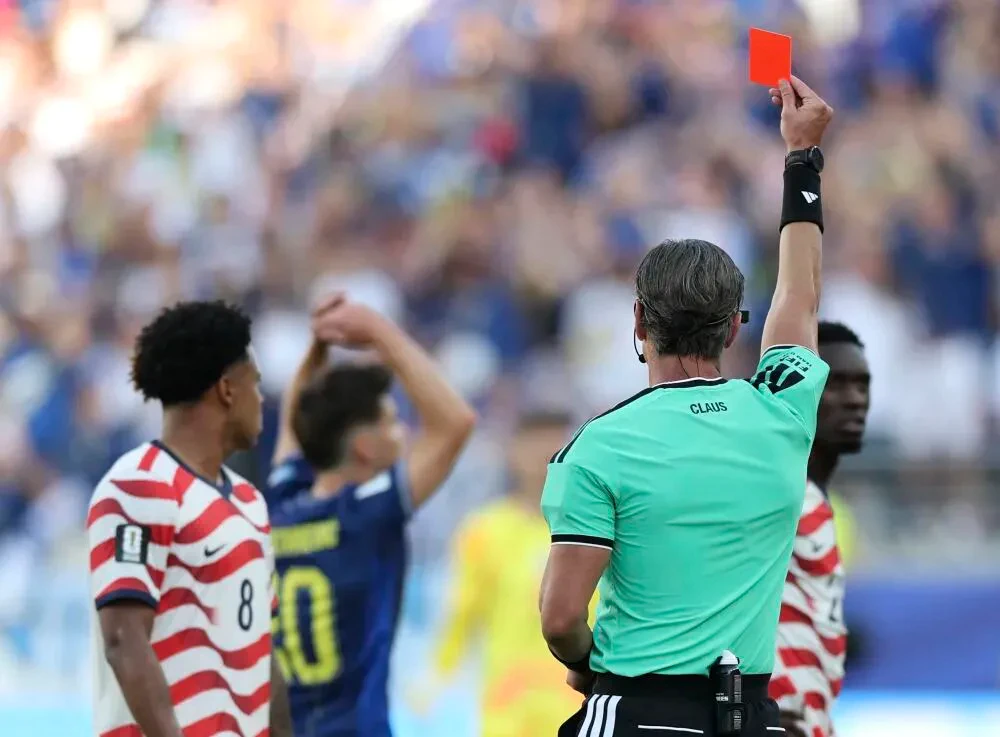
During the knockout stage of the 2026 FIFA World Cup, a historic disciplinary decision triggered intense debate across global sports law and regulatory compliance circles. On July 1, 2026, during the Round of 32 match between the United States and Poland, American star forward Folarin Balogun received a direct red card for a serious stamping foul.

(US player Folarin Balogun receiving a direct red card following a referee review during the World Cup Round of 32 match on July 1. Source: Agence France-Presse)

Under Article 10.5 of the Regulations for the FIFA World Cup 2026, a direct red card entails an automatic match suspension for the team's subsequent fixture (the Round of 16 match against Belgium).

However, on July 5, 2026, the FIFA Disciplinary Committee announced a unprecedented verdict: imposing a one-match suspension but suspending its execution under a one-year probation period. This ruling allowed Balogun to take the pitch against Belgium, sparking accusations of host-nation bias and procedural overreach.

This article dissects the statutory logic, procedural mechanics, and international dispute resolution principles underlying FIFA's controversial exercise of administrative discretion.
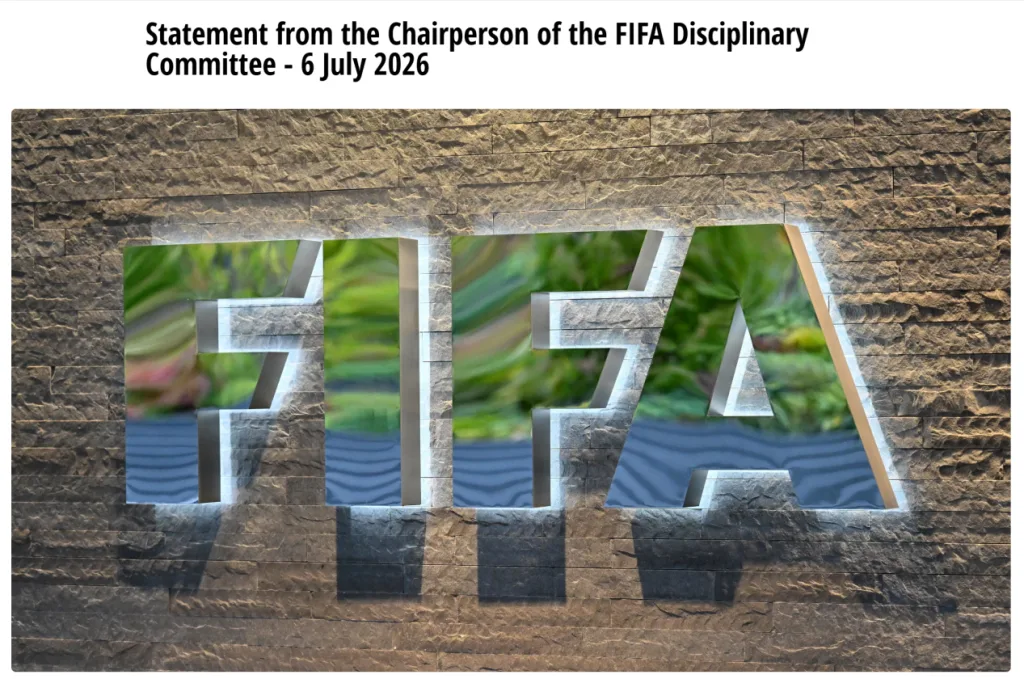
(Official press release published by the Chairman of the FIFA Disciplinary Committee addressing the legal basis of the decision on July 6. Source: FIFA)

I. The Two-Step Statutory Logic of FIFA's Disciplinary Framework

The FIFA Disciplinary Committee navigated a precise two-step legal methodology to uphold judicial authority while granting procedural relief:

Step 1: Statutory Affirmation ──> Affirm red card validity (Art. 66.4) + Impose $40,000 fine (Art. 14 & 66)
                                   ↓
Step 2: Execution Discretion   ──> Activate probation power (Art. 27) + Institute 1-year probationary period
1. Step 1: Fact-Finding and Authority Preservation

The Disciplinary Committee did not overturn the referee's pitch decision. Pursuant to Article 66.4 of the FIFA Disciplinary Code (FDC) and Article 10.5 of the World Cup Regulations, the automatic one-match suspension was officially confirmed. Additionally, a $40,000 fine was levied against the player and the US Soccer Federation under joint liability principles (Articles 14 and 66) for post-match pitch infractions, preserving referee authority.

2. Step 2: Activating Administrative Discretion Under Article 27

Under Article 27 of the FDC, the Disciplinary Committee possesses statutory authority to grant a suspension of implementation (probation) for disciplinary sanctions, except in cases involving match manipulation. FIFA did not "annul" the red card; rather, it converted the immediate suspension into a 1-year conditional probation. A repeat infraction within twelve months automatically triggers cumulative enforcement of both penalties.

                      ┌── Article 25 (FDC): Determination of Sanctions ──> Defines WHAT penalty is imposed.
Discretionary Matrix ─┤
                      └── Article 27 (FDC): Probation Mechanism       ──> Defines HOW penalty is executed.

This statutory interaction aligns with FIFA judicial precedent, as suspended bans and red-card probation mechanisms have been applied within UEFA domestic leagues and 2026 World Cup qualifying rounds.
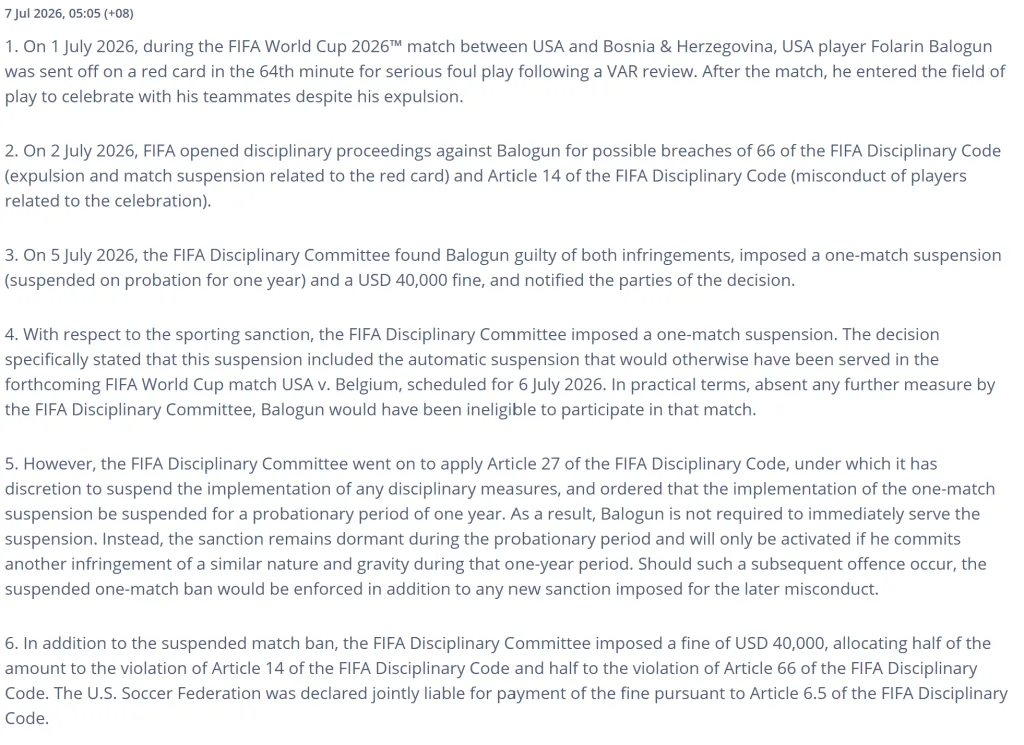
(Full text of the official compliance statement issued by the Chairman of the FIFA Disciplinary Committee regarding Article 27 application. Source: FIFA)

II. Harmonizing Mandatory Suspensions with Discretionary Powers

A central legal question emerged: Does applying Article 27 probation to a World Cup match violate the legal canon lex specialis derogat legi generali (special law overrides general law), given that World Cup Regulation Article 10.5 mandates "automatic" suspensions?

FIFA’s official statement clarified that the two provisions operate in complementary legal dimensions rather than in conflict:

  • Substantive Sanction vs. Procedural Execution: Article 10.5 of the World Cup Regulations establishes the substantive rule (confirming that a red card results in a one-match ban). Article 27 of the FDC governs the procedural execution (determining whether the ban must be served immediately or conditionally deferred).
  • Absence of Exclusionary Language: No statutory provision within the World Cup Regulations explicitly waives or excludes the application of FDC Article 27 probation mechanisms during final tournament phases.

III. Procedural Standing Barriers: The Dismissal of Belgium's Appeal

Following the ruling, the Royal Belgian Football Association lodged an immediate appeal. The FIFA Appeal Committee dismissed the challenge on procedural grounds, ruling that Belgium lacked procedural standing (locus standi) as a non-party to the underlying disciplinary proceeding.

PartyProcedural StatusStatutory Rights Under FIFA Code
US Soccer Federation & PlayerDirect Parties to ProceedingFull right to be heard, receive formal notice, and submit defense.
Belgian Football AssociationSubsequent Opponent / Affected Third PartyClassified as Non-Direct Party; denied formal standing to appeal internal administrative discretion.

This ruling highlights a fundamental tension in international sports arbitration: balancing strict procedural boundaries (limiting standing to direct sanction targets) against the rights of third parties whose competitive interests are directly impacted by administrative rulings.
(Match referee issuing a direct red card to US forward Folarin Balogun during the Round of 32 fixture. Source: Xinhua News )

IV. Judicial Independence in Multi-Stakeholder Governance

To counter allegations of geopolitical or commercial bias favoring the host nation, FIFA anchored its defense on the structural independence of its judicial bodies.

Under the FIFA Statutes and FIFA Governance Regulations, members of the Disciplinary Committee are subject to strict neutrality standards, operating independently of the FIFA Council and commercial partners. In transnational compliance and international arbitration, structural judicial independence serves as the primary safeguard for institutional legitimacy when handling high-stakes corporate or geopolitical disputes.

Conclusion & Cross-Border Legal Insights

On July 6, Belgium defeated the United States 4–1 in the Round of 16, ending the host nation's tournament run. However, the legal precedents established by this decision extend far beyond the pitch.

For cross-border corporate governance and regulatory compliance, the Balogun precedent offers valuable strategic lessons:

Sports Litigation Parallel ──> Uncovering procedural discretion to secure probation for a key athlete.
                                         ↓
Cross-Border Compliance   ──> Utilizing precise statutory interpretations, jurisdictional defenses, and procedural 
                              remedies to insulate commercial assets during extraterritorial regulatory enforcement.

Whether defending against administrative sanctions, trade restrictions, or long-arm enforcement, mastery of procedural rules and statutory discretion remains the cornerstone of effective international risk management.
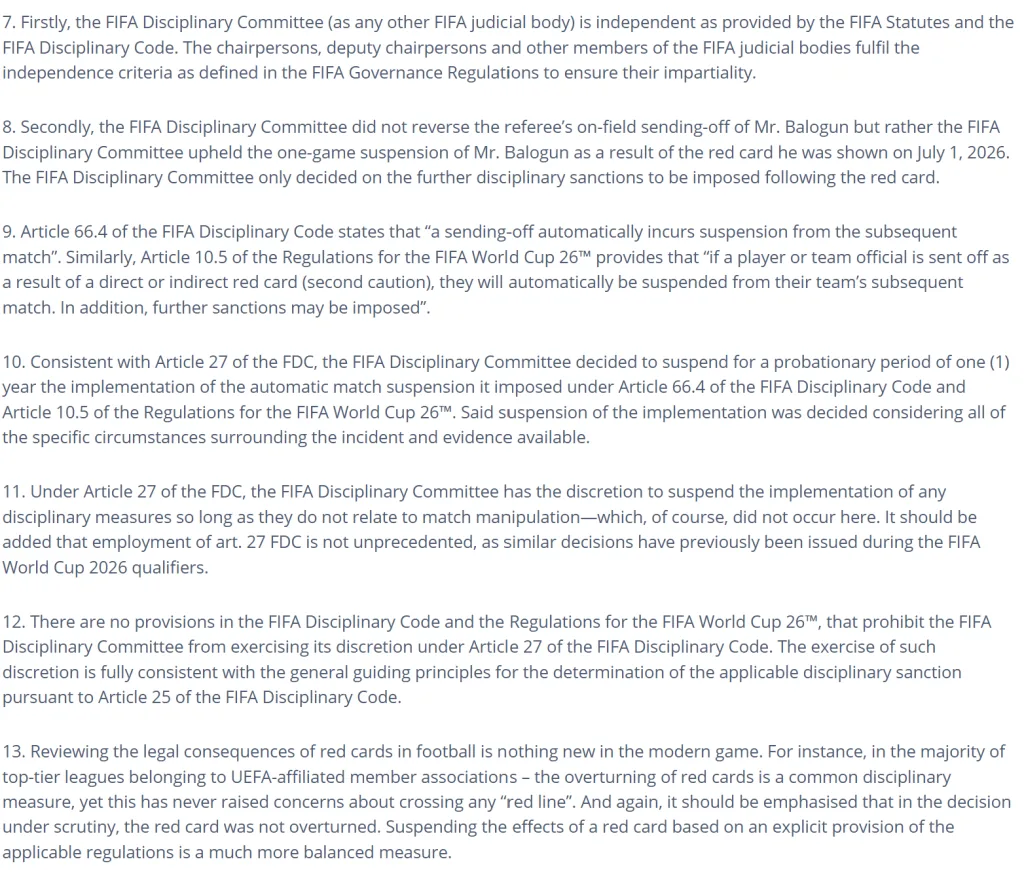
(Official FIFA statement confirming the procedural dismissal of the appeal submitted by the Royal Belgian Football Association. Source: FIFA)

About the Author

Yu Yuting
Partner | NEO-ARK Law Firm

Lawyer Yu focuses on foreign-related litigation, cross-border disputes, commercial matters, and legal services for overseas individuals and businesses in China.

Email: [email protected]

About NEO-ARK Law Firm

NEO-ARK Law Firm provides legal services in foreign-related litigation, commercial disputes, family law, and cross-border legal matters, assisting both international and domestic clients throughout China.


Recommend
Cross-Border IP & Digital Compliance | Unauthorized Reposting of TikTok Content to Douyin: Strategic Legal Remedies and Enforcement Protocols

With the expansion of global short-video ecosystems, cross-border content scraping—specifically downloading original videos from overseas platforms like TikTok, removing watermarks, and re-uploading them to domestic Chinese platforms such as Douyin for commercial monetization—has emerged as a systemic legal challenge for global content creators and multi-channel networks (MCNs).

This dual-language compliance guide analyzes civil and criminal jurisprudence within Chinese courts to map statutory violations, digital evidence preservation protocols, platform takedown mechanisms, and litigation strategies tailored for foreign right-holders.

(Official homepage of TikTok platform displaying global user-generated content creation. Source: tiktok.com)

I. Key Judicial Precedents: Chinese Court Enforcement Against Cross-Border Content Theft

1. Civil Jurisprudence: Zhang v. Liang (Beijing Internet Court)
  • Factual Background: The plaintiff, a TikTok creator with over 1 million followers, published 100 original product recommendation videos. The defendant downloaded all 100 videos, removed original attribution watermarks, and posted them on Douyin, gaining 350,000 followers and generating commercial sales revenue.
  • Legal Holding: Under the Berne Convention for the Protection of Literary and Artistic Works, lawful works first published in member states enjoy national treatment under China’s Copyright Law. The court held that deleting creator credits and unauthorized distribution infringed upon both the plaintiff’s Right of Authorship and Right of Communication through Information Networks. The defendant was ordered to pay RMB 50,000 in economic damages and RMB 22,500 in reasonable legal/notarization fees.
2. Criminal Jurisprudence: State v. Zhu & Wang (Nanhu District Court, Zhejiang)
  • Factual Background: The defendants systematically scraped, edited, and distributed copyrighted short video resources across digital networks to evade automated platform audits, generating over RMB 390,000 in illegal gains.
  • Legal Holding: Applying Article 217 of the Criminal Law of the People's Republic of China (Copyright Infringement Crime), the court sentenced both defendants to two years' imprisonment (suspended with two years and six months' probation) and imposed total criminal fines of RMB 380,000.

(Overview diagram illustrating judicial enforcement procedures and copyright rules in China. Source: Baidu Baike)

II. Statutory Breakdown of Infringing Acts Under Chinese Law

  1. Right of Communication through Information Networks (Information Network Transmission Right): Uploading protected works to open online platforms without consent, enabling public access at selected times and locations, violates Article 10 of China's Copyright Law.
  2. Right of Authorship (Attribution Right): Stripping original watermarks, creator logos, or closing credits directly violates moral rights of attribution.
  3. Right of Adaptation (Derivative Works): Unauthorized re-editing, dubbing, or slicing video content infringes upon derivative transformation rights.
  4. Unfair Competition (Anti-Unfair Competition Law): Where scraping constitutes a core commercial model that free-rides on established brand equity to siphon traffic, courts apply Article 2 of the Anti-Unfair Competition Law.
  5. Criminal Liability: Profit-driven copyright infringement with illegal revenue exceeding RMB 50,000 or illegal gains exceeding RMB 30,000 triggers criminal prosecution under Article 217 of the Criminal Law.

(Official portal interface of Douyin platform for content management and creator services. Source: douyin.com)

III. Four-Step Enforcement Protocol: From Evidence Preservation to Litigation

Step 1: Secure Digital Evidence (Critical Baseline)
  • Capture complete screen recordings of the infringing account, videos, fan count, likes, comments, and direct e-commerce conversion links.
  • Utilize verified electronic evidence platforms (e.g., Quanli Weishi, Cunnar) for blockchain timestamping, or engage a Chinese notary public for formal web page preservation (Highest Evidentiary Weight).
Step 2: Platform Administrative Takedown
  • Submit IP takedown complaints through Douyin’s Intellectual Property Protection Portal. Requires proof of prior original publication, raw creation logs, infringing URLs, and comparative claim charts.
Step 3: Formal Legal Demand Letter
  • Retain Chinese legal counsel to issue a formal Cease-and-Desist (C&D) letter to the infringing individual or operating entity, setting firm deadlines for video deletion, public apology, and financial settlement.
Step 4: Litigation via Specialized Internet Courts
  • If settlement negotiations stall, file a lawsuit in the competent People's Court. The three specialized Internet Courts (Beijing, Hangzhou, Guangzhou) exercise jurisdiction over internet-related disputes, supporting fully digitalized cross-border filing, electronic service of process, and remote trial proceedings.

IV. Practical Requirements for Foreign Creators & MCNs

  • Cross-Border Power of Attorney (POA) & Authentication: Procedural documents executed overseas (such as POAs and corporate registration certificates) must fulfill cross-border verification requirements. For signatory nations to the Hague Apostille Convention, documents require an Apostille Certificate. For non-signatory jurisdictions, consular legalization via the Chinese Embassy remains mandatory.REFER:https://www.neoarklawyers.com/navigating-legal-representation-how-foreign-parties-appoint-chinese-lawyers-in-the-apostille-convention-era/
  • Statute of Limitations: The statutory limitation period for copyright infringement in China is three years, running from the date the right-holder knew or reasonably should have known of the infringing activity.
  • Enforcement Mechanisms: Upon issuance of a binding court judgment, non-compliant defendants face judicial enforcement measures, including bank account freezing, asset seizure, and inclusion on credit blacklists.

Conclusion

China’s modern judicial framework offers robust, equal protection to international creators under the Berne Convention. Overseas creators and legal teams should act promptly upon discovering unauthorized reposting by securing admissible electronic evidence and executing systematic administrative or judicial remedies to safeguard their intellectual property.

About the Author

Yu Yuting
Partner | NEO-ARK Law Firm

Lawyer Yu focuses on foreign-related litigation, cross-border disputes, commercial matters, and legal services for overseas individuals and businesses in China.

Email: [email protected]

About NEO-ARK Law Firm

NEO-ARK Law Firm provides legal services in foreign-related litigation, commercial disputes, family law, and cross-border legal matters, assisting both international and domestic clients throughout China.

2026-07-21

Sports Law & Cross-Border Compliance | Will a 5% Transfer Cut Change the Game? Executive Breakdown of FIFA's 2027 RSTP Overhaul

Following a landmark settlement stemming from the European Court of Justice (CJEU) ruling in the Lassana Diarra v. FIFA case, FIFA officially adopted the revised Regulations on the Status and Transfer of Players (2027 RSTP), set for global implementation on January 1, 2027.About Ushttps://www.pinsentmasons.com/out-law/news/fifa-announces-new-player-transfer-regulations-following-diarra-settlement#:~:text=Revamped%20football%20transfer%20rules%20announced%20by%20FIFA,ruling%2C%20they%20did%20not%20go%20far%20enough.

(Lionel Messi and Cape Verde goalkeeper Vozinha competing during the World Cup Round of 32. Source: Xinhua News Agency)

The CJEU determined that FIFA's former transfer restrictions unlawfully impeded the free movement of workers and restricted market competition under EU law. Departing from unilateral rulemaking, FIFA formulated these amendments through collective negotiation via the newly established Global Social Dialogue Platform, alongside FIFPRO, the European Club Association (ECA), and the World Leagues Association (WLA).

This landmark shift marks the evolution of global football governance from unilateral regulatory authority to structured collective bargaining.

(Cristiano Ronaldo and Luka Modrić on the pitch during the World Cup Round of 32. Source: Xinhua News Agency)

I. Scope and Universal Application

  • Regulated Entities: Applies universally to professional football players, professional clubs, national member associations, licensed football agents/intermediaries, and sports dispute resolution bodies (such as the FIFA Football Tribunal and the Court of Arbitration for Sport).
  • Geographic Jurisdiction: Universally binding across all 211 FIFA member associations worldwide.

II. Core Structural Changes: Articles 17–21 Breakdown

1. Standardization of Contract Breach Calculations (Article 17)

Historically, unilateral contract terminations without just cause exposed buying clubs to unpredictable compensation awards and joint liability, discouraging the signing of players in contract disputes. The 2027 RSTP introduces two key structural fixes:

  • Enforceability of Liquidated Damages Clauses: Validates pre-agreed contractual liquidated damages (buyout clauses). When a buying club meets the pre-agreed valuation, the releasing club cannot impose artificial procedural barriers.
  • Standardized Compensation Benchmarks: Establishes predictable compensation floors tied to the residual value of the unfulfilled employment contract, eliminating speculative parameters such as unproven expected commercial revenue. Furthermore, buying clubs face joint financial liability only if proven to have actively induced the breach.
2. Statutory 5% Transfer Fee Equity Cut for Players (Article 21)

For the first time in football history, players hold a statutory right to participate directly in the financial value generated by their transfer fee:

  • Lower-Income Players (Earning under €150,000 / year): Entitled to a non-waivable, mandatory 5% direct cut of the fixed transfer fee received by the releasing club.
  • Higher-Income Players: May partially negotiate or waive their entitlement. However, the net payment received cannot fall below the higher of:
    • (a) The player’s total fixed annual salary during their final contract year; or
    • (b) 2.5% of the total fixed transfer fee.

(Opening ceremony performance at the FIFA World Cup. Source: Xinhua News Agency)

3. 5-Year Professional Contracts for Homegrown Academy Minors (Article 18)

To balance player mobility with academy investment protection, the default 3-year cap on professional contracts for minors under 18 can now be extended up to 5 years, provided:

  • The player has been registered with the club's academy for at least 20 months or two consecutive competitive periods.
  • The contract complies with local minimum wage statutes and respects annual squad allocation limits for long-term youth deals.
4. Tripartite Rulemaking via the Global Social Dialogue Platform

Substantive regulatory modifications regarding transfer frameworks, player welfare, international match calendars, and health standards can no longer be unilaterally enacted by FIFA. Future regulatory changes require formal consensus between FIFA, player unions (FIFPRO), and employer representatives (ECA, WLA) through the Global Social Dialogue Platform.

III. Strategic Legal & Industry Impact

  • Redefining Contractual Nature: Employment agreements transition from restrictive, life-binding lock-ins to redeemable commercial employment contracts with transparent buyout valuations and exit mechanisms.
  • Prohibition of Constructive Dismissal ("Solo Training"): Explicitly classifies squad exclusions, forced reserve-team demotions, or isolated training regimes as material employer breaches. Affected players gain immediate statutory grounds to terminate their contract for just cause and claim full residual compensation.
  • Sophisticated Financial Planning: Cross-border transfer budgets must account for mandatory 5% player distributions, agent commissions, training rewards, and an annualized 8% default interest penalty on late payments, squeezing unearned transfer markups.

IV. Star Player Case Studies Under the 2027 Framework

  • Constructive Breach Protections (The Mbappé Scenario): Unilateral exclusions from pre-season tours or isolated training routines—previously legal gray areas—are now statutory employer breaches. Players can immediately cancel their contract for just cause and claim full remaining salary payments.
  • Standardized Buyout Clauses (The Haaland Model): Pre-agreed buyout clauses, historically limited to elite negotiations, become the global statutory baseline. Acquiring clubs like Real Madrid or Manchester City can secure talent cleanly by meeting clear buyout thresholds without facing prolonged contractual holds.

(From left to right: Lionel Messi, Neymar Jr., Cristiano Ronaldo, Kylian Mbappé, and Erling Haaland. Source: Xinhua News Agency)

Conclusion

The 2027 RSTP represents a fundamental structural overhaul of global football governance. By pairing substantive legal protections with a collaborative social dialogue platform, the new framework establishes a more balanced, legally compliant, and predictable cross-border transfer market.https://www.pinsentmasons.com/out-law/news/fifa-announces-new-player-transfer-regulations-following-diarra-settlement#:~:text=Revamped%20football%20transfer%20rules%20announced%20by%20FIFA,ruling%2C%20they%20did%20not%20go%20far%20enough.

Disclaimer & Copyright: This article is co-authored by lawyer Yu Yuting and Mandy Wu. The insights shared are for general compliance trends only and do not constitute formal legal advice.As a specialized cross-border legal institution, Neo-Ark Law Firm provides comprehensive global compliance and rights-protection support for expanding enterprises. For more international legal updates, please visit the Neo-Ark Law Firm Official Websites (https://www.neoarklawyers.com/news).

2026-07-07

Honors | Multiple NEO-ARK Attorneys Awarded at the Guangzhou Bar Association 2025 Annual Member Awards

The Guangzhou Bar Association officially announced the Decision on Guangzhou Bar Association 2025 Annual Member Awards.

Multiple attorneys from Guangdong NEO-ARK Law Firm received prestigious recognitions across several key categories—including the Theoretical Achievement Award, Social Stability Maintenance Award, Practice Excellence Award, Outstanding Working Committee Member, and Outstanding Special Committee Member—in recognition of their outstanding clinical legal practice, academic research, and contributions to bar organization development.

I. Theoretical Achievement Award

  • Analysis of Practical Dilemmas and Institutional Solutions for Cross-Border Visitation Rights of Minors Between Mainland China and Hong Kong/MacaoAuthors: Attorney Liu Minghong, Attorney Li Wanjun
  • Research on the Digital Estate Manager System in the Guangdong-Hong Kong-Macao Greater Bay AreaAuthor: Attorney Pan Wenjing
  • Legal Conflicts and Judicial Coordination of Cross-Border Wills Between Hong Kong and Mainland ChinaAuthors: Attorney Tang Jingying, Attorney Sun Kaiyang
  • Research on Criminal Jurisdiction Conflicts for Telecom Fraud in the Guangdong-Hong Kong-Macao Greater Bay AreaAuthor: Attorney Xie Guizhen

II. Social Stability Maintenance Award

  • Construction Engineering Contract Dispute CaseAwardees: Attorney Huang Jianqiu, Attorney Yu Yuting

III. Practice Excellence Award

  • Network Tort Liability Dispute CaseAwardee: Attorney Liu Xinyi
  • Medical Cooperation Contract Dispute CaseAwardees: Attorney Sun Jianhui, Attorney Ye Wenya

IV. Working Committee & Special Committee Honors

1. Outstanding Working Committee Member
  • Attorney Chen MeijuanInformatics and Legal Technology Promotion Working Committee
2. Outstanding Special Committee Members
  • Attorney Fang ZhilinDuty-Related Crimes Criminal Law Special Committee
  • Attorney Li WanjunMarriage and Family Law Special Committee

Conclusion

Every award reflects dedication, rigors of practice, and social responsibility. These recognitions highlight our attorneys' sustained commitment to frontline legal practice, cutting-edge theoretical research, bar organization governance, and social service.

NEO-ARK Law Firm remains committed to building practice excellence and social responsibility. The firm will continue encouraging its legal team to deepen expertise in complex legal fields, actively contribute to bar association initiatives, and advance high-quality legal services in the Guangdong-Hong Kong-Macao Greater Bay Area.

Disclaimer & Copyright: This article is co-authored by Mandy Wu and Yu Yuting. The insights shared are for general compliance trends only and do not constitute formal legal advice.As a specialized cross-border legal institution, Neo-Ark Law Firm provides comprehensive global compliance and rights-protection support for expanding enterprises. For more international legal updates, please visit the Neo-Ark Law Firm Official Websites (https://www.neoarklawyers.com/news).

2026-07-02

Aviation & Tech Compliance | The New Civil Aviation Law Takes Effect: Key Rules for Low-Altitude Economy & Drone Operations

The newly amended Civil Aviation Law of the People's Republic of China officially takes effect today. As a comprehensive overhaul of the foundational legal statute that has governed China’s civil aviation sector for three decades, this legislative landmark transitions the low-altitude economy from fragmented regional trial programs into a unified, rule-of-law operational era.

(Source: Civil Aviation Administration of China)

Core Structural Shifts at a Glance:

  • Statutory Airspace Allocation: For the first time, low-altitude economy development is legally integrated into high-level airspace planning and local government infrastructure mandates.
  • Lifecycle Drone Identification: Mandatory airworthiness certifications and unique product identification codes (Product IDs) extend regulatory enforcement upstream to manufacturers.
  • Dynamic Enforcement & Countermeasures: Civil aviation authorities receive expanded enforcement powers, including site inspections, asset seizures, and mandatory anti-drone defense systems near sensitive zones.
  • Data Security & Privacy Safeguards: Explicit restrictions govern data collection, surveillance, and international data transfers during commercial drone operations.

I. Institutional Guarantee for Low-Altitude Airspace Allocation

Previously, low-altitude airspace opening and spatial planning relied primarily on local municipal rules or industry guidance, lacking direct grounding in national statute.

  • Core Statutory Provisions (Articles 74 & 225): The amended law explicitly mandates that airspace classification principles must incorporate the needs of low-altitude economic development. It adds a dedicated "Development Promotion" chapter, establishing legal duties for local governments at or above the county level to plan infrastructure and support industry growth.
  • Legal Impact: The law provides a solid legal foundation for government-led low-altitude infrastructure (such as physical vertiports, eVTOL landing pads, and integrated sensing-and-communication networks), accelerating municipal infrastructure investment and project rollouts.

II. Digital ID Enforcement: Full-Lifecycle Traceability for Unmanned Aircraft

To address public safety concerns surrounding commercial and consumer drones, the regulatory boundary extends directly upstream into aircraft design and manufacturing.

  • Core Statutory Provision (Article 34): Entities engaged in the design, production, import, maintenance, and flight operations of civil unmanned aircraft must obtain airworthiness approval, unless explicitly exempted by law. Furthermore, manufacturers are legally required to assign a standardized, unique product identification code to every aircraft.
  • Legal Impact: Commercial drones enter a fully transparent, lifecycle-monitored regulatory framework. Non-compliant manufacturers using uncertified components or failing safety standards will be phased out. In instances of unauthorized flights ("black flying") or property damage, regulatory agencies can achieve full-chain traceability from the aircraft straight to the registered operator.

(Source: Guangdong Digital Jurisprudence Society)

III. Enforcement Powers & Sensitive Zone Countermeasures

Recognizing the high volume and complex operational scenarios of low-altitude activities, the law equips civil aviation administrative authorities with enhanced enforcement mechanisms.

  • Core Statutory Provisions (Articles 61 & 228): Authorities are granted explicit powers for on-site inspections, data retrieval, asset impoundment, and temporary seizures. Additionally, civil airports are required to delineate designated drone control zones and equip them with detection and anti-drone countermeasure systems.
  • Legal Impact: Compliance for commercial low-altitude operators shifts from a one-time permit to continuous operational logging. Enterprises must maintain verifiable flight logs, real-time telemetry reporting, and audit trails to handle random dynamic inspections.

(source: Civil Aviation Administration of China)

IV. Urban Airspace Operational Restrictions

The law reinforces strict boundaries regarding flight paths over densely populated urban areas.

  • Core Statutory Provision (Article 83): Preserves the strict restriction that civil aircraft shall not fly over urban areas, unless strictly required for takeoff, landing, or designated flight corridors, maintaining altitudes sufficient to exit urban airspace in an emergency without endangering ground safety, or operating under special regulatory approval.
  • Legal Impact: Legislative encouragement of the low-altitude economy does not translate to unregulated urban flights. For enterprises planning urban air logistics or intercity eVTOL passenger transport, core competitiveness depends on maintaining superior safety standards, real-time airspace monitoring, and coordination with local air traffic control to secure special route permits.

(Source: Guangdong Digital Jurisprudence Society)

V. Data Privacy & Cross-Border Data Compliance

As aerial photography, infrastructure inspection, and geographic surveying become widespread, data privacy and national security controls have intensified.

  • Core Statutory Provisions (Articles 230 & 231): While encouraging the use of big data technologies for oversight, civil aviation authorities are legally bound to protect data security. In tandem with the Interim Regulations on the Flight Management of Unmanned Aircraft, the law strictly prohibits illegal data collection, infringement of individual privacy rights, and unauthorized cross-border data transfers.
  • Legal Impact: Enterprises utilizing drones for geographic mapping, industrial inspection, or high-definition surveying must implement strict data residency and access controls. Capturing sensitive geographic data or transferring flight telemetry abroad without security assessments triggers severe administrative and data privacy liabilities.

(Guangdong Digital Jurisprudence Society))

Conclusion

The implementation of the amended Civil Aviation Law reshapes legal predictability across the low-altitude sector, bringing an end to unregulated growth. Future market leaders will be those who seamlessly integrate airworthiness certification, data security protocols, and operational compliance into their core commercial architecture.

(Guangdong Digital Jurisprudence Society))

Disclaimer & Copyright: This article is co-authored by Mandy Wu and Yu Yuting. The insights shared are for general compliance trends only and do not constitute formal legal advice.As a specialized cross-border legal institution, Neo-Ark Law Firm provides comprehensive global compliance and rights-protection support for expanding enterprises. For more international legal updates, please visit the Neo-Ark Law Firm Official Websites (https://www.neoarklawyers.com/news).

2026-07-01

Scroll to Top

+86 13503030053

BackToTop

Inquiry Inquiry Email Email Tel Tel

Request A Quote

×
Please enable JavaScript in your browser to complete this form.