...

News

$2 Billion Deal Halted! Legal Red Lines for Chinese AI Enterprises Going Global via the Manus Case

The regulatory paradigm for artificial intelligence (AI) transactions has fundamentally transformed. On April 27, 2026, a brief yet historic announcement sent shockwaves through the global technology ecosystem: the National Development and Reform Commission (NDRC) issued a definitive prohibition on the foreign acquisition of the Manus project, ordering the immediate rescission and unwinding of the transaction.

Marking the very first publicly blocked foreign acquisition in the AI sector, this enforcement action abruptly terminated a "blockbuster marriage" valued at over $2 billion that had been announced at the end of last year. What specific legal red lines were crossed in this landmark case? More importantly, what urgent compliance warnings does it hold for Chinese technology companies executing international expansion strategies?

Crucially, the NDRC specifically targeted the "foreign acquisition of the Manus Project." The deliberate use of the term "project" rather than "company" indicates that regulators view Manus not merely as a single corporate entity, but as an interconnected "community of interests" woven from core algorithms, technical talent, intellectual property, underlying source code, and global commercial operations.
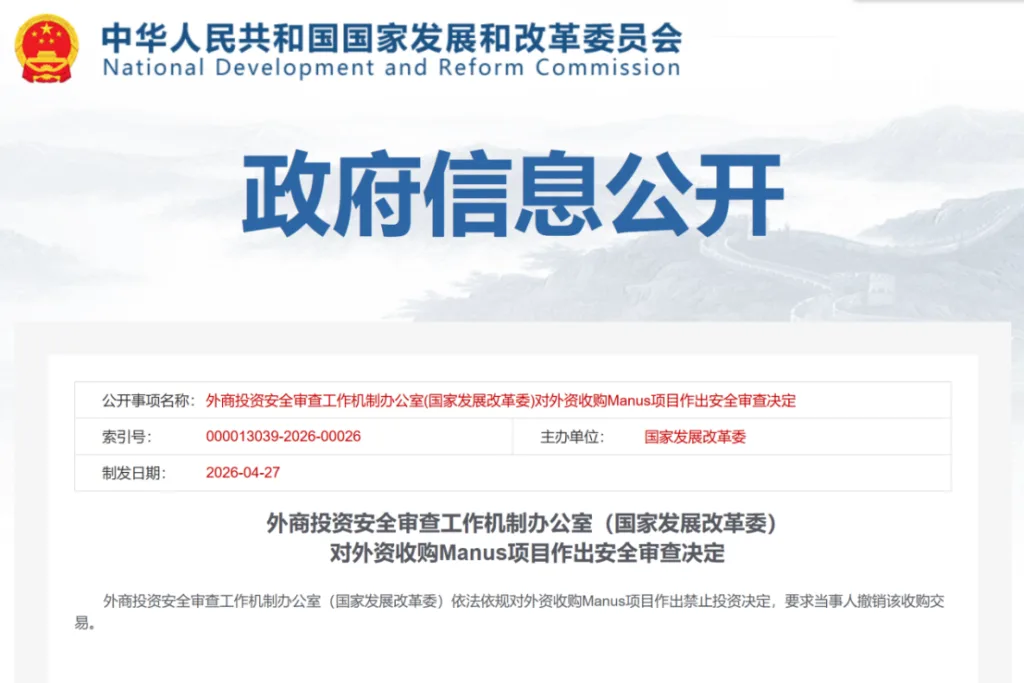
(Source:NDRC)

I. Background

Manus is an AI Agent framework initially researched and developed entirely within mainland China by its Chinese founders and engineering team. Engineered to dynamically call multiple digital tools to execute complex, multi-step tasks, its core technology, early-stage computing power, and training datasets all originated within China. Upon its release, it achieved viral global acclaim, with beta access codes reportedly trading for tens of thousands of RMB on secondary markets. Its parent enterprise, Butterfly Effect, carried out its core research and development across dedicated facilities in Beijing and Wuhan, establishing its primary intellectual assets firmly within Chinese borders.

On December 31, 2025, U.S. technology conglomerate Meta officially announced its acquisition of Manus for a valuation exceeding $2 billion, marking the third-largest M&A transaction in Meta's corporate history. However, this cross-border transaction was rapidly halted by state regulatory intervention.
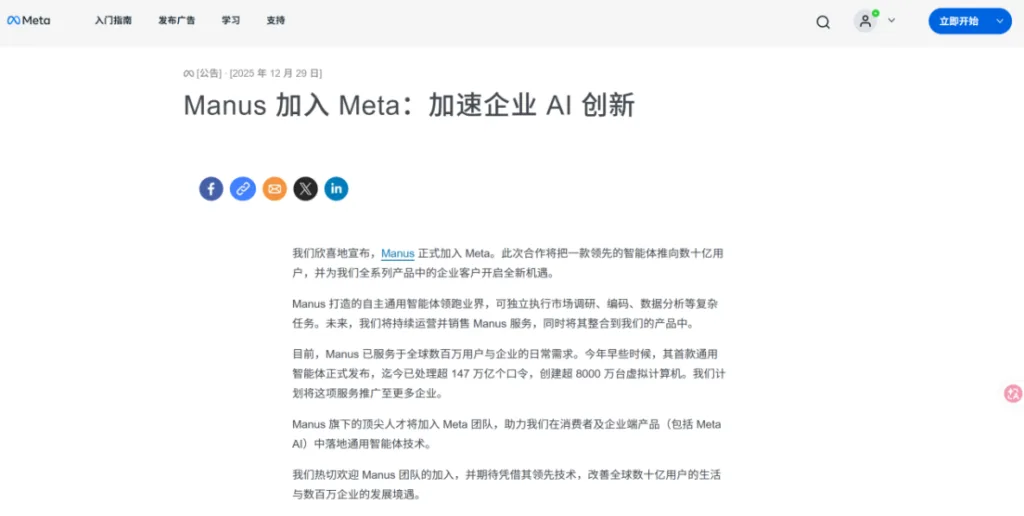
(Source:Meta Announcement)

II. The "De-China" Strategy Executed by Manus

Prior to the finalization of the acquisition, the transaction parties executed an aggressive restructuring strategy designed to sever connections with the Chinese market:

  1. Corporate Redomiciliation: Relocated global headquarters to Singapore, transferring the primary operating entity to a newly incorporated Singapore firm, Butterfly Effect Pte. Ltd.
  2. Talent Migration: Dismantled a substantial portion of the mainland China-based engineering teams and relocated core R&D personnel overseas.
  3. Market Severance: Decommissioned and terminated all product access and services within the mainland China region to physically isolate domestic operational footprints.
  4. Complete Equity Divestment: Structured the post-merger governance framework to retain zero equity, ownership, or voting rights for the original Chinese stakeholders.

(Source:South China Morning Post)

III. Which Legal Red Lines Were Crossed?

How did a transaction that effectively managed to bypass traditional antitrust thresholds and standard foreign M&A triggers end up directly prohibited? While the Meta-Manus deal was structurally engineered to sit below traditional market-share anti-monopoly filing metrics, it was completely blocked under national security review protocols due to the acute risks surrounding core AI technologies and data sovereignty.

Regulators directed their enforcement focus at three substantive compliance failures:

1. Technology Export Control and the "Deemed Export" Doctrine

Because the core algorithms, neural architecture, and foundational code of Manus were engineered inside China by a domestic team, they fall squarely under the regulatory purview of the Catalogue of Technologies Prohibited or Restricted from Export of China. The attempt to transfer these assets via personnel relocation, code sharing, and corporate restructuring was interpreted as a substantive technology export.

This enforcement action highlights a shift toward "piercing the corporate veil" in technology asset oversight. Regulators focused strictly on the timeline, methodology, and nature of the assets being moved rather than where the holding company happened to be incorporated. Under the Export Control Law, the doctrine of "Deemed Export" dictates that even if an entity is legally domiciled in Singapore, providing controlled technology originally developed in China to a foreign entity or citizen constitutes a regulated export event.

2. Illicit Cross-border Data Transfer

The foundational models of Manus were trained utilizing massive datasets extracted from within mainland China. To the extent that these training corpuses contain personal data or protected data categories, transferring the underlying models and technologies to a foreign corporation triggers severe cross-border data transfer violations.

Redomiciling to Singapore does not absolve an enterprise from historical data compliance liabilities. Furthermore, the post-merger routing of data from the Singapore entity to Meta’s infrastructure in the United States established an entirely new cross-border data pipeline requiring mandatory state data security assessments—a protocol the transacting parties failed to execute.

3. Foreign Investment Security Review Intervention

The NDRC ultimately invoked Articles 4, 12, and 19 of the Measures for the Security Review of Foreign Investment. Exercising mandatory review jurisdiction over transactions deemed to impact national security, regulators determined the cross-border acquisition to be a threat to state interests and issued a definitive prohibition order.

( Source:manus.im)

IV. The Jurisdictional Controversy: Substance Over Form

The central legal debate surrounding the Manus case is clear: Does China maintain legal jurisdiction to block a transaction involving an entity that has already shifted its legal registration and physical operations completely outside Chinese borders?

Modern regulatory enforcement demonstrates that state jurisdiction is no longer tethered exclusively to formal corporate registration or the physical location of an executive team. Instead, jurisdiction is asserted based on the technology, talent, and data retaining a substantive nexus to China. Because Manus's early-stage development occurred in China and its core training data was derived from Chinese infrastructure, its technological footprint remains structurally tied to national interests. Legal frameworks including the Measures for the Security Review of Foreign Investment, the Catalogue of Technologies Prohibited or Restricted from Export, and the Foreign Trade Law provide a rock-solid statutory foundation for this jurisdictional reach.
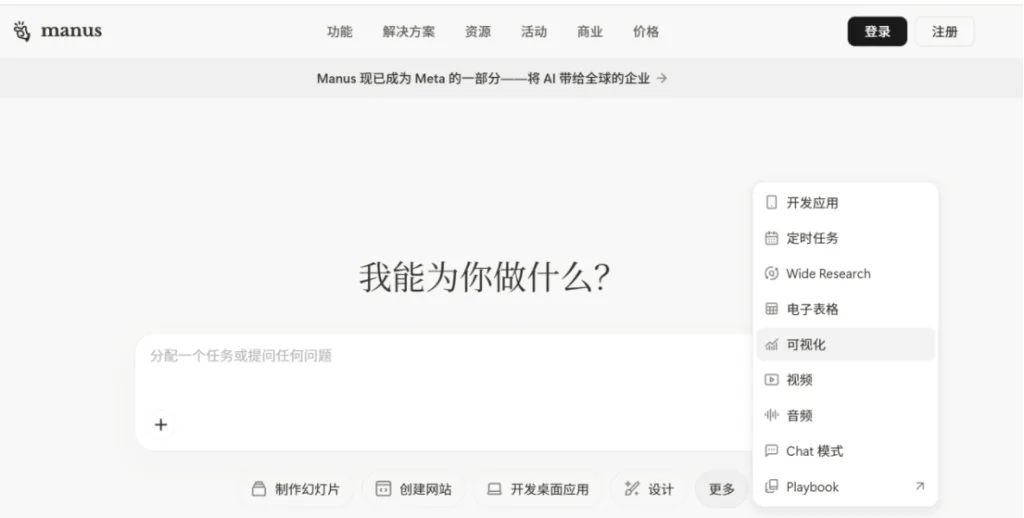
(Source:manus.im)

V. Mandatory "Divestiture of Control" and Functional Rollback

Unlike specialized export control orders or data-specific corrective fines, the "Foreign Investment Security Review" pathway leveraged by the NDRC focuses fundamentally on the absolute divestiture of corporate and operational control. The regulatory toolkit utilized here demands total, structural "functional rollback."

In the context of the Manus ruling, compliance remediation requires an absolute unwinding of the deal's architecture:

  • Legal & Governance Restructuring: Complete rescission of the $200 million+ transaction, full return of financial consideration, and total restoration of the pre-acquisition equity and ownership structure.
  • Severance of Practical Control: Establishing an audited inventory of controlled technical assets to completely sever Meta’s access to core code, model weights, and proprietary R&D datasets. This includes a strict mandate to disable, roll back, or completely re-train any "contaminated" model iterations influenced by Manus's proprietary assets post-acquisition.
  • Personnel Isolation: Imposing strict operational firewalls to prevent the core engineering team from providing any non-public technical assistance or consulting to the foreign acquirer.
  • Independent Technical Audits: Deploying third-party forensic IT auditors to verify that the unwinding is fully executed on a source-code level, neutralizing any grey areas where the transaction is canceled but the technology remains mirrored abroad.

VI. Insights & Compliance Suggestions

The Manus case indicates that regulatory oversight has evolved from monitoring transaction outcomes to scrutinizing operational processes. The physical migration of engineers, the automated synchronization of code repositories, and even remote server access privileges can all be legally classified as substantive technology exports.

1. Implement Stringent Pre-Transaction Assessments

Before executing cross-border investments, joint ventures, or M&A transactions, technology enterprises must implement comprehensive internal risk-screening mechanisms. These processes should explicitly evaluate:

  • Whether proprietary algorithms match technical benchmarks listed in the Catalogue of Technologies Prohibited or Restricted from Export.
  • Whether training data contains protected personal data or important industrial data.
  • Whether the proposed transaction structure could be interpreted as an artificial arrangement designed to circumvent export controls.

2. Re-engineer Transaction Structures around Compliance

Attempting to utilize corporate redomiciliation or talent relocation as a form of "structural camouflage" does not bypass regulatory scrutiny; instead, it demonstrates an intent to evade oversight, which heavily increases regulatory enforcement risks. Compliance must be treated as a foundational element of the deal architecture from day one, rather than an afterthought or a post-closing remediation item.

3. Maintain Continuous and Proactive Regulatory Dialogue

Technology firms operating in highly sensitive sectors should establish open communication channels with competent regulatory bodies. Developing a relationship rooted in transparency and proactively seeking pre-clearance guidance remains the most effective strategy for mitigating cross-border transaction risks.

Conclusion

From the blocked acquisition of Manus to the global rise of domestic open-source architectures like DeepSeek, we are witnessing a profound structural shift toward technology sovereignty. Regulatory authorities are look past superficial corporate facades to scrutinize the foundational mechanics of technology assets: where a project originated, where its data flows, and who exercises ultimate control.

This landmark case serves as a definitive notice that the era of unregulated global expansion for technology firms has ended. We have entered a new era where cross-border compliance must lead the way.

Disclaimer & Copyright: This article is co-authored by Mandy Wu and Yu Yuting. The insights shared are for general compliance trends only and do not constitute formal legal advice.As a specialized cross-border legal institution, Neo-Ark Law Firm provides comprehensive global compliance and rights-protection support for expanding enterprises. For more international legal updates, please visit the Neo-Ark Law Firm Official Websites (https://www.neoarklawyers.com/news).

Recommend
International Divorce in China: A Legal Guide to Jurisdictions and Procedures (Part 1)

Cross-border marriages are becoming increasingly common, but the legal issues involved in divorce are far more complex than ordinary divorces.

  • In which country should I get divorced?
  • Can domestic and overseas property be handled together?
  • If I divorce in China, do I still need to handle it in my country of nationality?

This guide unpacks the core procedural questions of cross-border divorce in China and answers them one by one.

(The cross-border divorce case of Li Yang, founder of "Crazy English", involving a Chinese husband and a foreign wife, under the jurisdiction of a Chinese court. Source: Chinanews.com)

I. Eligibility: Can Your Cross-Border Marriage Be Dissolved in China?

China's cross-border divorce system operates on two entirely independent tracks: Divorce by Litigation (Court Proceedings) and Uncontested Divorce (Registration at the Civil Affairs Bureau). Their jurisdictional thresholds and acceptance criteria are completely separate.

1. Divorce by Litigation: When Do Chinese Courts Have Jurisdiction?

Pursuant to Articles 13–16 of the Interpretation of the Civil Procedure Law, a Chinese court assumes jurisdiction if any of the following scenarios apply:

  • Scenario A: One Party Is a Chinese Citizen and the Other Resides AbroadRegardless of which party files the lawsuit first, the basic-level people's court in the place of domicile or habitual residence of the domestic party has jurisdiction. Under the parallel litigation rule, even if the overseas spouse has already filed a lawsuit in a foreign court, the Chinese court can still accept a separate filing by the domestic party.
  • Scenario B: Both Parties Are Chinese Citizens Residing Abroad
    • Registered marriage in China: If the court of the host country refuses to accept the divorce, it falls under the jurisdiction of the Chinese court where the marriage was concluded or the place of the last domestic residence of either party.
    • Registered marriage abroad: If the foreign host country's court declines the case, it is managed by the court where one party's original registered household (Hukou) or last domestic residence is located.
    • Not permanently settled abroad: If either party files a lawsuit, it falls under the jurisdiction of the court in the place of the original domestic domicile of the plaintiff or defendant before going abroad.
  • Scenario C: One Party Is a Foreign National and the Other Is a Chinese Citizen
    • If the foreign spouse has a habitual residence in China (continuous residence for a full 1 year), the court in the place of the defendant's habitual residence holds jurisdiction.
    • If the foreign spouse has no residence in China, the court in the place of the domicile or habitual residence of the Chinese citizen plaintiff can officially file the case (status litigation brought against an overseas natural person falls under the jurisdiction of the plaintiff's local court).
  • Scenario D: Supplementary Blanket JurisdictionIf the marriage was concluded in China, or the main community property is located within China, or the minor children have lived in China for a long time, these all constitute reasonable connecting points for Chinese courts to claim jurisdiction.

Key Takeaway on Jurisdiction: As long as one party to the marriage is a Chinese citizen, OR the marriage registration place is domestic, OR the children/main assets are within China, a Chinese court can generally accept the divorce lawsuit—unrestricted by the other party's nationality or parallel overseas litigation.

(The cross-border divorce lawsuit initiated by a Singaporean male party, where the court completed the online trial in the online mediation zone for foreign-related civil and commercial disputes. Source: China Peace Grid)

2. Uncontested Divorce: Strict Thresholds for Civil Registration

To bypass court litigation and register a mutual divorce at the Civil Affairs Bureau (under Articles 13-14 of the Regulations on Marriage Registration and Article 47 of the Specifications on Marriage Registration Work), all of the following conditions must be met simultaneously:

  1. Marriage Certificate Origin: The certificate must have been issued by a mainland Chinese marriage registration authority or a Chinese embassy/consulate abroad. If the marriage was registered under a foreign government authority, you cannot use the uncontested registration track in China.
  2. Civil Capacity: Both parties must possess full capacity for civil conduct.
  3. Complete Consensus: Both parties must voluntarily divorce, and have a written divorce agreement that outlines a complete consensus on child custody, domestic and foreign asset division, and all liabilities.
  4. No Proxies Allowed: Both parties must apply in person together; you cannot entrust an agent or attorney to stand in your place.
  5. Cooling-off Period: A mandatory 30-day divorce cooling-off period applies. After this period expires, both parties must appear in person together again to officially apply for and collect the divorce certificate.
3. Tactical Benefits: Why Choose China as Your Divorce Jurisdiction?
  • Advantage 1: Clear and Predictable Legal StandardsCore issues such as the legal grounds for divorce and judicial litigation procedures strictly apply Chinese law, meaning the adjudication standards are stable, transparent, and highly predictable.
  • Advantage 2: Cost-Effective Asset Investigation and EnforcementFor domestic assets (real estate, bank deposits, corporate equity, vehicles), the court can directly subpoena banking records, real estate registries, and commercial archives. Effective civil judgments and mediation sheets can be directly enforced by Chinese courts without navigating complex cross-border judicial assistance. If the vast majority of assets are onshore, domestic litigation is your optimal choice.
  • Advantage 3: Seamless Execution of Child Custody and SupportIf the children study and live in China long-term, domestic courts can verify the living, custody, and education status on the spot. Subsequent modifications—such as adjusting child support, changing visitation rights, or initiating compulsory execution for non-payment—can be filed directly in nearby domestic courts without cross-border litigation.

II. Strategic Choice: Uncontested Registration vs. Court Litigation

1. Uncontested Divorce (By Agreement)

  • The Pros: Fast process, low cost, completely private, and avoids the lengthy cross-border service of legal documents.
  • The Cons: Unavailable if you married abroad, if one party cannot physically return to China, or if there is any lingering disagreement regarding property, children, or debts.

2. Divorce by Litigation (Through the Courts)

If your case does not meet the strict criteria for an uncontested divorce, but satisfies the jurisdictional connecting points listed in Section I, your only path forward is litigation. Divorce by litigation can be initiated unilaterally by one party without the cooperation or consent of the other. As long as the Chinese court has jurisdiction, the court can try the case and render a binding judgment even if the spouse is abroad and fails to respond.

(The Chaoyang District People's Court releases the "White Paper on the Adjudication of Foreign-Related Family Cases". Source: Beijing Court Net)

III. Essential Elements of Cross-Border Divorce Litigation

1. Venue: Which Court Has Jurisdiction to File the Case?

In principle, foreign-related divorce cases are handled by basic-level People’s Courts. The filing location is determined by specific circumstances:

  • Defendant lives in China for a full year: Filed at the basic-level court of the defendant's habitual residence.
  • Defendant has no residence in China: Filed at the basic-level court of the plaintiff's registered household or habitual residence.
  • Both parties live abroad without permanent settlement: Filed at the domestic court where the plaintiff or defendant held their registered household before moving abroad.
2. Governing Law: Which Legal Framework Applies to the Merits?

Court jurisdiction and the application of law (governing law) are two entirely different legal concepts. While a Chinese court uses nationality and residence to determine its right to hear a case, it determines the actual rules of the trial based on the Law of the People's Republic of China on the Application of Laws to Foreign-Related Civil Relations.

The application of law in foreign-related divorces involves complex conflicts between jurisdictions. During litigation, parties must assert their governing law claims based on the exact nature of the dispute (e.g., location of property, actual residence of the children) and provide corresponding foreign legal texts or expert evidence for judicial review.

The mainstream application framework used by domestic courts includes:

  • Divorce Conditions & Procedures: Governed strictly by the law of the forum—Chinese law (Article 27).
  • Community Property & Debt Division: Governed by the law chosen by mutual agreement of the parties. In the absence of an agreement, courts apply the law of the closest connection, such as a common habitual residence, common nationality, or primary asset location (Article 24).
  • Child Custody & Support Disputes: Governed by the principle of "protecting the rights and interests of the weaker party." If there is no common habitual residence, the court prioritizes whichever legal framework—between the habitual residence of one parent or the country of nationality—is more favorable to protecting the minor child’s health, growth, and educational resources (Article 25).
3. Documentation: What Evidence Needs to Be Prepared?
  • Identity Profiles: PRC ID cards for Chinese citizens; Passports for foreign citizens; Travel Permits for Hong Kong, Macao, and Taiwan residents.
  • Marriage Proof: Marriage certificates (Foreign certificates require local notarization, an Apostille or consular legalization, and certified Chinese translations).
  • Grounds for Divorce: Evidence of a breakdown of mutual affection (e.g., separation records, domestic violence reports, proof of infidelity).
  • Assets & Liabilities: Bank statements, property deeds, vehicle registries, and corporate equity certificates.
  • Note: Official lawsuit documents can be drafted directly by your appointed legal counsel.
4. Service of Process: Navigating the Main Bottleneck

If a defendant resides outside of China, serving legal documents to them is the most time-consuming phase of cross-border litigation.

  • Hague Service Convention Countries: Service via official convention channels typically takes 2 to 3 months.
  • Non-Convention Countries (e.g., Thailand): Documents must move through formal diplomatic channels, which can stretch the timeline to nearly two years.

(Ai Fukuhara appears at a press conference to announce a settlement with her ex-husband Chiang Hung-chieh. Source: Chinanews.com)

5. Estimated Timeline: How Long to Get a Judgment?
  • Defendant is within China (Normal Service): 3 months under summary procedures; 6 months under ordinary procedures.
  • Defendant is abroad (Hague Service): The overall cycle ranges from 6 to 12 months.
  • Defendant is unreachable (Diplomatic / Public Notice Service): The cycle can take 1 to 2 years. Advance procedural planning is highly recommended.

Conclusion and Next Steps

This article has systematically organized the foundational procedural questions surrounding cross-border divorce: Is a Chinese divorce possible? Should you register or litigate? Which court do you approach? What documents are required, and what is the realistic timeline?

In Part 2 of this guide, we will break down exactly how Chinese courts split onshore versus offshore assets, address cross-border debt liabilities, and outline the precise steps required to have a Chinese divorce decree legally recognized and executed in foreign jurisdictions. Stay tuned.

Disclaimer & Copyright: This article is co-authored by Mandy Wu and Yu Yuting. The insights shared are for general compliance trends only and do not constitute formal legal advice.As a specialized cross-border legal institution, Neo-Ark Law Firm provides comprehensive global compliance and rights-protection support for expanding enterprises. For more international legal updates, please visit the Neo-Ark Law Firm Official Websites (https://www.neoarklawyers.com/news).

2026-06-23

Reviewing Growth, Steering the Future: NEO-ARK Law Firm Successfully Convenes 2026 Mid-Year Senior Partner Meeting

On the morning of June 13, 2026, Guangdong NEO-ARK Law Firm held its mid-year Senior Partner Meeting at the Musi Jia-Hua Hotel in Nankun Mountain. This convening served as both a strategic review of the firm’s performance during the first half of the year and a roadmap for second-half development. In addition to the primary partner deliberations, the meeting featured a special symposium with Senior Advisors and Junior Partners, fostering in-depth discussions on core strategic issues and passing several key management resolutions.

Eighteen senior partners, including Huang Jianqiu, Liu Zhimin, Sun Jianhui, Liu Minghong, Liang Xiaofeng, Pan Wenjing, Huang Ziran, Liu Jun, Lin Jianbo, Chen Meijuan, Peng Youjian, Qin Yongde, Zhang Feijun, Chen Quanjin, Zou Tao, Wang Hao, Tan Huiyi, and Zhang Honghao, attended the meeting.

I. Core Management & Governance Resolutions

The meeting focused on the long-term, standardized development of the firm with the following key outcomes:

  • Risk Management: To fortify the firm’s regulatory compliance and ensure sustainable operations, the partners reviewed and approved a Special Anti-Money Laundering (AML) Management Policy, establishing detailed risk control protocols across the entire legal service lifecycle.
  • Governance Architecture: The firm completed the re-election and expansion of the Supervisory Committee, formally appointing Senior Partners Chen Meijuan and Peng Youjian as Supervisors. This expansion reinforces the "Committee-led Decision Making, Department-led Execution, and Supervisory-led Monitoring" governance framework.
  • Strategic Marketing: Partners approved an upgrade plan for public lead acquisition. The firm will broaden its multi-channel digital advertising strategy and integrate AI-powered tools to optimize brand exposure and lead conversion pipelines.
  • Party Building Commitment: The firm决议 (resolved) to allocate a special annual budget to establish a Party Branch Development Fund, ensuring normalized and specialized Party building activities that integrate professional development with corporate social responsibility.

II. Strategic Symposium: Engaging Youth and Senior Advisors

A special closed-door symposium was held featuring Senior Advisors Zeng Fanlong, Lin Weiye, and Fan Liping, alongside Junior Partners Yao Qing, Yang Guoliang, Li Wanjun, Fang Zhilin, and Yu Yuting.

The participants engaged in transparent discussions regarding:

  • Systematic support mechanisms for young lawyers.
  • Enhancing the quality of firm-hosted seminars.
  • Building specialized practice branding.
  • Upgrading global promotional systems.
  • Scaling international business practice groups.

Director Huang Jianqiu addressed each suggestion, committing to the creation of an implementation checklist that transforms member feedback into tangible management optimizations and platform upgrades.

Conclusion

Marking the firm's 15th anniversary, Guangdong NEO-ARK Law Firm remains committed to the bottom line of compliant practice while deep-cultivating specialized legal service segments. The firm is dedicated to building a boutique comprehensive law practice defined by professional depth, governance stability, and broad developmental reach.

3. Operational Guidance for Your Independent Website

  • Strategic Transparency: Positioning your firm's internal governance (such as the new AML policy and the Supervisory Committee expansion) on your website is an excellent way to signal institutional maturity to large-scale international clients and global corporate legal departments.
  • Internal Culture Alignment: Use the names of the participants and partners provided to cross-link to their professional profiles, demonstrating the high density of your legal talent pool.
  • Corporate Call-to-Action (CTA): End this strategic update with a professional call-to-action:"Guided by 15 years of experience and a robust governance framework. Explore how NEO-ARK Law Firm delivers precision and stability for your corporate legal needs."

Disclaimer & Copyright: This article is co-authored by Mandy Wu and Yu Yuting. The insights shared are for general compliance trends only and do not constitute formal legal advice.As a specialized cross-border legal institution, Neo-Ark Law Firm provides comprehensive global compliance and rights-protection support for expanding enterprises. For more international legal updates, please visit the Neo-Ark Law Firm Official Websites (https://www.neoarklawyers.com/news).
2026-06-15

Marching Toward the Mountains, Climbing Higher: NEO-ARK Law Firm Successfully Concludes its 2026 Mid-Year Team-Building Retreat

Embracing the theme "Marching Toward the Mountains, Climbing Higher," the entire team of Guangdong NEO-ARK Law Firm gathered at the Musi Jia-Hua Hotel in Nankun Mountain, Huizhou, from June 13 to June 14, 2026. This two-day retreat provided a professional sanctuary for team members to disconnect from the pressures of daily practice, strengthen team synergy through competitive activities, and engage in high-level strategic discussions to catalyze the firm's high-quality development in the coming months.

I. Team Synergy: The Ultimate Frisbee Challenge

On the afternoon of June 13, the NEO-ARK Ultimate Frisbee Tournament commenced. Attorneys and staff demonstrated exceptional collaboration and competitive spirit, focusing on precision in every pass and defensive maneuver—a testament to the cohesive, synergistic spirit characteristic of the NEO-ARK team.

Following the intense competition, the Blue Team secured the championship, with the Orange and Pink Teams finishing in second and third place, respectively.

II. The Gala: Professionalism Meets Cultural Aesthetics

The evening banquet centered on Oriental aesthetic elegance, with all attendees adopting Chinese traditional attire. The event showcased the firm's dual identity: while team members are strictly professional and rigorous in their legal practice, the banquet highlighted the vibrant, refined, and empathetic side of the NEO-ARK legal community.

Key strategic presentations included:

  • Financial Review: Party Branch Secretary Attorney Liu Zhimin provided a concise briefing on the firm's financial status for the first half of the year, utilizing detailed data to review the firm's growth trajectory.
  • Internal Oversight: Deputy Supervisor Attorney Lin Jianbo shared insights on the Supervisory Committee's duties, reviewing the implementation of internal oversight protocols to strengthen the firm's stable and standardized development.
  • Talent Development: Executive Director Attorney Liu Minghong presented on the theme "Let Youth Be Seen," focusing on the cultivation of young legal talent and the firm’s commitment to supporting the next generation of legal professionals.
  • Strategic Summary: Firm Director Attorney Huang Jianqiu concluded with a presentation titled "The Road is Long, But Perseverance Will Lead to Success." He emphasized that "freedom of thought and inclusiveness" remain the firm's core values, and underscored that a strong NEO-ARK requires the collective effort of every member.

Conclusion

The retreat concluded with a series of creative, humorous short videos produced by the firm's own lawyers, highlighting the diverse personalities of the team beyond their professional legal roles. This mid-year retreat served not only as a rejuvenation of body and mind but also as a journey of consensus and growth. Looking forward, the team at Guangdong NEO-ARK Law Firm remains committed to deep cultivation in the legal service market, marching together toward new milestones of high-quality development.

Disclaimer & Copyright: This article is co-authored by Mandy Wu and Yu Yuting. The insights shared are for general compliance trends only and do not constitute formal legal advice.As a specialized cross-border legal institution, Neo-Ark Law Firm provides comprehensive global compliance and rights-protection support for expanding enterprises. For more international legal updates, please visit the Neo-Ark Law Firm Official Websites (https://www.neoarklawyers.com/news).
2026-06-15

Navigating Legal Representation: How Foreign Parties Appoint Chinese Lawyers in the Apostille Convention Era

Whether engaging in cross-border civil and commercial disputes, international investments, intellectual property defense, labor arbitration, or tort claims, foreign parties involved in Chinese proceedings must ensure their legal representation is appointed through valid, enforceable channels. This guide explores the procedural pathways for appointing Chinese counsel, focusing on the simplification afforded by the Apostille Convention.

(Source: CS.MFA.GOV.CN)

I. Pathways for Appointing Chinese Lawyers

1. Foreign Parties Outside China: The Apostille Path

Applicable to the 126 Contracting States under the Convention Abolishing the Requirement of Legalisation for Foreign Public Documents (e.g., U.S., UK, Canada, Japan, Korea, Russia).

  • Step 1: Notarization. The client signs the Power of Attorney (POA) before a local notary public, who verifies the signatory’s identity and authority.
  • Step 2: Obtaining the Apostille. Submit the notarized POA to the competent national authority. For instance, the Secretary of State handles this in U.S. states, while the Singapore Academy of Law (SAL) oversees it in Singapore.
  • Step 3: Domestic Translation. Upon receipt in China, the documentation must be translated and certified by a qualified domestic translation agency. Chinese courts typically reject translations provided by overseas entities.
2. Foreign Parties Outside China: Online Video Verification

For civil and commercial litigation, parties may apply for an Online Video Verification process.

  • Conducted under the supervision of a presiding judge, the party and their attorney record the POA signing via a secure platform (e.g., "People’s Court Online Service").
  • Advantage: This method fully waives the requirement for an Apostille.
  • Scope: Currently reserved for court litigation. International commercial arbitration and non-litigation matters still require standard Apostille or consular notarization.
3. Foreign Parties Within China: Immediate Execution

If the party is physically present in China (including short-term visitors), the process is streamlined:

  • Judicial Witness: Sign the POA directly before the presiding judge and present original passport documentation.
  • Domestic Notarization: Alternatively, visit any local Notary Public Office in China; the resulting document is immediately enforceable domestically.

( Source: CS.MFA.GOV.CN)

II. The Apostille Convention: A "Two-in-One" Framework

Since November 7, 2023, China has implemented the Apostille Convention, the most widely adopted international treaty under the Hague Conference on Private International Law (HCCH).

  • The "Two-in-One" Shift: It consolidates the previously required two-step "Double Authentication" (local Ministry of Foreign Affairs + Chinese Embassy/Consulate) into a single, standardized certificate—the Apostille.

III. Important Compliance & Strategy Notes

  • Exceptions (Vietnam & India):
    • Vietnam: Although Vietnam has deposited its instrument of accession, the Convention officially applies to China-Vietnam document exchanges effective September 11, 2026.
    • India: Due to India’s formal objection regarding China's accession, the Apostille Convention does not apply to China-India exchanges; traditional "Double Authentication" remains mandatory.
  • Document Validity: Many jurisdictions impose a 3–6 month validity window on commercial registration documents (e.g., Business Licenses). Timing your authentication to align with business progress is critical to prevent document expiration.
  • Translation Precision: In the Apostille era, technical accuracy is paramount. A single discrepancy in the translation of legal terminology can lead to judicial rejection of an entire filing at the final stage.

(source:hcch.net)

IV. Official Verification & Resource Links

  • HCCH Authority Lookup: Check competent authorities and fee standards for your specific country.
  • China Consular Service: For information on local procedures in China, visit the Ministry of Foreign Affairs portal.
  • Certificate Authentication Check: Verify the authenticity of an Apostille issued in China.
  • FAQs: Access the official Q&A repository for foreign public document certification.

V. Operational Call-to-Action

"Navigating cross-border litigation or need to authenticate your corporate representation in China? Contact NEO-ARK Law Firm’s Cross-Border Compliance Desk to ensure your documentation meets all judicial requirements."

(source:hcch.net)

Disclaimer & Copyright: This article is co-authored by Mandy Wu and Yu Yuting. The insights shared are for general compliance trends only and do not constitute formal legal advice.As a specialized cross-border legal institution, Neo-Ark Law Firm provides comprehensive global compliance and rights-protection support for expanding enterprises. For more international legal updates, please visit the Neo-Ark Law Firm Official Websites (https://www.neoarklawyers.com/news).
2026-06-11

Scroll to Top

+86 13503030053

BackToTop

Inquiry Inquiry Email Email Tel Tel

Request A Quote

×
Please enable JavaScript in your browser to complete this form.