Skip to content
The regulatory paradigm for artificial intelligence (AI) transactions has fundamentally transformed. On April 27, 2026, a brief yet historic announcement sent shockwaves through the global technology ecosystem: the National Development and Reform Commission (NDRC) issued a definitive prohibition on the foreign acquisition of the Manus project, ordering the immediate rescission and unwinding of the transaction.
Marking the very first publicly blocked foreign acquisition in the AI sector, this enforcement action abruptly terminated a "blockbuster marriage" valued at over $2 billion that had been announced at the end of last year. What specific legal red lines were crossed in this landmark case? More importantly, what urgent compliance warnings does it hold for Chinese technology companies executing international expansion strategies?
Crucially, the NDRC specifically targeted the "foreign acquisition of the Manus Project." The deliberate use of the term "project" rather than "company" indicates that regulators view Manus not merely as a single corporate entity, but as an interconnected "community of interests" woven from core algorithms, technical talent, intellectual property, underlying source code, and global commercial operations.
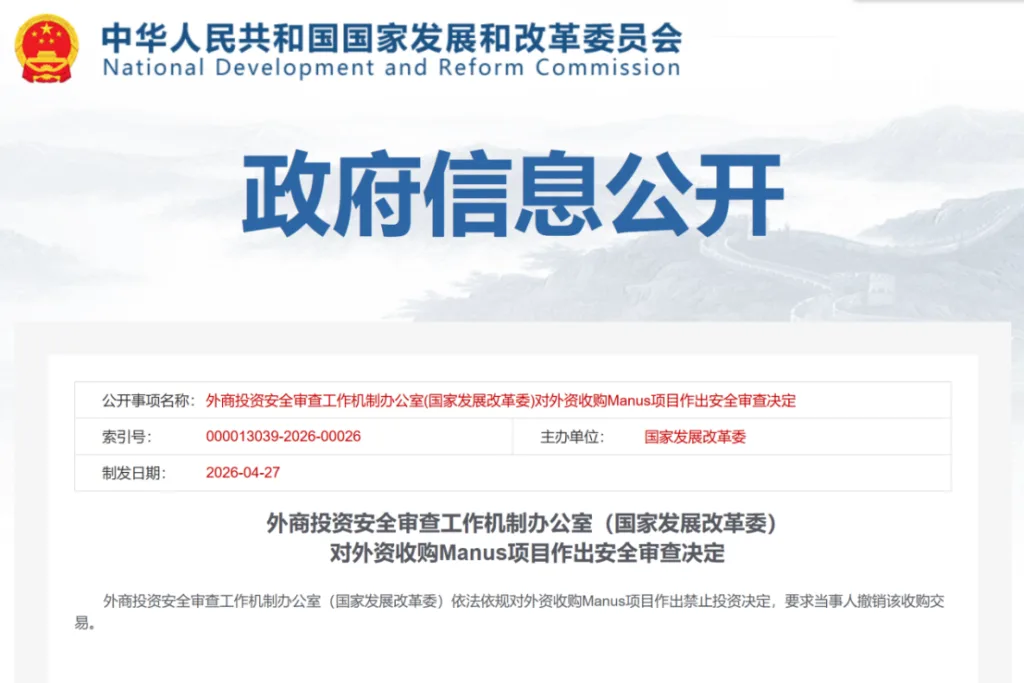
(Source:NDRC)
I. Background
Manus is an AI Agent framework initially researched and developed entirely within mainland China by its Chinese founders and engineering team. Engineered to dynamically call multiple digital tools to execute complex, multi-step tasks, its core technology, early-stage computing power, and training datasets all originated within China. Upon its release, it achieved viral global acclaim, with beta access codes reportedly trading for tens of thousands of RMB on secondary markets. Its parent enterprise, Butterfly Effect, carried out its core research and development across dedicated facilities in Beijing and Wuhan, establishing its primary intellectual assets firmly within Chinese borders.
On December 31, 2025, U.S. technology conglomerate Meta officially announced its acquisition of Manus for a valuation exceeding $2 billion, marking the third-largest M&A transaction in Meta's corporate history. However, this cross-border transaction was rapidly halted by state regulatory intervention.
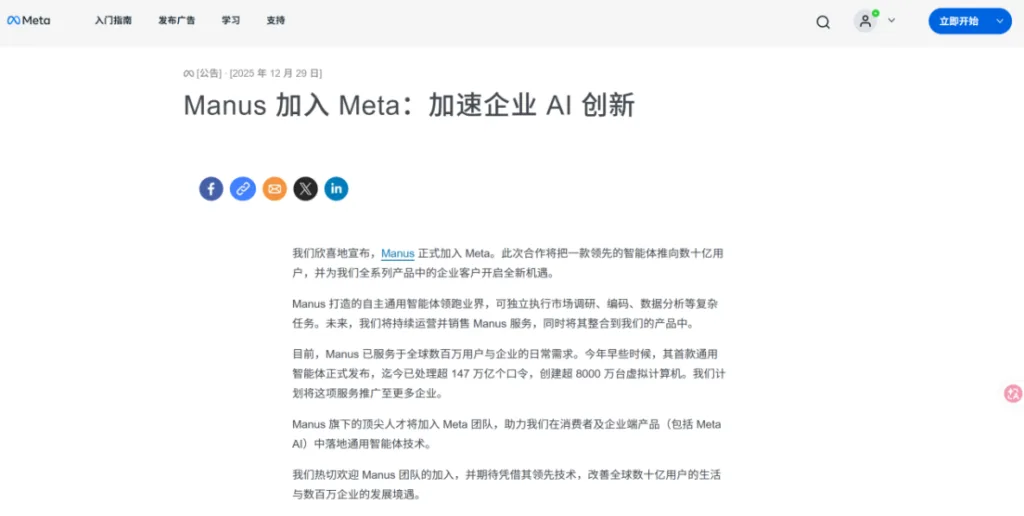
(Source:Meta Announcement)
II. The "De-China" Strategy Executed by Manus
Prior to the finalization of the acquisition, the transaction parties executed an aggressive restructuring strategy designed to sever connections with the Chinese market:
- Corporate Redomiciliation: Relocated global headquarters to Singapore, transferring the primary operating entity to a newly incorporated Singapore firm, Butterfly Effect Pte. Ltd.
- Talent Migration: Dismantled a substantial portion of the mainland China-based engineering teams and relocated core R&D personnel overseas.
- Market Severance: Decommissioned and terminated all product access and services within the mainland China region to physically isolate domestic operational footprints.
- Complete Equity Divestment: Structured the post-merger governance framework to retain zero equity, ownership, or voting rights for the original Chinese stakeholders.

(Source:South China Morning Post)
III. Which Legal Red Lines Were Crossed?
How did a transaction that effectively managed to bypass traditional antitrust thresholds and standard foreign M&A triggers end up directly prohibited? While the Meta-Manus deal was structurally engineered to sit below traditional market-share anti-monopoly filing metrics, it was completely blocked under national security review protocols due to the acute risks surrounding core AI technologies and data sovereignty.
Regulators directed their enforcement focus at three substantive compliance failures:
1. Technology Export Control and the "Deemed Export" Doctrine
Because the core algorithms, neural architecture, and foundational code of Manus were engineered inside China by a domestic team, they fall squarely under the regulatory purview of the Catalogue of Technologies Prohibited or Restricted from Export of China. The attempt to transfer these assets via personnel relocation, code sharing, and corporate restructuring was interpreted as a substantive technology export.
This enforcement action highlights a shift toward "piercing the corporate veil" in technology asset oversight. Regulators focused strictly on the timeline, methodology, and nature of the assets being moved rather than where the holding company happened to be incorporated. Under the Export Control Law, the doctrine of "Deemed Export" dictates that even if an entity is legally domiciled in Singapore, providing controlled technology originally developed in China to a foreign entity or citizen constitutes a regulated export event.
2. Illicit Cross-border Data Transfer
The foundational models of Manus were trained utilizing massive datasets extracted from within mainland China. To the extent that these training corpuses contain personal data or protected data categories, transferring the underlying models and technologies to a foreign corporation triggers severe cross-border data transfer violations.
Redomiciling to Singapore does not absolve an enterprise from historical data compliance liabilities. Furthermore, the post-merger routing of data from the Singapore entity to Meta’s infrastructure in the United States established an entirely new cross-border data pipeline requiring mandatory state data security assessments—a protocol the transacting parties failed to execute.
3. Foreign Investment Security Review Intervention
The NDRC ultimately invoked Articles 4, 12, and 19 of the Measures for the Security Review of Foreign Investment. Exercising mandatory review jurisdiction over transactions deemed to impact national security, regulators determined the cross-border acquisition to be a threat to state interests and issued a definitive prohibition order.

( Source:manus.im)
IV. The Jurisdictional Controversy: Substance Over Form
The central legal debate surrounding the Manus case is clear: Does China maintain legal jurisdiction to block a transaction involving an entity that has already shifted its legal registration and physical operations completely outside Chinese borders?
Modern regulatory enforcement demonstrates that state jurisdiction is no longer tethered exclusively to formal corporate registration or the physical location of an executive team. Instead, jurisdiction is asserted based on the technology, talent, and data retaining a substantive nexus to China. Because Manus's early-stage development occurred in China and its core training data was derived from Chinese infrastructure, its technological footprint remains structurally tied to national interests. Legal frameworks including the Measures for the Security Review of Foreign Investment, the Catalogue of Technologies Prohibited or Restricted from Export, and the Foreign Trade Law provide a rock-solid statutory foundation for this jurisdictional reach.

(Source:manus.im)
V. Mandatory "Divestiture of Control" and Functional Rollback
Unlike specialized export control orders or data-specific corrective fines, the "Foreign Investment Security Review" pathway leveraged by the NDRC focuses fundamentally on the absolute divestiture of corporate and operational control. The regulatory toolkit utilized here demands total, structural "functional rollback."
In the context of the Manus ruling, compliance remediation requires an absolute unwinding of the deal's architecture:
- Legal & Governance Restructuring: Complete rescission of the $200 million+ transaction, full return of financial consideration, and total restoration of the pre-acquisition equity and ownership structure.
- Severance of Practical Control: Establishing an audited inventory of controlled technical assets to completely sever Meta’s access to core code, model weights, and proprietary R&D datasets. This includes a strict mandate to disable, roll back, or completely re-train any "contaminated" model iterations influenced by Manus's proprietary assets post-acquisition.
- Personnel Isolation: Imposing strict operational firewalls to prevent the core engineering team from providing any non-public technical assistance or consulting to the foreign acquirer.
- Independent Technical Audits: Deploying third-party forensic IT auditors to verify that the unwinding is fully executed on a source-code level, neutralizing any grey areas where the transaction is canceled but the technology remains mirrored abroad.
VI. Insights & Compliance Suggestions
The Manus case indicates that regulatory oversight has evolved from monitoring transaction outcomes to scrutinizing operational processes. The physical migration of engineers, the automated synchronization of code repositories, and even remote server access privileges can all be legally classified as substantive technology exports.
1. Implement Stringent Pre-Transaction Assessments
Before executing cross-border investments, joint ventures, or M&A transactions, technology enterprises must implement comprehensive internal risk-screening mechanisms. These processes should explicitly evaluate:
- Whether proprietary algorithms match technical benchmarks listed in the Catalogue of Technologies Prohibited or Restricted from Export.
- Whether training data contains protected personal data or important industrial data.
- Whether the proposed transaction structure could be interpreted as an artificial arrangement designed to circumvent export controls.
2. Re-engineer Transaction Structures around Compliance
Attempting to utilize corporate redomiciliation or talent relocation as a form of "structural camouflage" does not bypass regulatory scrutiny; instead, it demonstrates an intent to evade oversight, which heavily increases regulatory enforcement risks. Compliance must be treated as a foundational element of the deal architecture from day one, rather than an afterthought or a post-closing remediation item.
3. Maintain Continuous and Proactive Regulatory Dialogue
Technology firms operating in highly sensitive sectors should establish open communication channels with competent regulatory bodies. Developing a relationship rooted in transparency and proactively seeking pre-clearance guidance remains the most effective strategy for mitigating cross-border transaction risks.
Conclusion
From the blocked acquisition of Manus to the global rise of domestic open-source architectures like DeepSeek, we are witnessing a profound structural shift toward technology sovereignty. Regulatory authorities are look past superficial corporate facades to scrutinize the foundational mechanics of technology assets: where a project originated, where its data flows, and who exercises ultimate control.
This landmark case serves as a definitive notice that the era of unregulated global expansion for technology firms has ended. We have entered a new era where cross-border compliance must lead the way.
Disclaimer & Copyright: This article is co-authored by Mandy Wu and Yu Yuting. The insights shared are for general compliance trends only and do not constitute formal legal advice.As a specialized cross-border legal institution, Neo-Ark Law Firm provides comprehensive global compliance and rights-protection support for expanding enterprises. For more international legal updates, please visit the Neo-Ark Law Firm Official Websites (https://www.neoarklawyers.com/news).