...

News

Monolithic Privacy Fine on General Motors: Strategic Compliance Takeaways for Outbound Smart Vehicle Manufacturers

On May 8, the California Attorney General announced a historic settlement compelling General Motors (GM) to pay a $12.75 million civil penalty. This enforcement action stems from the unauthorized collection and monetization of drivers' behavioral datasets, marking the highest financial penalty issued under the California Consumer Privacy Act (CCPA) since its enactment in 2020.

This case shifts regulatory focus from passive consent checklists to rigorous algorithmic governance, carrying far-reaching implications for global connected vehicle manufacturers.
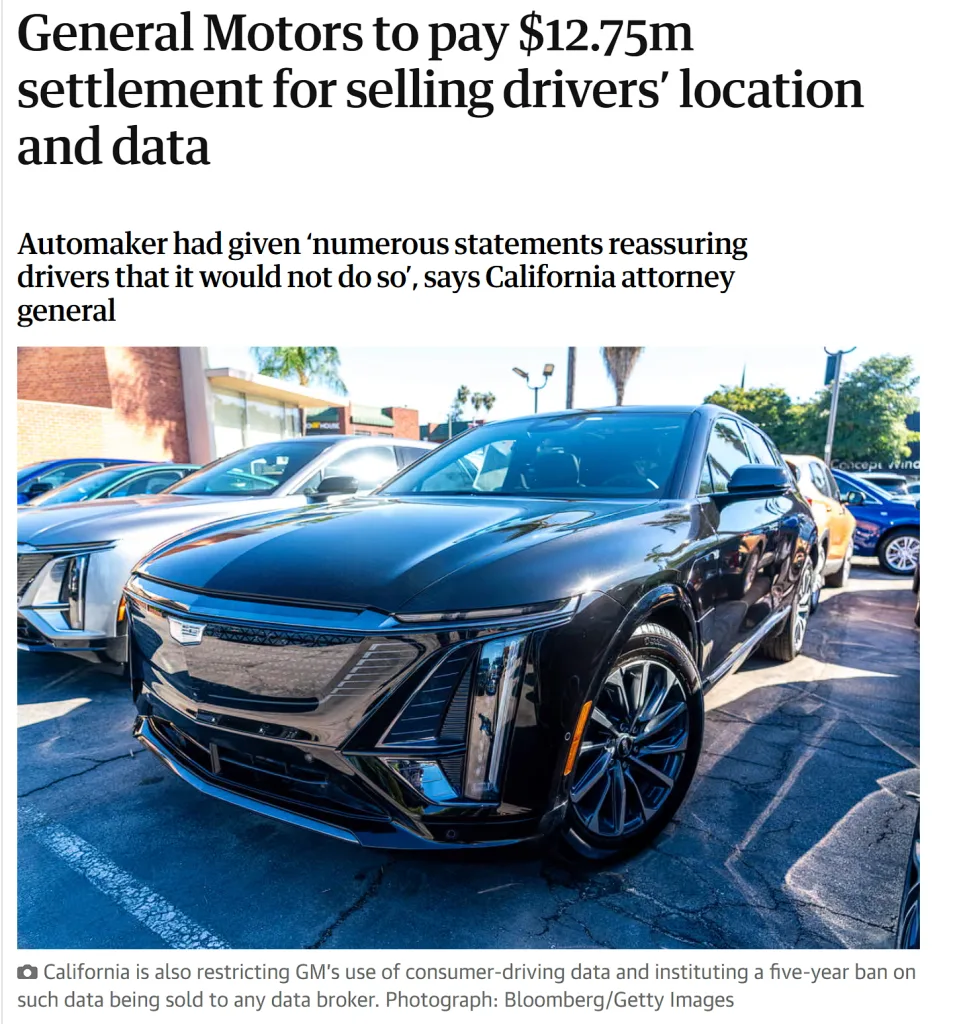
(source:The Guardian)

I. Anatomy of the Breach: Turning Telematics into Commercial Commodities

The data harvested by GM extended far beyond consumer profiles, encompassing driver names, contact directories, real-time precise geolocation logging, and telemetry metrics (including hard-braking events, late-night driving intervals, and speeding patterns).

Through its integrated OnStar emergency roadside and navigation systems, GM surreptitiously compiled and sold the telematics profiles of hundreds of thousands of California motorists between 2020 and 2024. These assets were commercialized through data brokers, specifically Verisk Analytics and LexisNexis Risk Solutions, to generate proprietary driver safety scores which were ultimately acquired by auto insurance underwriters to adjust consumer premium rates. GM generated approximately $20 million in revenue from these transactions.

This data monetization model is widespread across the automotive ecosystem. Investigations reveal that major manufacturers—including Honda, Hyundai, Kia, Ford, Subaru, and Mitsubishi—have leveraged integrated telematics services to monitor and commercialize driving habits, revealing a systemic vulnerability in automotive data governance.

(source:Reuter)

II. Structural Remedies: Remediation and Long-Term Oversight

The settlement goes beyond financial penalties, imposing structural restrictions on GM's data operations:

  1. Five-Year Monetization Ban: A comprehensive prohibition barring GM from transferring, licensing, or selling driving behavioral datasets to consumer reporting bureaus or third-party data brokers.
  2. Mandatory Data Purging: A strict 180-day mandate to delete all historical telemetry files from corporate repositories, alongside a legal obligation to enforce matching data deletion across the downstream data brokers.
  3. Enhanced Transparency Disclosures: Implementation of highly explicit consumer notifications alongside frictionless "opt-out" mechanisms.
  4. Independent Compliance Monitoring: Establishment of an enterprise-wide data privacy verification program subject to recurring audits and direct reporting to the California Attorney General’s Office.

(source:xinlangcaijing)

III. Core Legal Principles Established by the Precedent

1. Prohibition of Deceptive and Coercive User Interactivity (Dark Patterns)

Regulators did not merely check whether a user checked an "I Agree" box. Instead, the investigation scrutinized whether the user interface intentionally obscured the boundary between baseline vehicular functionality (e.g., safety navigation) and optional telemetry tracking.

Under global data privacy standards, if an interactive system architecture makes a consumer believe that refusing telemetry tracking will disable fundamental vehicle features, the interface constitutes a deceptive trade practice.

2. Rejection of Regulatory Provision Proliferation

The volume of a privacy policy does not equal compliance. GM featured structured disclosures, but buried the critical fact that it was selling telemetry data to affect insurance premiums inside highly complex, multi-layered digital text.

Regulators ruled that emphasizing "enhanced security features" while hiding commercial data-sharing agreements with third-party insurance firms constitutes intentional deception.

(source:General Motors)

3. Extra-Territorial Universality of Telemetry Risks

Even within regions lacking unified automotive data regulations, the commercialization of driving telematics is classified as a high-risk operational activity. Telemetry vectors require explicit, standalone user authorization. Cross-border transfers must adhere strictly to the "data minimization" principle, maintaining strict chain-of-custody tracking.

IV. Strategic Action Plan for Outbound Smart Vehicle Enterprises

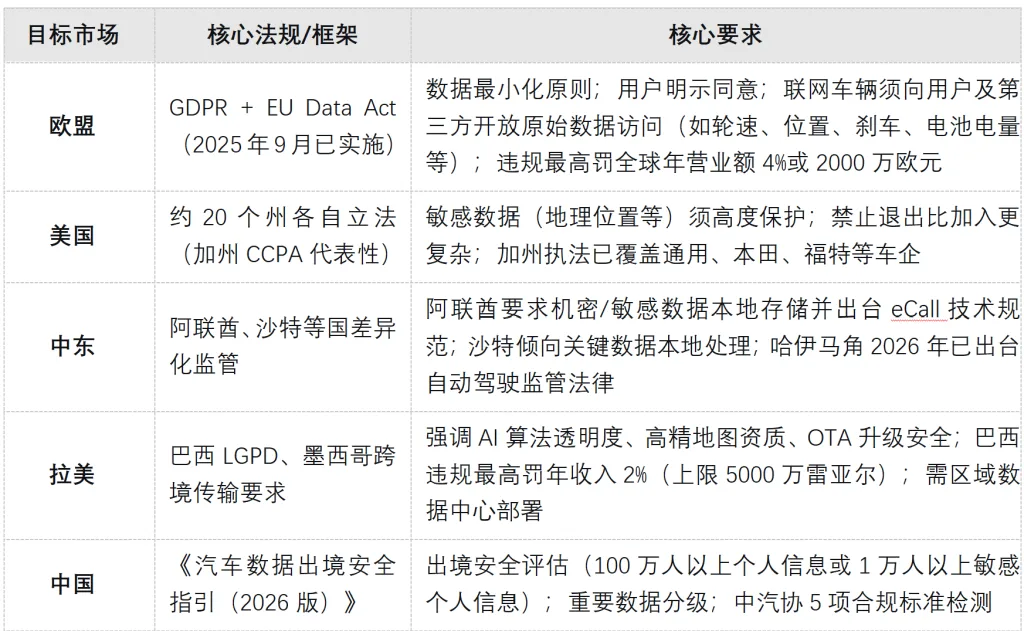
1. Global Market Data Regulatory Architecture Overview

Smart vehicle export volumes are growing rapidly. In 2025, outbound shipments reached 7.098 million vehicles—a 21.1% year-on-year increase—securing a leading position in global automotive exports. By the first quarter of 2026, vehicle exports reached 2.312 million units (up 40.9%), with new energy vehicles (NEVs) accounting for 954,000 units (up 116.3%).

Concurrently, advanced driver-assistance systems (ADAS) have scaled significantly, with Level 2 autonomy penetration exceeding 50% globally, generating immense daily data volumes. The regulatory landscape across primary export jurisdictions is structured as follows:

[Outbound Automotive Data Compliance Framework]
  ├── European Union (GDPR & Data Act) ──► Imposes strict personal sovereignty over vehicle telematics; requires offline-by-default processing.
  ├── United States (CCPA/CPRA & FTC) ──► Enforces heavy penalties for deceptive UI and hidden monetization with insurance underwriters.
  ├── Southeast Asia (PDPA Frameworks) ──► Mandates localized storage architectures and explicit consent gates for cross-border transmission.
  • European Union (GDPR & Data Act Compliance): The EU treats vehicle telemetry (such as spatial paths, brake metrics, and cabin sensor data) as highly protected personal property. The regulatory framework prioritizes consumer data sovereignty, requiring edge-computing or offline-by-default processing wherever technically feasible.
  • United States (Federal Trade Commission & State-Level CCPA/CPRA): Focuses heavily on deceptive corporate trade practices. Regulators systematically penalize companies that use hidden consumer data monetization models, opaque third-party sharing agreements, and convoluted digital user agreements.
  • Southeast Asia (Regional PDPA Frameworks): Jurisdictions are accelerating the deployment of Personal Data Protection Acts (PDPA). These regulations require localized data storage architectures, explicit consent gates for cross-border data routing, and quick, responsive protocols for user data deletion requests.

(source:AE Asia)

2. Institutional Action Items for Automotive Compliance Executives

  • Comprehensive Data Mapping and Classification: Implement a comprehensive cataloging of all internal and external data collection points, including spatial tracking, real-time telemetry, in-cabin imaging, and voice command recordings. Categorize these vectors under local target market definitions (e.g., Personal, Sensitive, Critical, or State-level data assets).
  • De-coupled User Interface Design: Separate consent mechanisms for baseline vehicle functionality from premium connected features. System opt-out configurations must not be mechanically more complex than onboarding sequences. Interfaces must explicitly disclose downstream data transfers to third-party insurance or analytics companies in plain language.
  • Technical Alignment of Data Rights Execution: Build automated, API-driven workflows to execute user data access, correction, and deletion requests. Deactivation configurations must stop data transmission at the firmware and application layers. Regulatory Precedent: In a parallel enforcement case, a platform was fined $2.75 million because its back-end systems continued transmitting tracking telemetry after users disabled front-end tracking cookies.
  • Cross-Border Data Control Systems: Establish secure, audited storage architectures for localized server environments based on the scale and type of data collected. Implement cryptographic auditing mechanisms and maintain activity logs for a minimum rolling duration of 3 years to ensure compliance with cross-border discovery requests.
  • Upstream and Downstream Ecosystem Due Diligence: Conduct routine compliance audits across your entire supply chain, including cloud service providers, autonomous driving system partners, and in-cabin infotainment vendors. Clearly define data ownership, split liability allocations, and establish immediate notification protocols for data breaches within your master service agreements.
Conclusion

The enforcement action in California marks a shift toward proactive structural auditing of connected vehicle ecosystems. As automated driving systems and smart vehicle telematics scale globally, consumer privacy protection is no longer just a peripheral compliance requirement—it is a core pillar of international market viability.

(source:cxtoday)

Disclaimer & Copyright: This article is co-authored by Mandy Wu and Yu Yuting. The insights shared are for general compliance trends only and do not constitute formal legal advice.As a specialized cross-border legal institution, Neo-Ark Law Firm provides comprehensive global compliance and rights-protection support for expanding enterprises. For more international legal updates, please visit the Neo-Ark Law Firm Official Websites (https://www.neoarklawyers.com/news).

Recommend
Brazil Enacts Visa-Free Entry! Turning the "South American Dream" into Reality: Corporate Legal Risks & Cross-Border Solutions

Brazil has officially implemented its visa-free policy for Chinese citizens, structurally accelerating the movement of personnel, capital, and information across the South American continent. As Latin America’s largest economy and home to one of its largest Chinese diaspora communities, Brazil represents an immense strategic frontier.

To maximize the economic dividends of this mobility, this comprehensive legal brief outlines critical compliance guardrails for outbound Chinese investors, dispute resolution frameworks for Brazilian entities in China, and high-growth sectoral opportunities.

(source:xinhua news agency)

I. Inbound to Brazil: Full-Lifecycle Compliance Guide for Chinese Capital

1. Outbound Security: Domestic ODI Approval is Non-Negotiable

Before remitting capital, Chinese enterprises must complete outbound direct investment (ODI) procedures. This requires a sequential three-step process: National Development and Reform Commission (NDRC) filing, Ministry of Commerce (MOFCOM) approval, and State Administration of Foreign Exchange (SAFE) registration. Retroactive registrations are strictly prohibited.

(source:www.gov.cn)

2. Market Entry Strategy: Greenfield Investment vs. M&A

  • Greenfield Investment: Most sectors are fully open to foreign equity, excluding limited restrictions in healthcare, media, insurance, aviation, and nuclear energy. Standard incorporation takes approximately one month, though specialized licenses may extend this timeline.
  • Mergers & Acquisitions (M&A): A faster route to local distribution networks and mature technologies. Key precedents include Oriental Yuhong's RMB 144 million acquisition of a 60% stake in Brazilian cement additives manufacturer Novakem, and Geely’s acquisition of a 26.4% stake in Renault Brazil alongside an RMB 5.1 billion joint venture for localized electric vehicle (EV) manufacturing.
  • Antitrust Notice (CADE Regulation): Mergers must obtain prior regulatory clearance from the Administrative Council for Economic Defense (CADE) if one party’s annual Brazilian revenue equals or exceeds BRL 750 million and the other party's revenue equals or exceeds BRL 75 million.

NEO-ARK Strategic Recommendation: Small and medium-sized enterprises (SMEs) should opt for Greenfield entry to minimize historical liability exposure.

(source:xinhua news agency)

3. High-Risk Operational Domains

  • Labor and Employment Law: Brazil enforces some of the world's most protective labor standards. Even under visa-free entry and in the absence of a written employment contract, the factual provision of labor under managerial oversight establishes a local employment relationship. This triggers mandatory costs including the 13th-month salary, 30 days of paid annual leave, and Severance Indemnity Fund (FGTS) contributions. Personnel staying beyond 90 days must secure a formal work visa; working under a tourist status constitutes illegal employment.
  • Tax Compliance Architecture: Brazil’s tripartite tax regime (Federal, State, and Municipal) is exceptionally complex. Key vulnerabilities include unfamiliarity with the electronic invoicing system, inaccurate customs declarations, permanent establishment (PE) risks for unregistered entities, cross-border data transfer violations, and unregistered foreign exchange movements.
  • Intellectual Property (IP) Defense: Brazil operates under a strict "first-to-file" trademark system. Launching a product prior to trademark registration often results in bad-faith registrations by local distributors or competitors, exposing the investor to infringement counterclaims. Trademark applications should be submitted immediately to the National Institute of Industrial Property (INPI), a process taking 12 to 24 months.

(source:xinhua news agency)

4. Cross-Border Dispute Resolution

Contracts should explicitly specify the governing law and designate preferred arbitration institutions (with a strategic preference for Chinese arbitral bodies for China-based entities). Under the 1993 China-Brazil Treaty on Judicial Assistance in Civil and Commercial Matters, both nations recognize and enforce court judgments and arbitral awards, allowing Chinese judicial rulings to be executed directly in Brazil.

5. Criminal Compliance: Severe Discrepancies in Statutory Thresholds

Brazilian authorities enforce severe criminal penalties for tax, environmental, and intellectual property offenses. Outbound enterprises must closely monitor two distinct operational risks:

  • Anti-Money Laundering (AML) Risks: Avoid any structural or facilitating roles in unauthorized financial routing. In 2026, Brazilian authorities dismantled an e-commerce money-laundering network involving BRL 6 billion, resulting in severe criminal enforcement against the participating entities and executives.
  • Environmental Crimes: Pursuant to the Brazilian Environmental Crimes Act (Law No. 9,605/1998), corporations face direct corporate criminal liability for ecological disruption, carrying severe institutional penalties.

(source:xinhua news agency)

II. Inbound to China: Legal Protections for Brazilian Entities & Citizens

1. Core Litigation Categories in China

Brazilian commercial entities and citizens navigating the Chinese market frequently require legal assistance across the following areas:

  • International Trade Disputes: Resolving payment defaults, supply chain delays, and product quality variances.
  • Corporate Setting & Employment: Structuring foreign-invested enterprises (FIEs) and aligning human resource policies with local labor laws.
  • Intellectual Property Protection: Combating bad-faith trademark registrations and resolving involuntary infringement claims.
  • Criminal Defense & Compliance: Navigating enforcement actions within high-stakes, zero-tolerance areas such as narcotics trafficking, cross-border telecom fraud, anti-money laundering compliance, and illegal employment.

(source:xinhua news agency)

2. Power of Attorney (POA) Verification Protocols

Retaining legal counsel within Mainland China requires formal authentication of the Power of Attorney (POA):

  • Offshore Execution: If the Brazilian client is outside China, the POA must be notarized locally and verified via the Hague Apostille Convention framework to be valid in Chinese courts.
  • Onshore Execution: If the client is physically present in China, they may execute the POA directly before a domestic notary public or perform an in-person verification with the presiding judge.

III. Strategic Growth Sectors: Emerging & Established Verticals

1. Primary Established Sectors

  • New Energy Vehicles (EVs): Chinese manufacturers dominate the local consumer shift. By April 2026, BYD achieved a monthly retail volume of 14,911 vehicles in Brazil, capturing a 12.8% market share and securing the top position in total retail automotive sales.
  • Clean Energy & Infrastructure: The China-Brazil Science and Technology Innovation Center is fully operational. State Grid has commenced construction on major ultra-high-voltage (UHV) DC transmission lines, while manufacturers like JA Solar and Goldwind lead the renewable market.
  • Critical Minerals: Institutional acquisitions are highly active. China Molybdenum (CMOC) completed a USD 1.015 billion acquisition of four operating gold mines in Brazil within a 40-day timeframe, while Chinalco collaborated with Rio Tinto to secure a 68.6% stake in Albras for approximately RMB 6.286 billion.
  • Cross-Border E-Commerce: Shopee leads total order volumes, complemented by the aggressive expansion of SHEIN, Temu, and TikTok Shop as high-growth market entrants.

(source:xinhua news agency)

2. Future Investment Frontiers

  • Bioeconomy & Carbon Credit Trading: Supported by the joint USD 1 billion China-Brazil Sustainable Development Fund targeting green technologies and carbon-neutral initiatives.
  • Fintech & Artificial Intelligence: High prioritization for Information and Communications Technology (ICT), IoT deployment, and integrated fintech infrastructure.
  • Agrotech & Precision Agriculture: Growing market demand for smart agricultural hardware, automated farming systems, and digital transformations across food processing supply chains.

(source:xinhua news agency)

Conclusion

The implementation of bilateral visa-free entry is a structural catalyst for cross-border commerce, but technological and operational mobility must match regulatory compliance. Whether executing an outbound strategy into the South American market or protecting corporate rights within China, navigating localized legal frameworks with expert counsel is essential to safeguarding corporate growth.

Disclaimer & Copyright: This article is co-authored by Mandy Wu and Yu Yuting. The insights shared are for general compliance trends only and do not constitute formal legal advice.As a specialized cross-border legal institution, Neo-Ark Law Firm provides comprehensive global compliance and rights-protection support for expanding enterprises. For more international legal updates, please visit the Neo-Ark Law Firm Official Websites (https://www.neoarklawyers.com/news).
2026-05-19

Can Your AI Chat History Incriminate You? Deep Dive into the US Heppner Case and Privacy Policies of 10 Leading AI Platforms

Can a confidential conversation with an Artificial Intelligence platform be subpoenaed and used to convict you in a court of law? A recent landmark ruling in the United States says yes.

Bradley Heppner, the former CEO of financial firm GWG Holdings, faced multiple federal charges, including conspiracy to commit securities fraud, wire fraud, making false statements to auditors, and falsifying corporate records. Following his indictment, Heppner input extensive, sensitive details of his case into Anthropic's AI assistant, Claude, generating a 31-page document detailing case analyses and prospective defense strategies.

Subsequent to a search warrant executed by the FBI, federal agents seized the AI chat logs directly from Heppner’s personal devices. US prosecutors moved to introduce these records into evidence to verify whether Heppner had concealed assets or information during the investigation.

On February 17, 2026, the U.S. District Court for the Southern District of New York (S.D.N.Y.) issued an official memorandum ruling that these 31 AI chat logs are not protected by attorney-client privilege or the work-product doctrine. Consequently, the prosecution was granted lawful access to introduce them as trial evidence.

I. Judicial Rationale: Why AI Communications Lack Privilege

Heppner’s defense counsel argued that the strategic consultations with Claude constituted privileged legal preparation and should be immune from government scrutiny. The court decisively rejected this argument, ruling that user inputs and AI outputs operate under the same evidentiary standards as a standard search engine log. The court outlined three primary justifications:

  1. Ineligibility of the Entity: Claude is an algorithmic model, not a licensed attorney. Attorney-client privilege is legally predicated on a trusted, qualified relationship between human professionals. Claude's terms of service explicitly disclaim providing formal legal counsel, invalidating any claim of a legally recognized retainer or agency relationship.
  2. Absence of a Reasonable Expectation of Confidentiality: Anthropic’s privacy policy expressly reserves the right to collect user inputs for model training and to disclose data to third parties, including government regulatory and law enforcement bodies. By agreeing to these terms, the user forfeits any "reasonable expectation of privacy" under the law.
  3. Nature of Use: Because the platform explicitly states it does not provide professional legal opinions, Heppner’s interactions were classified as independent pro se research utilizing a digital utility, rather than seeking counsel from a credentialed professional.

(source: U.S. Air Force)

II. Global Regulatory Landscape: Privacy Terms of 10 Major AI Platforms

Under standard cross-border legal frameworks, electronic data is a globally recognized category of statutory evidence. Unlike common-law jurisdictions, many civil-law systems lack a broad application of "attorney-client privilege" exemptions. If a party inputs admissions of guilt, structural corporate vulnerabilities, or operational execution steps into an AI, these logs can be legally collected as electronic evidence and directly leveraged in sentencing.

1. Model Training & Data Opt-Out Policies

  • International Platforms: Across standard consumer tiers (excluding premium enterprise or dedicated API accounts), user inputs are activated for model optimization by default, requiring proactive manual intervention from the user to opt out.
  • Domestic Platforms: Leading providers reserve the structural right to utilize user queries for algorithmic alignment, creating heightened data-discoverability risks during litigation.
PlatformModel Training StatusKey Structural ProvisionThird-Party Disclosure
OpenAI ChatGPTEnabled by defaultFree tier inputs train models; paid tiers allow users to manually turn off "Chat History & Training".Yes
Anthropic ClaudeEnabled by defaultPersonal tier (Free/Pro/Team) data optimizes models; data retention lasts up to 5 years.Yes
Google GeminiEnabled by defaultFree tier inputs are reviewed by human operators; enterprise tiers exclude training data by default.Yes
Microsoft 365 CopilotDisabled (Enterprise Only)Commercial data protection ensures enterprise tenant data is never utilized for public LLM training.Yes (Affiliates)
DeepSeekEnabled by defaultUser inputs, history, and uploaded files are used for fine-tuning; users can opt out via privacy settings.Unspecified
Baichuan (Doubao)Enabled by defaultInputs and operational metadata train models; adjustable via "Privacy and Permissions" dashboard.Partners/Co-processors
Tencent YuanbaoEnabled by defaultInputs optimize models; requires users to manually navigate settings to toggle off optimization.Pursuant to judicial order
Alibaba Tongyi QianwenEnabled by defaultSystem logs and conversational sequences train models; explicit exemptions apply via opt-out clauses.Pursuant to judicial order
Moonshot AI (KIMI)Enabled by defaultCommunications, documents, and rich media train models; users can toggle off features manually.Affiliates & Service Providers
Baidu ERNIE BotEnabled by defaultCollected dialogue data undergoes de-identification and anonymization protocols before system training.Pursuant to judicial order

(source:gov.uscourts.nysd)

2. Mandatory Disclosures Under Criminal Investigations

A comprehensive analysis of the privacy agreements across all ten major international and domestic platforms confirms a uniform compliance standard: Every platform reserves the right to disclose user data to law enforcement, national security, or regulatory agencies without user consent when executing a valid legal order.

  • OpenAI (ChatGPT): Discloses records to comply with subpoenas, search warrants, or court orders, and to investigate potential terms-of-service violations or fraudulent activity. Subject to global regulatory scrutiny, including a May 2026 Office of the Privacy Commissioner of Canada (OPC) joint report finding data practices non-compliant prior to recent platform updates.
  • Anthropic (Claude): Explicitly reserves the right to disclose records to regulatory authorities. This provision served as a foundational basis for the Heppner ruling. Furthermore, its designation under strategic supply chain frameworks exposes it to rigorous data disclosure oversight.
  • Google (Gemini) & Microsoft (Copilot): Both platforms enforce strict compliance procedures requiring disclosure under valid legal processes across consumer and standard enterprise endpoints. Microsoft publishes annual transparency reports documenting government data access volume.
  • Domestic LLMs (DeepSeek, Doubao, Yuanbao, Tongyi Qianwen, KIMI, ERNIE Bot): All operate under explicit statutory exemptions regarding user consent. Under local data security frameworks, platforms are legally mandated to cooperate without user authorization during criminal inquiries, national security threats, public interest exemptions, or asset freezing mandates (e.g., assisting in unfreezing over RMB 4 million in illicitly flagged deposits).

III. Strategic Takeaways for Enterprise Users & Legal Practitioners

  1. Enforce Strict Data Anonymization: Never input personally identifiable information (PII), banking credentials, sensitive trade secrets, or unmasked case details into public AI environments. Manually adjust platform configurations to opt out of data-retention and training programs.
  2. Deploy Enterprise-Grade, Zero-Retention Architectures: For corporate environments handling protected data, bypass consumer models entirely. Utilize enterprise instances or API endpoints that provide contractually guaranteed "Zero Data Retention" (ZDR) and explicitly exclude user inputs from model optimization pools.
  3. Recognize the Risk of Algorithmic Subpoenas: Understand that when case data is processed on an external server, it generates an enduring digital footprint. Under global regulatory compliance exemptions, regulatory and judicial bodies possess the authority to compel platforms to hand over these server-side logs during an active investigation.
  4. Mandate Professional Human Oversight: AI outputs must never be treated as definitive legal or professional authority. As shown in recent California appellate sanctions where an attorney was fined $10,000 for submitting 21 AI-fabricated precedents, all generative material must undergo rigorous verification by qualified counsel prior to formal submission.
  5. Strict Professional Guardrails for Attorneys: Processing client materials through public LLMs can constitute a direct breach of an attorney's professional duty of confidentiality. Counsel must formally advise clients against inputting case details into public models to protect case strategy and isolate liability exposure.

Conclusion

The ruling in the Heppner case does not reshape fundamental evidentiary laws; rather, it applies long-standing doctrines of privilege and privacy to the frontiers of generative technology. As enterprises integrate AI into their operational workflows, maintaining an accurate equilibrium between technological agility and regulatory compliance is paramount. The realization that AI chats can serve as evidence in a prosecution underscores a clear directive: proactive digital risk management remains an indispensable asset.

Disclaimer & Copyright: This article is co-authored by Mandy Wu and Yu Yuting. The insights shared are for general compliance trends only and do not constitute formal legal advice.As a specialized cross-border legal institution, Neo-Ark Law Firm provides comprehensive global compliance and rights-protection support for expanding enterprises. For more international legal updates, please visit the Neo-Ark Law Firm Official Websites (https://www.neoarklawyers.com/news).
2026-05-15

"Sentenced to 3 Years by AI?" Navigating Legal Risks of AI Hallucinations and Platform Liability

China's first effective judicial ruling on reputation infringement caused by Artificial Intelligence (AI) has triggered intense discussion across global tech and legal sectors. Nanjing attorney Li Xiaoliang successfully sued Baidu after its generative AI platform fabricated a response stating he had been "sentenced to three years in prison," complete with an incorrectly matched photograph.

Baidu’s defense—arguing that "AI hallucinations are inherently uncertain, technologically neutral, and part of an evolving developmental phase"—was rejected by both trial and appellate courts. The judiciary ruled that generative AI outputs are subject to defamation and tort laws, ordering Baidu to issue a formal written apology. As of May 2026, Baidu has failed to comply, prompting the plaintiff to file for compulsory enforcement.

This landmark case establishes a critical judicial precedent for the boundaries of platform liability regarding algorithmic errors.

(source:Baidu)

I. Decoding "AI Hallucination": The Root Cause

AI hallucination refers to instances where Large Language Models (LLMs) generate content that appears fluent and factually persuasive but is entirely false or unsupported by training data.

Rather than a simple software bug, hallucination is a byproduct of the probabilistic token-prediction mechanism inherent to LLMs. Instead of retrieving verified facts like a traditional search engine, an LLM predicts the next most statistically probable word.

Primary Types of AI Hallucinations:

  • Fact Distortion: Fabricating non-existent events, financial statistics, or legal metrics.
  • Source Fabrication: Inventing fictional citations, academic papers, or legal precedents.
  • Logical Disconnects: Outputting flawed arguments through a superficially coherent reasoning chain.
  • Identity Commingling (Misattribution): Conflating individuals with similar names or backgrounds. (The Li Xiaoliang case fell into this category, as the AI misattributed a non-existent criminal profile to a licensed attorney).

II. Framework of Liability: The Legal Reality of Algorithmic Errors

Under current PRC civil and regulatory frameworks, AI hallucinations do not operate in a legal vacuum.

1. Civil Tort Liability (PRC Civil Code, Article 1024)

The right to reputation is protected irrespective of whether the infringing content was authored by a human or generated by an algorithm. When an LLM outputs defamatory, false information that points to an identifiable individual or entity, it satisfies the criteria for systemic reputation infringement.

2. Administrative Regulatory Duties

Pursuant to the Interim Measures for the Management of Generative Artificial Intelligence Services, service providers must deploy robust measures to improve data quality, ensuring the truthfulness, accuracy, and objectivity of training sets. Platforms must act swiftly upon receiving infringement notices to mitigate liability.

3. Fault-Based Liability Principle

Judicial consensus dictates that generative AI providers are subject to a fault-based liability standard. Fault is determined by evaluating whether the platform had the technical capability and commercial opportunity to prevent the harm but failed to meet industry-standard duty of care.

Judicial Benchmark: In the Li case, the court noted that peer LLMs (such as Doubao and DeepSeek) did not generate the same defamatory error when queried, proving that the defendant failed to meet the baseline compliance standards of the industry.

III. International Precedents: The Proliferation of Fictional Citations

The liabilities surrounding AI hallucinations are escalating globally, particularly within high-stakes professional fields:

  • China (Domestic Commercial Dispute): In 2025, the Tongzhou District People’s Court of Beijing discovered that litigation documents submitted by a plaintiff's counsel contained entirely fictional judicial precedents generated by an LLM (e.g., matching real case serial numbers to completely fabricated facts). The court rejected the briefs and formally sanctioned the attorney.
  • United States (Sanctions for AI Citations): In California, attorney Amir Mostafavi was fined $10,000 by the Court of Appeal after using ChatGPT, Claude, Gemini, and Grok to draft and cross-verify an appellate brief. Despite using multiple models, the final text contained 21 completely fabricated case citations. The court published a formal disciplinary opinion warning the bar against unverified algorithmic reliance.

IV. Strategic Compliance Advice: Rights Protection & Platform Risk Management

For Users & Enterprise Victims of AI Infringement:

  1. Immediate Evidence Preservation: Secure timestamped screen recordings, source codes, and interface captures. Continuous logging over an extended duration is essential to prove the persistence of the infringement.
  2. Formal Cease-and-Desist Notifications: Transmit formal legal letters via official platform channels. A platform’s failure to implement swift takedown or filtration mechanisms upon notice increases its punitive risk exposure.
  3. Targeted Litigation Claims: Litigants may petition for immediate cessation of generation, public retractions, and compensatory damages. Note: Claims for economic compensation must be backed by quantifiable evidence of financial loss or clinical psychological duress.

For AI Platform Developers & Operators:

  1. Data Provenance & Source Auditing: Implement rigorous compliance gates for training datasets, checking for data integrity and intellectual property alignment.
  2. Real-Time Safety & Alignment Filtering: Deploy advanced reinforcement learning (RLHF) and dynamic retrieval-augmented generation (RAG) to cross-check outputs against verified external knowledge bases.
  3. Responsive Takedown Protocols: Build low-friction, rapid-response reporting mechanisms to isolate, modify, or delete infringing parametric weights and generated data strings upon user complaint.

(source:JD Supra)

Conclusion

As generative technologies scale globally, the judiciary is drawing definitive compliance boundaries: commercial platforms cannot harvest the financial benefits of AI traffic while outsourcing the legal liabilities to technology's inherent flaws.

Large language models may experience hallucinations, but legal liability remains an absolute reality.

Disclaimer & Copyright: This article is co-authored by Mandy Wu and Yu Yuting. The insights shared are for general compliance trends only and do not constitute formal legal advice.As a specialized cross-border legal institution, Neo-Ark Law Firm provides comprehensive global compliance and rights-protection support for expanding enterprises. For more international legal updates, please visit the Neo-Ark Law Firm Official Websites (https://www.neoarklawyers.com/news).
2026-05-11

Legal Review of the Sun Yang Case: Was There a Better Path? (Ban Reduced from 8 Years to 4 Years and 3 Months)

In September 2018, three International Doping Tests & Management (IDTM) officials conducted an out-of-competition anti-doping test on elite swimmer Sun Yang. Due to Sun’s team questioning the testers’ professional qualifications, refusing to cooperate, and ultimately destroying sample containers, the case went to the Court of Arbitration for Sport (CAS) for a high-profile retrial. This resulted in a final four-year and three-month suspension for the athlete.

Setting aside public sentiment and media rhetoric, the core professional questions remain: Could Sun Yang’s legal team have executed a superior defense strategy? Could "defects in testing qualifications" serve as a valid absolute defense under international sports law? This article evaluates these issues through the lens of CAS adjudicative logic, the World Anti-Doping Code (WADC), and the International Standard for Testing and Investigations (ISTI), offering critical compliance guidance for athletes moving forward.

(Source:ABC News)

I. Core CAS Logic: Sporting Autonomy and Procedural Precedence

CAS arbitration operates strictly under the principle of sporting autonomy, with the WADC and the ISTI serving as its primary constitutional frameworks. Established CAS jurisprudence dictates that an athlete's objections to testing protocols must be funneled exclusively through compliant, pre-defined legal channels:

  • Conditional acceptance of the test.
  • Formal contemporaneous written objections on the doping control form.
  • Retrospective post-test administrative and legal appeals.

Unless the testing authority is conclusively proven to have committed fundamental, malicious procedural fraud, athletes are strictly barred from executing unilateral, self-help confrontational actions—such as destroying biological samples or physically obstructing collection officers—on the mere suspicion of procedural flaws.

Sun Yang’s legal team anchored their defense on the argument that the blood collection nurse was practicing cross-provincially in violation of Chinese domestic administrative laws. However, the CAS Retrial Panel explicitly applied ISTI Article 5.3.3 and Annex H, which stipulate only that blood sampling officers must hold a valid, internationally recognized qualification and a formal written authorization from the testing agency (IDTM).

The tribunal ruled that territorial practice restrictions under China’s Nurses Regulations represent domestic administrative norms and do not invalidate compliance metrics established under international sports law. This highlights a foundational reality in international sports dispute resolution: domestic statutes cannot override international anti-doping treaty frameworks.

(Source:CCTV NEWS)

II. The Qualification Defense: A Lack of Evidentiary Support

The strategy to treat the nurse's cross-provincial practice as an absolute defense failed primarily due to an insufficient evidentiary foundation before the tribunal. While Sun’s team reported the nurse to local Chinese health authorities, those regulatory bodies never issued an official, binding administrative decision confirming a statutory violation. In international arbitration, if a party invokes a violation of domestic law but cannot produce a final, binding determination from the competent state authority proving that breach, the arbitral tribunal will routinely dismiss the argument. Consequently, this core defense lacked legal traction from the outset.

Furthermore, the CAS Retrial Panel re-verified that the ISTI enforces no specialized medical or professional qualification metrics on a "Chaperone" (or Urinalysis Witness). The international standard requires only that the chaperone be an adult, of the same gender as the athlete, and completely free from identifiable conflicts of interest. Because Sun's defense could not demonstrate actual malice, hostility, or a structural conflict of interest on the part of the chaperone, the witness's primary employment background had no bearing on the validity of the doping control session.

(Source:LawInSport)

III. The Fatal Mistake: Escalating Procedural Objections into Substantive Violations

The catastrophic failure of Sun Yang's defense strategy lay in escalating a legitimate procedural objection into a clear substantive violation of international rules. This breakdown manifested across three distinct operational errors:

  1. Blurs in Legal Boundaries: The defense confused the right to dispute a process with the right to physically terminate it. Legitimate disputes require on-site evidence preservation and formal notation on the DCO's forms, not the destruction of biological samples or security standoffs.
  2. Absence of Specialized Sports Law Protocols: The operational directive issued by the athlete's support staff to "withhold the samples" was an intuitive reaction rooted in domestic administrative enforcement logic, completely ignoring the strict liability rules of international sports arbitration.
  3. Emotional Countermeasures Over Strategic Litigation: By converting procedural frustration into physical non-cooperation, the team forfeited their status as compliant actors, completely shifting the burden of proof against them.

(Source:inewsweek.cn)

IV. Replay of the Better Path: The Optimal Legal Framework

Had the athlete's support team been trained in international anti-doping compliance, they would have executed the following sequence to preserve the athlete's career while fully contesting the test's validity:

1. Conditional Acceptance Strategy

The athlete should have declared on-site: "I formally object to the authorization and specific credentials of this testing team. However, to maintain full compliance and protect sample integrity, I will submit to the collection under protest, provided all samples are sealed, co-signed, and photographed by both parties for the record." This approach aligns with the WADA Guidelines and completely insulates an athlete from triggering a refusal charge.

2. Rigorous Evidence Preservation

The support team should have systematically photographed the DCO’s IDTM authorization letter, the nurse’s practice certificate, and the chaperone’s identification, while recording a clear audio log asking the officers to verify their individual project-specific authorizations.

3. Post-Test Administrative Appeal

Within one hour of the session, the team should have contacted the national anti-doping agency and specialized external counsel to file a formal, written jurisdictional objection with IDTM and the international federation (FINA) within 24 hours. So long as the physical samples remain intact, even if the tribunal later rules the testing session valid, the athlete faces no threat of a violation under WADC Article 2.3 (Evading/Refusing Sample Collection) or WADC Article 2.5 (Tampering with Doping Control).

4. The Critical Prohibition

Under no circumstances should a support team open a sealed sample bottle, smash a biological transport container, or seize documentation from a DCO. The moment physical destruction occurs, Articles 2.3 and 2.5 are automatically triggered, both carrying a mandatory baseline sanction of a 4-year suspension for first-time infractions.

(Source:caixin)

V. Key Takeaways from the Reduced Sanction on Retrial

The reduction of Sun Yang's ban from eight years down to four years and three months during the 2021 retrial stemmed entirely from a reassessment of the athlete's intent. The Retrial Panel concluded that the destruction of the collection containers was not part of a premeditated, long-term strategy to evade drug testing or mask a prohibited substance. Instead, it was an immediate reaction sparked by panic and poor advice from his inner circle regarding the testers' credentials.

While this mitigated the "intent" element of the infraction—thereby avoiding the max penalty—the panel firmly reiterated that an athlete's mistaken belief does not excuse the physical destruction of a sample. The baseline four-year penalty was maintained because the act of destroying the container independently satisfied the statutory definition of tampering. This underscores the absolute rule of anti-doping litigation: protect the sample first, litigate the process second.

This case exposes a systemic vulnerability in the operational readiness of elite sports teams. The support staff (including team doctors and managers) relied on localized instincts regarding "unauthorized enforcement" to issue a directive that directly violated global sports regulations. Elite athlete delegations cannot manage anti-doping interventions based on general common sense; they must undergo mandatory, simulated compliance drills to handle these highly technical procedures.

(Source:WADA)

VI. Compliance Guidance and Conclusion

The precedent set by this case provides three non-negotiable compliance rules for international sports organizations and athletes:

  • The Absolute Structural Boundary: Biological samples must never be compromised or withheld under any circumstances. Physical integrity of the sample is the red line of sports law.
  • Procedural Recourse Execution: Every procedural anomaly must be detailed in writing on the official DCO forms at the time of the test, creating an unassailable contemporaneous paper trail for subsequent litigation.
  • Institutional Legal Integration: National sports associations must embed specialized international sports lawyers directly into their traveling delegations, replacing standard administrative staff with compliance experts trained in WADA regulations.

(Source:WADA)

It is well-recognized within international law that the composition of CAS panels and the interpretive control over WADA statutes can present structural hurdles for non-Western athletes—particularly regarding the strict thresholds required to prove mitigating factors like "psychological panic."

Yet, even within an unforgiving regulatory environment, the legal failures executed by Sun Yang's team were entirely preventable. Acknowledging structural biases in global institutions does not absolve a defense team from executing flawed strategies.

Ultimately, rule consciousness in international sports is about navigating procedural justice, not pursuing immediate substantive alignment. Even if an athlete believes a specific test is fundamentally unfair or improperly authorized, they must first comply and subsequently appeal. The institutional limitations of CAS cannot obscure the basic legal missteps made on the night of the test. Respecting the process and following designated legal pathways is the only way to safeguard an elite career from catastrophic, unforced regulatory errors.

Disclaimer & Copyright: This article is co-authored by Mandy Wu and Yu Yuting. The insights shared are for general compliance trends only and do not constitute formal legal advice.As a specialized cross-border legal institution, Neo-Ark Law Firm provides comprehensive global compliance and rights-protection support for expanding enterprises. For more international legal updates, please visit the Neo-Ark Law Firm Official Websites (https://www.neoarklawyers.com/news).

2026-05-06

Scroll to Top

+86 13503030053

BackToTop

Inquiry Inquiry Email Email Tel Tel

Request A Quote

×
Please enable JavaScript in your browser to complete this form.