...

News

Can Your AI Chat History Incriminate You? Deep Dive into the US Heppner Case and Privacy Policies of 10 Leading AI Platforms

Can a confidential conversation with an Artificial Intelligence platform be subpoenaed and used to convict you in a court of law? A recent landmark ruling in the United States says yes.

Bradley Heppner, the former CEO of financial firm GWG Holdings, faced multiple federal charges, including conspiracy to commit securities fraud, wire fraud, making false statements to auditors, and falsifying corporate records. Following his indictment, Heppner input extensive, sensitive details of his case into Anthropic's AI assistant, Claude, generating a 31-page document detailing case analyses and prospective defense strategies.

Subsequent to a search warrant executed by the FBI, federal agents seized the AI chat logs directly from Heppner’s personal devices. US prosecutors moved to introduce these records into evidence to verify whether Heppner had concealed assets or information during the investigation.

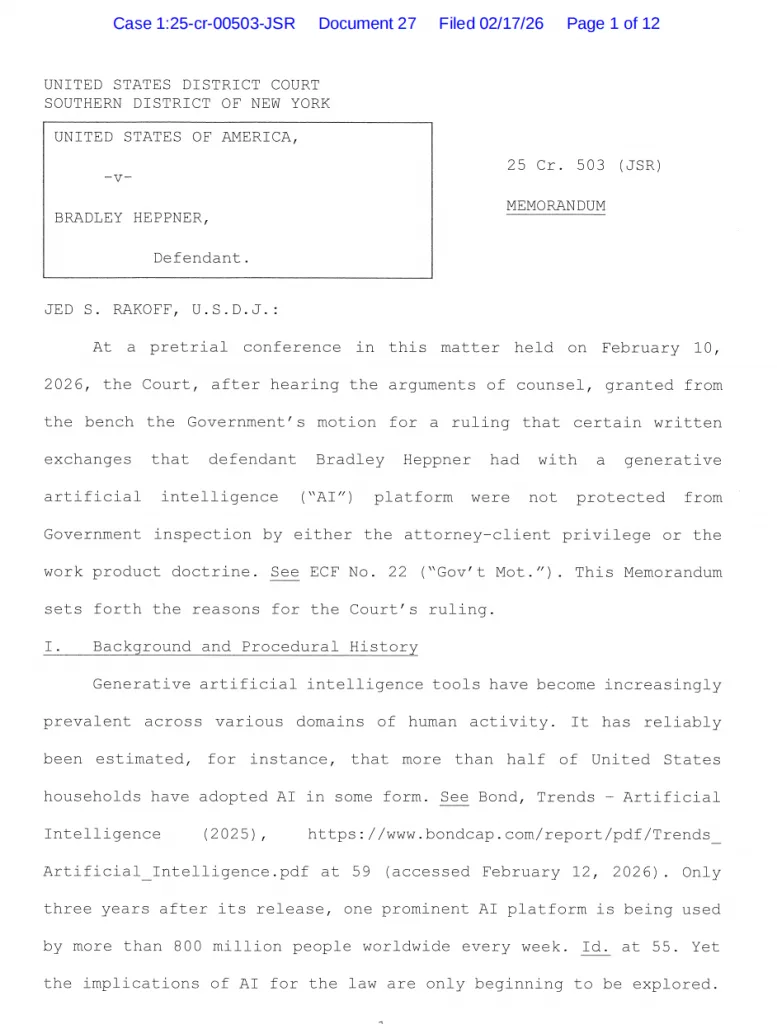
On February 17, 2026, the U.S. District Court for the Southern District of New York (S.D.N.Y.) issued an official memorandum ruling that these 31 AI chat logs are not protected by attorney-client privilege or the work-product doctrine. Consequently, the prosecution was granted lawful access to introduce them as trial evidence.

I. Judicial Rationale: Why AI Communications Lack Privilege

Heppner’s defense counsel argued that the strategic consultations with Claude constituted privileged legal preparation and should be immune from government scrutiny. The court decisively rejected this argument, ruling that user inputs and AI outputs operate under the same evidentiary standards as a standard search engine log. The court outlined three primary justifications:

  1. Ineligibility of the Entity: Claude is an algorithmic model, not a licensed attorney. Attorney-client privilege is legally predicated on a trusted, qualified relationship between human professionals. Claude's terms of service explicitly disclaim providing formal legal counsel, invalidating any claim of a legally recognized retainer or agency relationship.
  2. Absence of a Reasonable Expectation of Confidentiality: Anthropic’s privacy policy expressly reserves the right to collect user inputs for model training and to disclose data to third parties, including government regulatory and law enforcement bodies. By agreeing to these terms, the user forfeits any "reasonable expectation of privacy" under the law.
  3. Nature of Use: Because the platform explicitly states it does not provide professional legal opinions, Heppner’s interactions were classified as independent pro se research utilizing a digital utility, rather than seeking counsel from a credentialed professional.

(source: U.S. Air Force)

II. Global Regulatory Landscape: Privacy Terms of 10 Major AI Platforms

Under standard cross-border legal frameworks, electronic data is a globally recognized category of statutory evidence. Unlike common-law jurisdictions, many civil-law systems lack a broad application of "attorney-client privilege" exemptions. If a party inputs admissions of guilt, structural corporate vulnerabilities, or operational execution steps into an AI, these logs can be legally collected as electronic evidence and directly leveraged in sentencing.

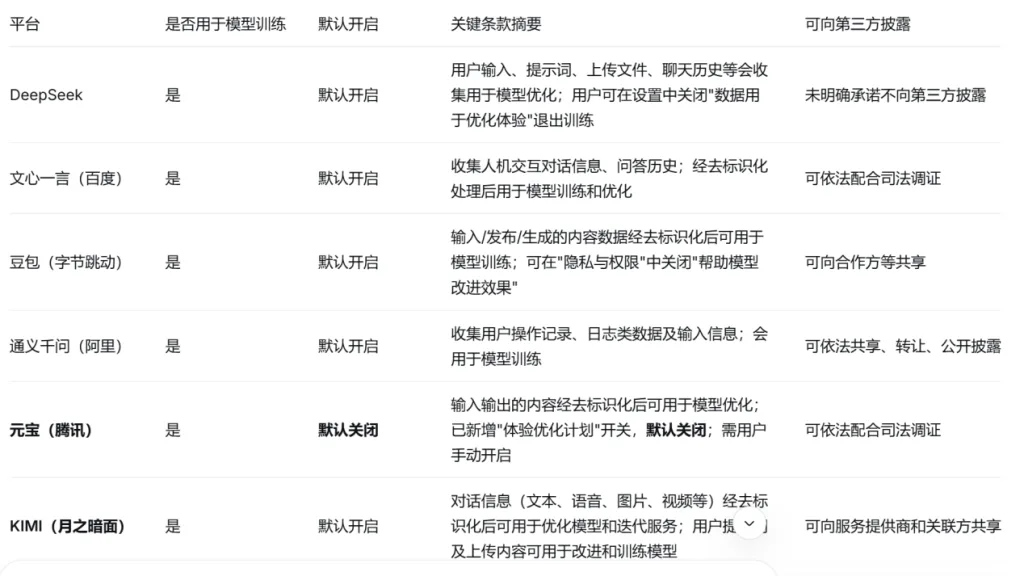
1. Model Training & Data Opt-Out Policies

  • International Platforms: Across standard consumer tiers (excluding premium enterprise or dedicated API accounts), user inputs are activated for model optimization by default, requiring proactive manual intervention from the user to opt out.
  • Domestic Platforms: Leading providers reserve the structural right to utilize user queries for algorithmic alignment, creating heightened data-discoverability risks during litigation.
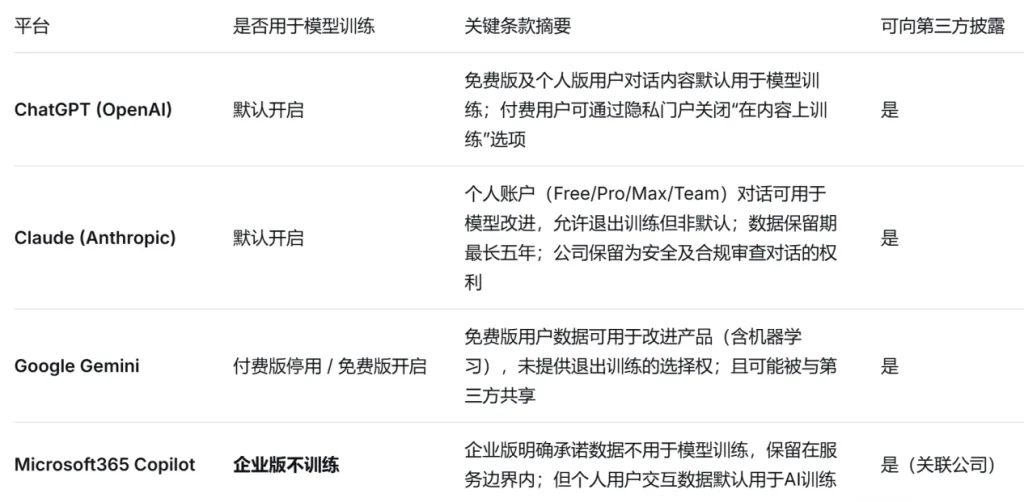
PlatformModel Training StatusKey Structural ProvisionThird-Party Disclosure
OpenAI ChatGPTEnabled by defaultFree tier inputs train models; paid tiers allow users to manually turn off "Chat History & Training".Yes
Anthropic ClaudeEnabled by defaultPersonal tier (Free/Pro/Team) data optimizes models; data retention lasts up to 5 years.Yes
Google GeminiEnabled by defaultFree tier inputs are reviewed by human operators; enterprise tiers exclude training data by default.Yes
Microsoft 365 CopilotDisabled (Enterprise Only)Commercial data protection ensures enterprise tenant data is never utilized for public LLM training.Yes (Affiliates)
DeepSeekEnabled by defaultUser inputs, history, and uploaded files are used for fine-tuning; users can opt out via privacy settings.Unspecified
Baichuan (Doubao)Enabled by defaultInputs and operational metadata train models; adjustable via "Privacy and Permissions" dashboard.Partners/Co-processors
Tencent YuanbaoEnabled by defaultInputs optimize models; requires users to manually navigate settings to toggle off optimization.Pursuant to judicial order
Alibaba Tongyi QianwenEnabled by defaultSystem logs and conversational sequences train models; explicit exemptions apply via opt-out clauses.Pursuant to judicial order
Moonshot AI (KIMI)Enabled by defaultCommunications, documents, and rich media train models; users can toggle off features manually.Affiliates & Service Providers
Baidu ERNIE BotEnabled by defaultCollected dialogue data undergoes de-identification and anonymization protocols before system training.Pursuant to judicial order

(source:gov.uscourts.nysd)

2. Mandatory Disclosures Under Criminal Investigations

A comprehensive analysis of the privacy agreements across all ten major international and domestic platforms confirms a uniform compliance standard: Every platform reserves the right to disclose user data to law enforcement, national security, or regulatory agencies without user consent when executing a valid legal order.

  • OpenAI (ChatGPT): Discloses records to comply with subpoenas, search warrants, or court orders, and to investigate potential terms-of-service violations or fraudulent activity. Subject to global regulatory scrutiny, including a May 2026 Office of the Privacy Commissioner of Canada (OPC) joint report finding data practices non-compliant prior to recent platform updates.
  • Anthropic (Claude): Explicitly reserves the right to disclose records to regulatory authorities. This provision served as a foundational basis for the Heppner ruling. Furthermore, its designation under strategic supply chain frameworks exposes it to rigorous data disclosure oversight.
  • Google (Gemini) & Microsoft (Copilot): Both platforms enforce strict compliance procedures requiring disclosure under valid legal processes across consumer and standard enterprise endpoints. Microsoft publishes annual transparency reports documenting government data access volume.
  • Domestic LLMs (DeepSeek, Doubao, Yuanbao, Tongyi Qianwen, KIMI, ERNIE Bot): All operate under explicit statutory exemptions regarding user consent. Under local data security frameworks, platforms are legally mandated to cooperate without user authorization during criminal inquiries, national security threats, public interest exemptions, or asset freezing mandates (e.g., assisting in unfreezing over RMB 4 million in illicitly flagged deposits).
III. Strategic Takeaways for Enterprise Users & Legal Practitioners

  1. Enforce Strict Data Anonymization: Never input personally identifiable information (PII), banking credentials, sensitive trade secrets, or unmasked case details into public AI environments. Manually adjust platform configurations to opt out of data-retention and training programs.
  2. Deploy Enterprise-Grade, Zero-Retention Architectures: For corporate environments handling protected data, bypass consumer models entirely. Utilize enterprise instances or API endpoints that provide contractually guaranteed "Zero Data Retention" (ZDR) and explicitly exclude user inputs from model optimization pools.
  3. Recognize the Risk of Algorithmic Subpoenas: Understand that when case data is processed on an external server, it generates an enduring digital footprint. Under global regulatory compliance exemptions, regulatory and judicial bodies possess the authority to compel platforms to hand over these server-side logs during an active investigation.
  4. Mandate Professional Human Oversight: AI outputs must never be treated as definitive legal or professional authority. As shown in recent California appellate sanctions where an attorney was fined $10,000 for submitting 21 AI-fabricated precedents, all generative material must undergo rigorous verification by qualified counsel prior to formal submission.
  5. Strict Professional Guardrails for Attorneys: Processing client materials through public LLMs can constitute a direct breach of an attorney's professional duty of confidentiality. Counsel must formally advise clients against inputting case details into public models to protect case strategy and isolate liability exposure.

Conclusion

The ruling in the Heppner case does not reshape fundamental evidentiary laws; rather, it applies long-standing doctrines of privilege and privacy to the frontiers of generative technology. As enterprises integrate AI into their operational workflows, maintaining an accurate equilibrium between technological agility and regulatory compliance is paramount. The realization that AI chats can serve as evidence in a prosecution underscores a clear directive: proactive digital risk management remains an indispensable asset.

Disclaimer & Copyright: This article is co-authored by Mandy Wu and Yu Yuting. The insights shared are for general compliance trends only and do not constitute formal legal advice.As a specialized cross-border legal institution, Neo-Ark Law Firm provides comprehensive global compliance and rights-protection support for expanding enterprises. For more international legal updates, please visit the Neo-Ark Law Firm Official Websites (https://www.neoarklawyers.com/news).

Recommend
Sports Law & Cross-Border Compliance | Will a 5% Transfer Cut Change the Game? Executive Breakdown of FIFA's 2027 RSTP Overhaul

Following a landmark settlement stemming from the European Court of Justice (CJEU) ruling in the Lassana Diarra v. FIFA case, FIFA officially adopted the revised Regulations on the Status and Transfer of Players (2027 RSTP), set for global implementation on January 1, 2027.About Ushttps://www.pinsentmasons.com/out-law/news/fifa-announces-new-player-transfer-regulations-following-diarra-settlement#:~:text=Revamped%20football%20transfer%20rules%20announced%20by%20FIFA,ruling%2C%20they%20did%20not%20go%20far%20enough.

(Lionel Messi and Cape Verde goalkeeper Vozinha competing during the World Cup Round of 32. Source: Xinhua News Agency)

The CJEU determined that FIFA's former transfer restrictions unlawfully impeded the free movement of workers and restricted market competition under EU law. Departing from unilateral rulemaking, FIFA formulated these amendments through collective negotiation via the newly established Global Social Dialogue Platform, alongside FIFPRO, the European Club Association (ECA), and the World Leagues Association (WLA).

This landmark shift marks the evolution of global football governance from unilateral regulatory authority to structured collective bargaining.

(Cristiano Ronaldo and Luka Modrić on the pitch during the World Cup Round of 32. Source: Xinhua News Agency)

I. Scope and Universal Application

  • Regulated Entities: Applies universally to professional football players, professional clubs, national member associations, licensed football agents/intermediaries, and sports dispute resolution bodies (such as the FIFA Football Tribunal and the Court of Arbitration for Sport).
  • Geographic Jurisdiction: Universally binding across all 211 FIFA member associations worldwide.

II. Core Structural Changes: Articles 17–21 Breakdown

1. Standardization of Contract Breach Calculations (Article 17)

Historically, unilateral contract terminations without just cause exposed buying clubs to unpredictable compensation awards and joint liability, discouraging the signing of players in contract disputes. The 2027 RSTP introduces two key structural fixes:

  • Enforceability of Liquidated Damages Clauses: Validates pre-agreed contractual liquidated damages (buyout clauses). When a buying club meets the pre-agreed valuation, the releasing club cannot impose artificial procedural barriers.
  • Standardized Compensation Benchmarks: Establishes predictable compensation floors tied to the residual value of the unfulfilled employment contract, eliminating speculative parameters such as unproven expected commercial revenue. Furthermore, buying clubs face joint financial liability only if proven to have actively induced the breach.
2. Statutory 5% Transfer Fee Equity Cut for Players (Article 21)

For the first time in football history, players hold a statutory right to participate directly in the financial value generated by their transfer fee:

  • Lower-Income Players (Earning under €150,000 / year): Entitled to a non-waivable, mandatory 5% direct cut of the fixed transfer fee received by the releasing club.
  • Higher-Income Players: May partially negotiate or waive their entitlement. However, the net payment received cannot fall below the higher of:
    • (a) The player’s total fixed annual salary during their final contract year; or
    • (b) 2.5% of the total fixed transfer fee.

(Opening ceremony performance at the FIFA World Cup. Source: Xinhua News Agency)

3. 5-Year Professional Contracts for Homegrown Academy Minors (Article 18)

To balance player mobility with academy investment protection, the default 3-year cap on professional contracts for minors under 18 can now be extended up to 5 years, provided:

  • The player has been registered with the club's academy for at least 20 months or two consecutive competitive periods.
  • The contract complies with local minimum wage statutes and respects annual squad allocation limits for long-term youth deals.
4. Tripartite Rulemaking via the Global Social Dialogue Platform

Substantive regulatory modifications regarding transfer frameworks, player welfare, international match calendars, and health standards can no longer be unilaterally enacted by FIFA. Future regulatory changes require formal consensus between FIFA, player unions (FIFPRO), and employer representatives (ECA, WLA) through the Global Social Dialogue Platform.

III. Strategic Legal & Industry Impact

  • Redefining Contractual Nature: Employment agreements transition from restrictive, life-binding lock-ins to redeemable commercial employment contracts with transparent buyout valuations and exit mechanisms.
  • Prohibition of Constructive Dismissal ("Solo Training"): Explicitly classifies squad exclusions, forced reserve-team demotions, or isolated training regimes as material employer breaches. Affected players gain immediate statutory grounds to terminate their contract for just cause and claim full residual compensation.
  • Sophisticated Financial Planning: Cross-border transfer budgets must account for mandatory 5% player distributions, agent commissions, training rewards, and an annualized 8% default interest penalty on late payments, squeezing unearned transfer markups.

IV. Star Player Case Studies Under the 2027 Framework

  • Constructive Breach Protections (The Mbappé Scenario): Unilateral exclusions from pre-season tours or isolated training routines—previously legal gray areas—are now statutory employer breaches. Players can immediately cancel their contract for just cause and claim full remaining salary payments.
  • Standardized Buyout Clauses (The Haaland Model): Pre-agreed buyout clauses, historically limited to elite negotiations, become the global statutory baseline. Acquiring clubs like Real Madrid or Manchester City can secure talent cleanly by meeting clear buyout thresholds without facing prolonged contractual holds.

(From left to right: Lionel Messi, Neymar Jr., Cristiano Ronaldo, Kylian Mbappé, and Erling Haaland. Source: Xinhua News Agency)

Conclusion

The 2027 RSTP represents a fundamental structural overhaul of global football governance. By pairing substantive legal protections with a collaborative social dialogue platform, the new framework establishes a more balanced, legally compliant, and predictable cross-border transfer market.https://www.pinsentmasons.com/out-law/news/fifa-announces-new-player-transfer-regulations-following-diarra-settlement#:~:text=Revamped%20football%20transfer%20rules%20announced%20by%20FIFA,ruling%2C%20they%20did%20not%20go%20far%20enough.

Disclaimer & Copyright: This article is co-authored by lawyer Yu Yuting and Mandy Wu. The insights shared are for general compliance trends only and do not constitute formal legal advice.As a specialized cross-border legal institution, Neo-Ark Law Firm provides comprehensive global compliance and rights-protection support for expanding enterprises. For more international legal updates, please visit the Neo-Ark Law Firm Official Websites (https://www.neoarklawyers.com/news).
2026-07-07

Honors | Multiple NEO-ARK Attorneys Awarded at the Guangzhou Bar Association 2025 Annual Member Awards

The Guangzhou Bar Association officially announced the Decision on Guangzhou Bar Association 2025 Annual Member Awards.

Multiple attorneys from Guangdong NEO-ARK Law Firm received prestigious recognitions across several key categories—including the Theoretical Achievement Award, Social Stability Maintenance Award, Practice Excellence Award, Outstanding Working Committee Member, and Outstanding Special Committee Member—in recognition of their outstanding clinical legal practice, academic research, and contributions to bar organization development.

I. Theoretical Achievement Award

  • Analysis of Practical Dilemmas and Institutional Solutions for Cross-Border Visitation Rights of Minors Between Mainland China and Hong Kong/MacaoAuthors: Attorney Liu Minghong, Attorney Li Wanjun
  • Research on the Digital Estate Manager System in the Guangdong-Hong Kong-Macao Greater Bay AreaAuthor: Attorney Pan Wenjing
  • Legal Conflicts and Judicial Coordination of Cross-Border Wills Between Hong Kong and Mainland ChinaAuthors: Attorney Tang Jingying, Attorney Sun Kaiyang
  • Research on Criminal Jurisdiction Conflicts for Telecom Fraud in the Guangdong-Hong Kong-Macao Greater Bay AreaAuthor: Attorney Xie Guizhen

II. Social Stability Maintenance Award

  • Construction Engineering Contract Dispute CaseAwardees: Attorney Huang Jianqiu, Attorney Yu Yuting

III. Practice Excellence Award

  • Network Tort Liability Dispute CaseAwardee: Attorney Liu Xinyi
  • Medical Cooperation Contract Dispute CaseAwardees: Attorney Sun Jianhui, Attorney Ye Wenya

IV. Working Committee & Special Committee Honors

1. Outstanding Working Committee Member
  • Attorney Chen MeijuanInformatics and Legal Technology Promotion Working Committee
2. Outstanding Special Committee Members
  • Attorney Fang ZhilinDuty-Related Crimes Criminal Law Special Committee
  • Attorney Li WanjunMarriage and Family Law Special Committee

Conclusion

Every award reflects dedication, rigors of practice, and social responsibility. These recognitions highlight our attorneys' sustained commitment to frontline legal practice, cutting-edge theoretical research, bar organization governance, and social service.

NEO-ARK Law Firm remains committed to building practice excellence and social responsibility. The firm will continue encouraging its legal team to deepen expertise in complex legal fields, actively contribute to bar association initiatives, and advance high-quality legal services in the Guangdong-Hong Kong-Macao Greater Bay Area.

Disclaimer & Copyright: This article is co-authored by Mandy Wu and Yu Yuting. The insights shared are for general compliance trends only and do not constitute formal legal advice.As a specialized cross-border legal institution, Neo-Ark Law Firm provides comprehensive global compliance and rights-protection support for expanding enterprises. For more international legal updates, please visit the Neo-Ark Law Firm Official Websites (https://www.neoarklawyers.com/news).
2026-07-02

Aviation & Tech Compliance | The New Civil Aviation Law Takes Effect: Key Rules for Low-Altitude Economy & Drone Operations

The newly amended Civil Aviation Law of the People's Republic of China officially takes effect today. As a comprehensive overhaul of the foundational legal statute that has governed China’s civil aviation sector for three decades, this legislative landmark transitions the low-altitude economy from fragmented regional trial programs into a unified, rule-of-law operational era.

(Source: Civil Aviation Administration of China)

Core Structural Shifts at a Glance:

  • Statutory Airspace Allocation: For the first time, low-altitude economy development is legally integrated into high-level airspace planning and local government infrastructure mandates.
  • Lifecycle Drone Identification: Mandatory airworthiness certifications and unique product identification codes (Product IDs) extend regulatory enforcement upstream to manufacturers.
  • Dynamic Enforcement & Countermeasures: Civil aviation authorities receive expanded enforcement powers, including site inspections, asset seizures, and mandatory anti-drone defense systems near sensitive zones.
  • Data Security & Privacy Safeguards: Explicit restrictions govern data collection, surveillance, and international data transfers during commercial drone operations.

I. Institutional Guarantee for Low-Altitude Airspace Allocation

Previously, low-altitude airspace opening and spatial planning relied primarily on local municipal rules or industry guidance, lacking direct grounding in national statute.

  • Core Statutory Provisions (Articles 74 & 225): The amended law explicitly mandates that airspace classification principles must incorporate the needs of low-altitude economic development. It adds a dedicated "Development Promotion" chapter, establishing legal duties for local governments at or above the county level to plan infrastructure and support industry growth.
  • Legal Impact: The law provides a solid legal foundation for government-led low-altitude infrastructure (such as physical vertiports, eVTOL landing pads, and integrated sensing-and-communication networks), accelerating municipal infrastructure investment and project rollouts.

II. Digital ID Enforcement: Full-Lifecycle Traceability for Unmanned Aircraft

To address public safety concerns surrounding commercial and consumer drones, the regulatory boundary extends directly upstream into aircraft design and manufacturing.

  • Core Statutory Provision (Article 34): Entities engaged in the design, production, import, maintenance, and flight operations of civil unmanned aircraft must obtain airworthiness approval, unless explicitly exempted by law. Furthermore, manufacturers are legally required to assign a standardized, unique product identification code to every aircraft.
  • Legal Impact: Commercial drones enter a fully transparent, lifecycle-monitored regulatory framework. Non-compliant manufacturers using uncertified components or failing safety standards will be phased out. In instances of unauthorized flights ("black flying") or property damage, regulatory agencies can achieve full-chain traceability from the aircraft straight to the registered operator.

(Source: Guangdong Digital Jurisprudence Society)

III. Enforcement Powers & Sensitive Zone Countermeasures

Recognizing the high volume and complex operational scenarios of low-altitude activities, the law equips civil aviation administrative authorities with enhanced enforcement mechanisms.

  • Core Statutory Provisions (Articles 61 & 228): Authorities are granted explicit powers for on-site inspections, data retrieval, asset impoundment, and temporary seizures. Additionally, civil airports are required to delineate designated drone control zones and equip them with detection and anti-drone countermeasure systems.
  • Legal Impact: Compliance for commercial low-altitude operators shifts from a one-time permit to continuous operational logging. Enterprises must maintain verifiable flight logs, real-time telemetry reporting, and audit trails to handle random dynamic inspections.

(source: Civil Aviation Administration of China)

IV. Urban Airspace Operational Restrictions

The law reinforces strict boundaries regarding flight paths over densely populated urban areas.

  • Core Statutory Provision (Article 83): Preserves the strict restriction that civil aircraft shall not fly over urban areas, unless strictly required for takeoff, landing, or designated flight corridors, maintaining altitudes sufficient to exit urban airspace in an emergency without endangering ground safety, or operating under special regulatory approval.
  • Legal Impact: Legislative encouragement of the low-altitude economy does not translate to unregulated urban flights. For enterprises planning urban air logistics or intercity eVTOL passenger transport, core competitiveness depends on maintaining superior safety standards, real-time airspace monitoring, and coordination with local air traffic control to secure special route permits.

(Source: Guangdong Digital Jurisprudence Society)

V. Data Privacy & Cross-Border Data Compliance

As aerial photography, infrastructure inspection, and geographic surveying become widespread, data privacy and national security controls have intensified.

  • Core Statutory Provisions (Articles 230 & 231): While encouraging the use of big data technologies for oversight, civil aviation authorities are legally bound to protect data security. In tandem with the Interim Regulations on the Flight Management of Unmanned Aircraft, the law strictly prohibits illegal data collection, infringement of individual privacy rights, and unauthorized cross-border data transfers.
  • Legal Impact: Enterprises utilizing drones for geographic mapping, industrial inspection, or high-definition surveying must implement strict data residency and access controls. Capturing sensitive geographic data or transferring flight telemetry abroad without security assessments triggers severe administrative and data privacy liabilities.

(Guangdong Digital Jurisprudence Society))

Conclusion

The implementation of the amended Civil Aviation Law reshapes legal predictability across the low-altitude sector, bringing an end to unregulated growth. Future market leaders will be those who seamlessly integrate airworthiness certification, data security protocols, and operational compliance into their core commercial architecture.

(Guangdong Digital Jurisprudence Society))

Disclaimer & Copyright: This article is co-authored by Mandy Wu and Yu Yuting. The insights shared are for general compliance trends only and do not constitute formal legal advice.As a specialized cross-border legal institution, Neo-Ark Law Firm provides comprehensive global compliance and rights-protection support for expanding enterprises. For more international legal updates, please visit the Neo-Ark Law Firm Official Websites (https://www.neoarklawyers.com/news).
2026-07-01

Private Equity Compliance | Reconstructing China's PE Regulatory Framework: Executive Roadmap for State Council Decree No. 54

On June 5, 2026, the General Office of the State Council issued the Guiding Opinions on Strengthening Supervision, Preventing Risks, and Promoting High-Quality Development of Private Equity Investment Funds (State Council Letter [2026] No. 54, hereinafter referred to as "Decree 54").

As the top-level charter governing China's "1+N+X" private equity regulatory framework, Decree 54 marks the end of wild expansion and ushers in an era of stringent, high-quality institutional compliance.

Core Structural Shifts at a Glance:

  • Market Entry Control: Prequalification screening by provincial regulators is now a mandatory prerequisite prior to corporate registration.
  • Mandatory Custody: Mandatory fund custody rules expand significantly, systematically eliminating "self-custody" loopholes.
  • Valuation Adjustment Mechanism (VAM) Governance: Introduces the first-ever top-level regulatory restriction on VAM and Earn-out agreements, cracking down on disguised debt and rigid redemptions.
  • State Capital Scrutiny: Strictly bans county-level governments from establishing redundant new government funds, prohibiting state-owned enterprises (SOEs) from off-spectrum cross-industry investments.

(source:CCTV 13)

I. Regulatory Restructuring: Rebalancing Administrative Enforcement and Self-Regulation

Decree 54 establishes a dual-tier governance system that explicitly segregates administrative enforcement from industry self-regulation:

  • Legacy Model: Heavy reliance on Asset Management Association of China (AMAC) self-regulation, resulting in limited deterrence over unregistered entities.
  • Decree 54 Model: China Securities Regulatory Commission (CSRC) and its regional offices act as administrative gatekeepers for entry checks, investigations, and penalties, supported by AMAC for frontline daily monitoring, filings, and self-disciplinary reviews.

By placing administrative oversight at the forefront, compliance obligations transition from mere industry association rules to binding statutory duties. Continued compliance is now the absolute legal precondition for fund managers to operate in mainland China.

Attorney's Compliance Note:

Existing fund managers should establish a dual-line compliance protocol connecting both the CSRC and AMAC. Shift internal compliance priorities from formality-based initial filing reviews to full-lifecycle ongoing operational control. Fund managers should proactively build audit-response mechanisms for sudden regulatory inquiries and on-site inspections.

(Official release and regulatory bulletin on private equity oversight guidelines issued by the China Securities Regulatory Commission. Source: CSRC)

II. Gatekeeping at Market Entry: Mandatory Joint Prequalification Screening

Under Section II of Decree 54, any entity seeking to register as a private equity fund manager—or planning to include private equity or venture capital terminology in its corporate name or business scope—must complete a joint prequalification screening by the provincial financial regulatory authority and local CSRC office before applying for market regulation registration.

Registration Procedure Framework:

  1. Apply for Joint Prequalification Screening through the Provincial Authority and Local CSRC.
  2. Upon prequalification approval, proceed to Market Regulation Corporate Registration.
  3. Complete official AMAC Fund Manager Registration.
Entity TypeCorporate Name / Scope FeatureTrigger Prequalification?Required Registration Path
Licensed PE/VC ManagerContains "Private Equity", "VCF", etc.Yes (Mandatory)Prequalification Screening -> Corporate Registration -> AMAC Filing
Standard Investment FirmGeneral "Investment Management", "Asset Management"NoStandard Market Regulation Corporate Registration

Attorney's Compliance Note:

Prospective fund managers must factor in an additional 1 to 3 months for prequalification screening. Applications require complete transparency regarding ultimate beneficial owners (UBOs), actual controllers, capital contribution capabilities, and risk control systems.

III. Custody System Upgrade: Full-Coverage Mandatory Custody Execution

Decree 54 mandates the creation of unified, mandatory fund custody regulations across all PE structures. The regulatory threshold for custody exemptions has shrunk considerably:

  • Contractual Securities Funds: Mandatory custody applies across all structures.
  • Partnership & Corporate Securities Funds (Issued post-Aug 2024): Mandatory custody required without exception.
  • PE & VC Funds: Mandatory custody applies to all contractual structures, Special Purpose Vehicle (SPV) investments, and fund expansion products.

Attorney's Compliance Note:

Audit all active non-custodial funds within your portfolio immediately. Distinguish between legally exempted products and non-compliant structures requiring remediation. For newly established funds, embed qualified custodian institutions during the initial structural design phase to establish unambiguous cash-sweep and oversight covenants.

IV. Refining Equity Investments: Dual Regulation of VAM Agreements

For the first time, a State Council policy explicitly mandates the creation of specialized regulatory rules governing Valuation Adjustment Mechanisms (VAM / Earn-out agreements).

Going forward, VAM terms in PE/VC deals will be governed by two independent, parallel legal frameworks:

  1. Civil & Judicial Review: Governed by Supreme People's Court judicial guidelines evaluating corporate law feasibility and capital maintenance principles.
  2. Administrative Regulation (Decree 54): Strictly prohibiting VAMs structured to guarantee returns ("rigid redemption"), disguise debt as equity, or bypass leverage limits.

Attorney's Compliance Note:

Review all existing portfolio VAM provisions and classify them into strategic remediation categories:

  • Maintain: Commercial performance adjustments and legitimate shareholder-level compensation arrangements that comply with capital maintenance.
  • Amend or Excise: Unenforceable target-company buybacks, guaranteed return provisions, and rigid repurchase clauses that risk being recharacterized as illegal debt disguised as equity.

(CSRC Chairman Wu Qing delivering an opening address at the 4th Member Representative Congress of the Asset Management Association of China. Source: CSRC)

V. Tightening State-Owned and Government Fund Participation

Decree 54 imposes strict parameters on state-backed capital commitments:

  1. Government Investment Funds: County and district-level governments are principally prohibited from launching new government investment funds. Exceptions require approval from higher-level municipal or provincial governments. Functional overlaps across funds are eliminated, and disguised debt raising or guaranteed returns are strictly illegal.
  2. State-Owned Enterprise (SOE) Capital: SOE fund investments must align tightly with the enterprise's core operational mandate. SOEs are barred from cross-industry non-core investments, pure conduit operations, and non-compliant real estate funding.

Attorney's Compliance Note:

Shift fundraising priorities toward established provincial and municipal guidance funds. When partnering with SOE capital, conduct formal core business alignment reviews beforehand to ensure all transaction documents are stripped of guaranteed return terms.

VI. Closed-Loop Risk Cleanup & Digital Supervision

Decree 54 institutes a centralized digital monitoring platform that aggregates data across corporate registries, fund filings, bank custody, and judicial records to enable full-scope look-through enforcement:

  • Fund Manager Phase-Out: Entities involved in major illegalities will have their registrations revoked directly. Dormant ("shell"), abnormal, or untraceable managers will face strict time-bound rectification or cancellation.
  • Commercial Entity Phase-Out: Entities holding private equity designations in their business scope without actual operational capacity will have their business licenses revoked by market regulation authorities.

Conclusion & Strategic Action Plan

With the release of Decree 54, detailed departmental rules addressing information disclosure, fundraising, custody, VAM terms, and state capital will be rolled out rapidly. Compliance is no longer an operational cost—it is the foundational license to operate. Fund managers and institutional investors should immediately initiate comprehensive internal compliance audits to navigate this regulatory transition safely.

(Official data presentation from the State Council press conference detailing the implementation metrics and timeline for Decree No. 54. Source: CSRC Press Briefing)

Disclaimer & Copyright: This article is co-authored by Mandy Wu and Yu Yuting. The insights shared are for general compliance trends only and do not constitute formal legal advice.As a specialized cross-border legal institution, Neo-Ark Law Firm provides comprehensive global compliance and rights-protection support for expanding enterprises. For more international legal updates, please visit the Neo-Ark Law Firm Official Websites (https://www.neoarklawyers.com/news).

2026-06-30

Scroll to Top

+86 13503030053

BackToTop

Inquiry Inquiry Email Email Tel Tel

Request A Quote

×
Please enable JavaScript in your browser to complete this form.