Skip to content
China's first effective judicial ruling on reputation infringement caused by Artificial Intelligence (AI) has triggered intense discussion across global tech and legal sectors. Nanjing attorney Li Xiaoliang successfully sued Baidu after its generative AI platform fabricated a response stating he had been "sentenced to three years in prison," complete with an incorrectly matched photograph.
Baidu’s defense—arguing that "AI hallucinations are inherently uncertain, technologically neutral, and part of an evolving developmental phase"—was rejected by both trial and appellate courts. The judiciary ruled that generative AI outputs are subject to defamation and tort laws, ordering Baidu to issue a formal written apology. As of May 2026, Baidu has failed to comply, prompting the plaintiff to file for compulsory enforcement.
This landmark case establishes a critical judicial precedent for the boundaries of platform liability regarding algorithmic errors.
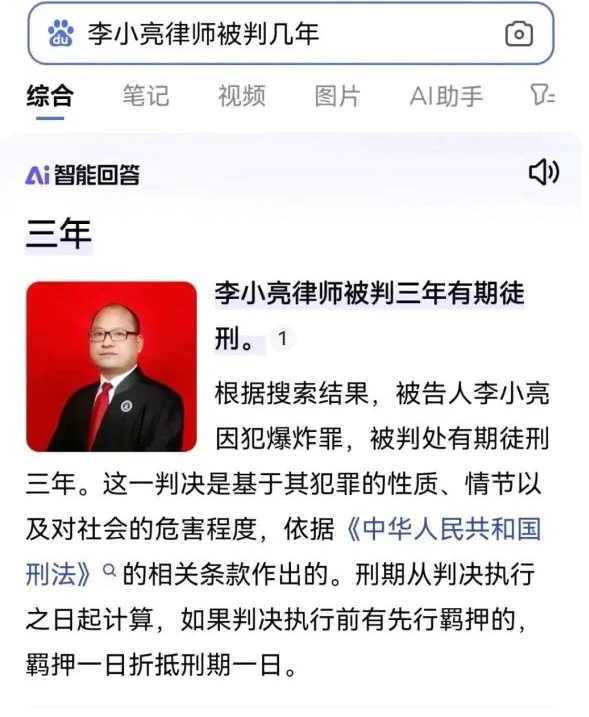
(source:Baidu)
I. Decoding "AI Hallucination": The Root Cause
AI hallucination refers to instances where Large Language Models (LLMs) generate content that appears fluent and factually persuasive but is entirely false or unsupported by training data.
Rather than a simple software bug, hallucination is a byproduct of the probabilistic token-prediction mechanism inherent to LLMs. Instead of retrieving verified facts like a traditional search engine, an LLM predicts the next most statistically probable word.
Primary Types of AI Hallucinations:
- Fact Distortion: Fabricating non-existent events, financial statistics, or legal metrics.
- Source Fabrication: Inventing fictional citations, academic papers, or legal precedents.
- Logical Disconnects: Outputting flawed arguments through a superficially coherent reasoning chain.
- Identity Commingling (Misattribution): Conflating individuals with similar names or backgrounds. (The Li Xiaoliang case fell into this category, as the AI misattributed a non-existent criminal profile to a licensed attorney).
II. Framework of Liability: The Legal Reality of Algorithmic Errors
Under current PRC civil and regulatory frameworks, AI hallucinations do not operate in a legal vacuum.
1. Civil Tort Liability (PRC Civil Code, Article 1024)
The right to reputation is protected irrespective of whether the infringing content was authored by a human or generated by an algorithm. When an LLM outputs defamatory, false information that points to an identifiable individual or entity, it satisfies the criteria for systemic reputation infringement.
2. Administrative Regulatory Duties
Pursuant to the Interim Measures for the Management of Generative Artificial Intelligence Services, service providers must deploy robust measures to improve data quality, ensuring the truthfulness, accuracy, and objectivity of training sets. Platforms must act swiftly upon receiving infringement notices to mitigate liability.
3. Fault-Based Liability Principle
Judicial consensus dictates that generative AI providers are subject to a fault-based liability standard. Fault is determined by evaluating whether the platform had the technical capability and commercial opportunity to prevent the harm but failed to meet industry-standard duty of care.
Judicial Benchmark: In the Li case, the court noted that peer LLMs (such as Doubao and DeepSeek) did not generate the same defamatory error when queried, proving that the defendant failed to meet the baseline compliance standards of the industry.
III. International Precedents: The Proliferation of Fictional Citations
The liabilities surrounding AI hallucinations are escalating globally, particularly within high-stakes professional fields:
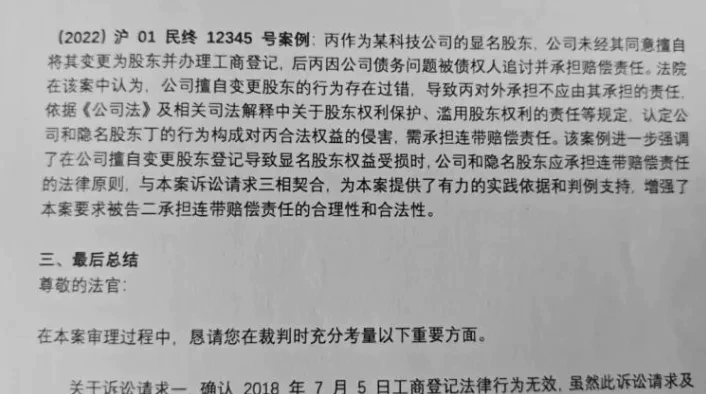
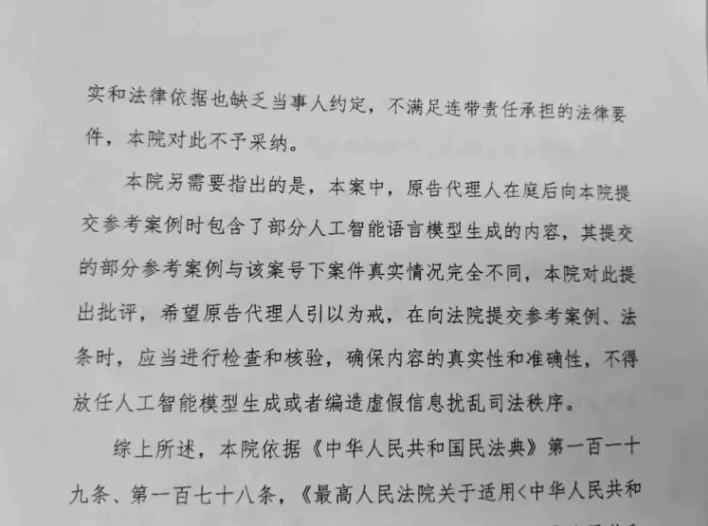
- China (Domestic Commercial Dispute): In 2025, the Tongzhou District People’s Court of Beijing discovered that litigation documents submitted by a plaintiff's counsel contained entirely fictional judicial precedents generated by an LLM (e.g., matching real case serial numbers to completely fabricated facts). The court rejected the briefs and formally sanctioned the attorney.
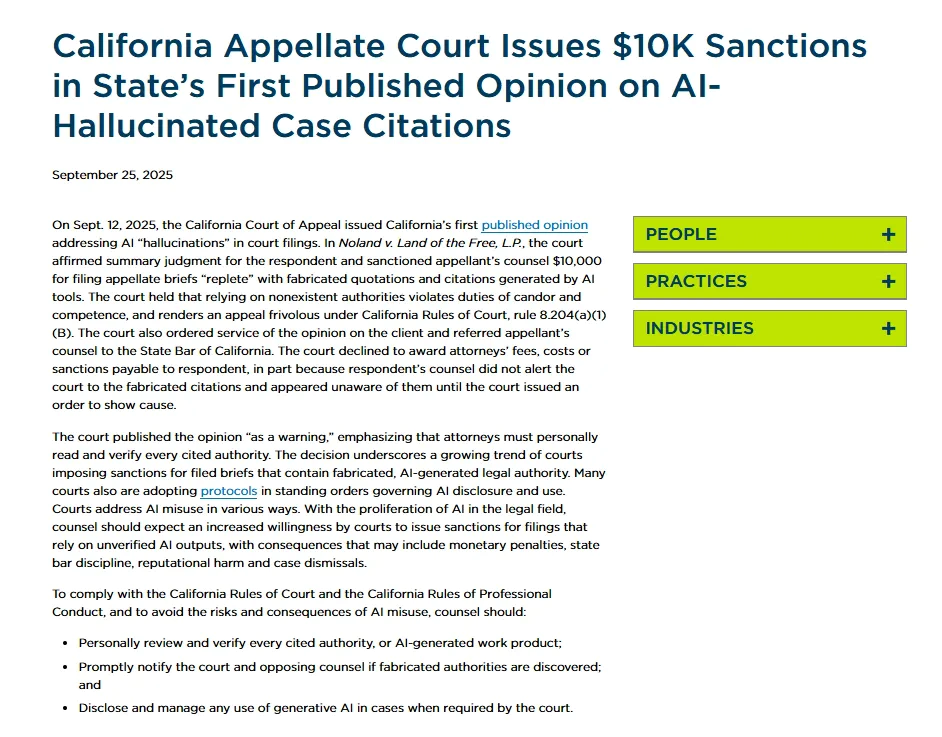
- United States (Sanctions for AI Citations): In California, attorney Amir Mostafavi was fined $10,000 by the Court of Appeal after using ChatGPT, Claude, Gemini, and Grok to draft and cross-verify an appellate brief. Despite using multiple models, the final text contained 21 completely fabricated case citations. The court published a formal disciplinary opinion warning the bar against unverified algorithmic reliance.
IV. Strategic Compliance Advice: Rights Protection & Platform Risk Management
For Users & Enterprise Victims of AI Infringement:
- Immediate Evidence Preservation: Secure timestamped screen recordings, source codes, and interface captures. Continuous logging over an extended duration is essential to prove the persistence of the infringement.
- Formal Cease-and-Desist Notifications: Transmit formal legal letters via official platform channels. A platform’s failure to implement swift takedown or filtration mechanisms upon notice increases its punitive risk exposure.
- Targeted Litigation Claims: Litigants may petition for immediate cessation of generation, public retractions, and compensatory damages. Note: Claims for economic compensation must be backed by quantifiable evidence of financial loss or clinical psychological duress.
For AI Platform Developers & Operators:
- Data Provenance & Source Auditing: Implement rigorous compliance gates for training datasets, checking for data integrity and intellectual property alignment.
- Real-Time Safety & Alignment Filtering: Deploy advanced reinforcement learning (RLHF) and dynamic retrieval-augmented generation (RAG) to cross-check outputs against verified external knowledge bases.
- Responsive Takedown Protocols: Build low-friction, rapid-response reporting mechanisms to isolate, modify, or delete infringing parametric weights and generated data strings upon user complaint.
(source:JD Supra)
Conclusion
As generative technologies scale globally, the judiciary is drawing definitive compliance boundaries: commercial platforms cannot harvest the financial benefits of AI traffic while outsourcing the legal liabilities to technology's inherent flaws.
Large language models may experience hallucinations, but legal liability remains an absolute reality.
Disclaimer & Copyright: This article is co-authored by Mandy Wu and Yu Yuting. The insights shared are for general compliance trends only and do not constitute formal legal advice.As a specialized cross-border legal institution, Neo-Ark Law Firm provides comprehensive global compliance and rights-protection support for expanding enterprises. For more international legal updates, please visit the Neo-Ark Law Firm Official Websites (https://www.neoarklawyers.com/news).