Skip to content
On May 8, the California Attorney General announced a historic settlement compelling General Motors (GM) to pay a $12.75 million civil penalty. This enforcement action stems from the unauthorized collection and monetization of drivers' behavioral datasets, marking the highest financial penalty issued under the California Consumer Privacy Act (CCPA) since its enactment in 2020.
This case shifts regulatory focus from passive consent checklists to rigorous algorithmic governance, carrying far-reaching implications for global connected vehicle manufacturers.
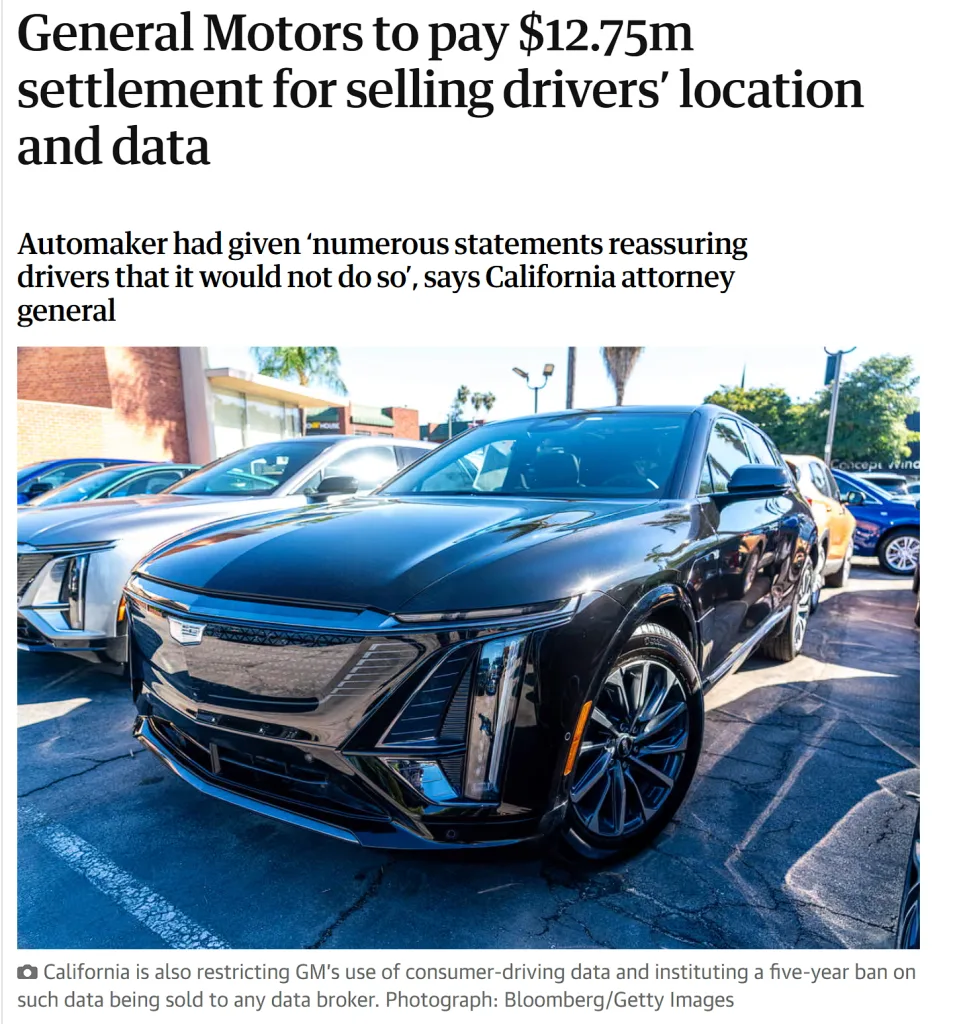
(source:The Guardian)
I. Anatomy of the Breach: Turning Telematics into Commercial Commodities
The data harvested by GM extended far beyond consumer profiles, encompassing driver names, contact directories, real-time precise geolocation logging, and telemetry metrics (including hard-braking events, late-night driving intervals, and speeding patterns).
Through its integrated OnStar emergency roadside and navigation systems, GM surreptitiously compiled and sold the telematics profiles of hundreds of thousands of California motorists between 2020 and 2024. These assets were commercialized through data brokers, specifically Verisk Analytics and LexisNexis Risk Solutions, to generate proprietary driver safety scores which were ultimately acquired by auto insurance underwriters to adjust consumer premium rates. GM generated approximately $20 million in revenue from these transactions.
This data monetization model is widespread across the automotive ecosystem. Investigations reveal that major manufacturers—including Honda, Hyundai, Kia, Ford, Subaru, and Mitsubishi—have leveraged integrated telematics services to monitor and commercialize driving habits, revealing a systemic vulnerability in automotive data governance.

(source:Reuter)
II. Structural Remedies: Remediation and Long-Term Oversight
The settlement goes beyond financial penalties, imposing structural restrictions on GM's data operations:
- Five-Year Monetization Ban: A comprehensive prohibition barring GM from transferring, licensing, or selling driving behavioral datasets to consumer reporting bureaus or third-party data brokers.
- Mandatory Data Purging: A strict 180-day mandate to delete all historical telemetry files from corporate repositories, alongside a legal obligation to enforce matching data deletion across the downstream data brokers.
- Enhanced Transparency Disclosures: Implementation of highly explicit consumer notifications alongside frictionless "opt-out" mechanisms.
- Independent Compliance Monitoring: Establishment of an enterprise-wide data privacy verification program subject to recurring audits and direct reporting to the California Attorney General’s Office.

(source:xinlangcaijing)
III. Core Legal Principles Established by the Precedent
1. Prohibition of Deceptive and Coercive User Interactivity (Dark Patterns)
Regulators did not merely check whether a user checked an "I Agree" box. Instead, the investigation scrutinized whether the user interface intentionally obscured the boundary between baseline vehicular functionality (e.g., safety navigation) and optional telemetry tracking.
Under global data privacy standards, if an interactive system architecture makes a consumer believe that refusing telemetry tracking will disable fundamental vehicle features, the interface constitutes a deceptive trade practice.
2. Rejection of Regulatory Provision Proliferation
The volume of a privacy policy does not equal compliance. GM featured structured disclosures, but buried the critical fact that it was selling telemetry data to affect insurance premiums inside highly complex, multi-layered digital text.
Regulators ruled that emphasizing "enhanced security features" while hiding commercial data-sharing agreements with third-party insurance firms constitutes intentional deception.

(source:General Motors)
3. Extra-Territorial Universality of Telemetry Risks
Even within regions lacking unified automotive data regulations, the commercialization of driving telematics is classified as a high-risk operational activity. Telemetry vectors require explicit, standalone user authorization. Cross-border transfers must adhere strictly to the "data minimization" principle, maintaining strict chain-of-custody tracking.
IV. Strategic Action Plan for Outbound Smart Vehicle Enterprises
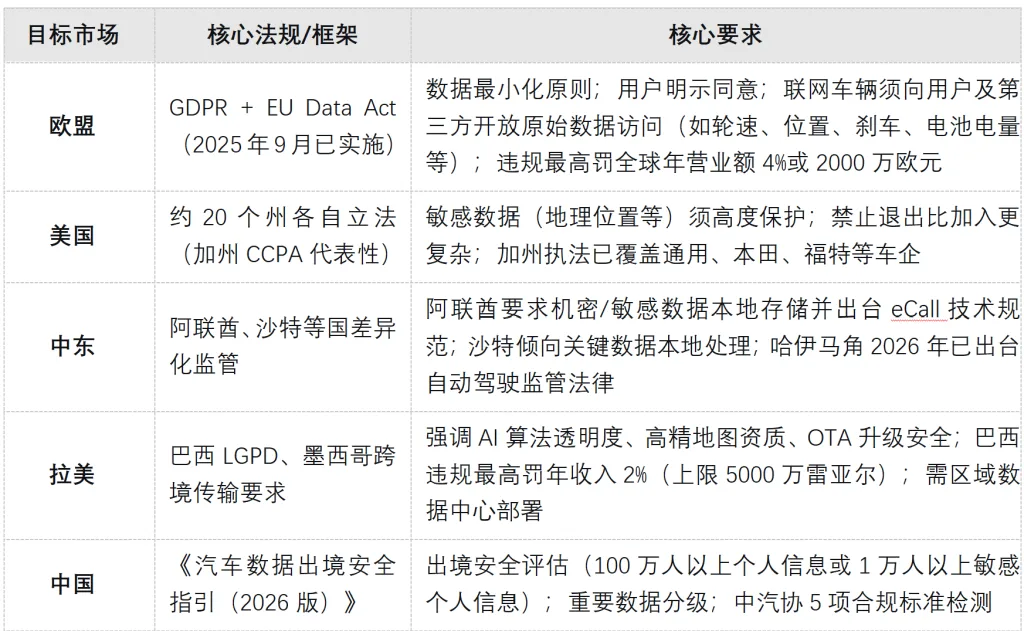
1. Global Market Data Regulatory Architecture Overview
Smart vehicle export volumes are growing rapidly. In 2025, outbound shipments reached 7.098 million vehicles—a 21.1% year-on-year increase—securing a leading position in global automotive exports. By the first quarter of 2026, vehicle exports reached 2.312 million units (up 40.9%), with new energy vehicles (NEVs) accounting for 954,000 units (up 116.3%).
Concurrently, advanced driver-assistance systems (ADAS) have scaled significantly, with Level 2 autonomy penetration exceeding 50% globally, generating immense daily data volumes. The regulatory landscape across primary export jurisdictions is structured as follows:
[Outbound Automotive Data Compliance Framework]
  ├── European Union (GDPR & Data Act) ──► Imposes strict personal sovereignty over vehicle telematics; requires offline-by-default processing.
  ├── United States (CCPA/CPRA & FTC) ──► Enforces heavy penalties for deceptive UI and hidden monetization with insurance underwriters.
  ├── Southeast Asia (PDPA Frameworks) ──► Mandates localized storage architectures and explicit consent gates for cross-border transmission.
- European Union (GDPR & Data Act Compliance): The EU treats vehicle telemetry (such as spatial paths, brake metrics, and cabin sensor data) as highly protected personal property. The regulatory framework prioritizes consumer data sovereignty, requiring edge-computing or offline-by-default processing wherever technically feasible.
- United States (Federal Trade Commission & State-Level CCPA/CPRA): Focuses heavily on deceptive corporate trade practices. Regulators systematically penalize companies that use hidden consumer data monetization models, opaque third-party sharing agreements, and convoluted digital user agreements.
- Southeast Asia (Regional PDPA Frameworks): Jurisdictions are accelerating the deployment of Personal Data Protection Acts (PDPA). These regulations require localized data storage architectures, explicit consent gates for cross-border data routing, and quick, responsive protocols for user data deletion requests.

(source:AE Asia)
2. Institutional Action Items for Automotive Compliance Executives
- Comprehensive Data Mapping and Classification: Implement a comprehensive cataloging of all internal and external data collection points, including spatial tracking, real-time telemetry, in-cabin imaging, and voice command recordings. Categorize these vectors under local target market definitions (e.g., Personal, Sensitive, Critical, or State-level data assets).
- De-coupled User Interface Design: Separate consent mechanisms for baseline vehicle functionality from premium connected features. System opt-out configurations must not be mechanically more complex than onboarding sequences. Interfaces must explicitly disclose downstream data transfers to third-party insurance or analytics companies in plain language.
- Technical Alignment of Data Rights Execution: Build automated, API-driven workflows to execute user data access, correction, and deletion requests. Deactivation configurations must stop data transmission at the firmware and application layers. Regulatory Precedent: In a parallel enforcement case, a platform was fined $2.75 million because its back-end systems continued transmitting tracking telemetry after users disabled front-end tracking cookies.
- Cross-Border Data Control Systems: Establish secure, audited storage architectures for localized server environments based on the scale and type of data collected. Implement cryptographic auditing mechanisms and maintain activity logs for a minimum rolling duration of 3 years to ensure compliance with cross-border discovery requests.
- Upstream and Downstream Ecosystem Due Diligence: Conduct routine compliance audits across your entire supply chain, including cloud service providers, autonomous driving system partners, and in-cabin infotainment vendors. Clearly define data ownership, split liability allocations, and establish immediate notification protocols for data breaches within your master service agreements.
Conclusion
The enforcement action in California marks a shift toward proactive structural auditing of connected vehicle ecosystems. As automated driving systems and smart vehicle telematics scale globally, consumer privacy protection is no longer just a peripheral compliance requirement—it is a core pillar of international market viability.

(source:cxtoday)
Disclaimer & Copyright: This article is co-authored by Mandy Wu and Yu Yuting. The insights shared are for general compliance trends only and do not constitute formal legal advice.As a specialized cross-border legal institution, Neo-Ark Law Firm provides comprehensive global compliance and rights-protection support for expanding enterprises. For more international legal updates, please visit the Neo-Ark Law Firm Official Websites (https://www.neoarklawyers.com/news).