...

News

International Divorce in China: A Legal Guide to Jurisdictions and Procedures (Part 1)

Cross-border marriages are becoming increasingly common, but the legal issues involved in divorce are far more complex than ordinary divorces.

  • In which country should I get divorced?
  • Can domestic and overseas property be handled together?
  • If I divorce in China, do I still need to handle it in my country of nationality?

This guide unpacks the core procedural questions of cross-border divorce in China and answers them one by one.

(The cross-border divorce case of Li Yang, founder of "Crazy English", involving a Chinese husband and a foreign wife, under the jurisdiction of a Chinese court. Source: Chinanews.com)

I. Eligibility: Can Your Cross-Border Marriage Be Dissolved in China?

China's cross-border divorce system operates on two entirely independent tracks: Divorce by Litigation (Court Proceedings) and Uncontested Divorce (Registration at the Civil Affairs Bureau). Their jurisdictional thresholds and acceptance criteria are completely separate.

1. Divorce by Litigation: When Do Chinese Courts Have Jurisdiction?

Pursuant to Articles 13–16 of the Interpretation of the Civil Procedure Law, a Chinese court assumes jurisdiction if any of the following scenarios apply:

  • Scenario A: One Party Is a Chinese Citizen and the Other Resides AbroadRegardless of which party files the lawsuit first, the basic-level people's court in the place of domicile or habitual residence of the domestic party has jurisdiction. Under the parallel litigation rule, even if the overseas spouse has already filed a lawsuit in a foreign court, the Chinese court can still accept a separate filing by the domestic party.
  • Scenario B: Both Parties Are Chinese Citizens Residing Abroad
    • Registered marriage in China: If the court of the host country refuses to accept the divorce, it falls under the jurisdiction of the Chinese court where the marriage was concluded or the place of the last domestic residence of either party.
    • Registered marriage abroad: If the foreign host country's court declines the case, it is managed by the court where one party's original registered household (Hukou) or last domestic residence is located.
    • Not permanently settled abroad: If either party files a lawsuit, it falls under the jurisdiction of the court in the place of the original domestic domicile of the plaintiff or defendant before going abroad.
  • Scenario C: One Party Is a Foreign National and the Other Is a Chinese Citizen
    • If the foreign spouse has a habitual residence in China (continuous residence for a full 1 year), the court in the place of the defendant's habitual residence holds jurisdiction.
    • If the foreign spouse has no residence in China, the court in the place of the domicile or habitual residence of the Chinese citizen plaintiff can officially file the case (status litigation brought against an overseas natural person falls under the jurisdiction of the plaintiff's local court).
  • Scenario D: Supplementary Blanket JurisdictionIf the marriage was concluded in China, or the main community property is located within China, or the minor children have lived in China for a long time, these all constitute reasonable connecting points for Chinese courts to claim jurisdiction.

Key Takeaway on Jurisdiction: As long as one party to the marriage is a Chinese citizen, OR the marriage registration place is domestic, OR the children/main assets are within China, a Chinese court can generally accept the divorce lawsuit—unrestricted by the other party's nationality or parallel overseas litigation.
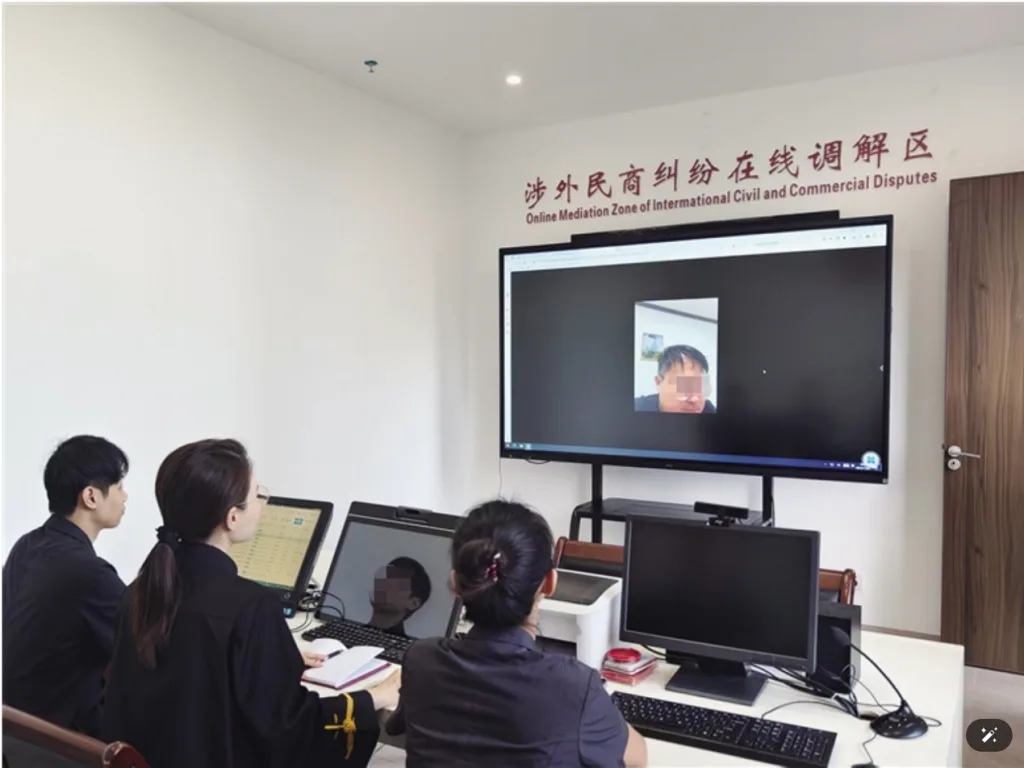
(The cross-border divorce lawsuit initiated by a Singaporean male party, where the court completed the online trial in the online mediation zone for foreign-related civil and commercial disputes. Source: China Peace Grid)

2. Uncontested Divorce: Strict Thresholds for Civil Registration

To bypass court litigation and register a mutual divorce at the Civil Affairs Bureau (under Articles 13-14 of the Regulations on Marriage Registration and Article 47 of the Specifications on Marriage Registration Work), all of the following conditions must be met simultaneously:

  1. Marriage Certificate Origin: The certificate must have been issued by a mainland Chinese marriage registration authority or a Chinese embassy/consulate abroad. If the marriage was registered under a foreign government authority, you cannot use the uncontested registration track in China.
  2. Civil Capacity: Both parties must possess full capacity for civil conduct.
  3. Complete Consensus: Both parties must voluntarily divorce, and have a written divorce agreement that outlines a complete consensus on child custody, domestic and foreign asset division, and all liabilities.
  4. No Proxies Allowed: Both parties must apply in person together; you cannot entrust an agent or attorney to stand in your place.
  5. Cooling-off Period: A mandatory 30-day divorce cooling-off period applies. After this period expires, both parties must appear in person together again to officially apply for and collect the divorce certificate.
3. Tactical Benefits: Why Choose China as Your Divorce Jurisdiction?
  • Advantage 1: Clear and Predictable Legal StandardsCore issues such as the legal grounds for divorce and judicial litigation procedures strictly apply Chinese law, meaning the adjudication standards are stable, transparent, and highly predictable.
  • Advantage 2: Cost-Effective Asset Investigation and EnforcementFor domestic assets (real estate, bank deposits, corporate equity, vehicles), the court can directly subpoena banking records, real estate registries, and commercial archives. Effective civil judgments and mediation sheets can be directly enforced by Chinese courts without navigating complex cross-border judicial assistance. If the vast majority of assets are onshore, domestic litigation is your optimal choice.
  • Advantage 3: Seamless Execution of Child Custody and SupportIf the children study and live in China long-term, domestic courts can verify the living, custody, and education status on the spot. Subsequent modifications—such as adjusting child support, changing visitation rights, or initiating compulsory execution for non-payment—can be filed directly in nearby domestic courts without cross-border litigation.

II. Strategic Choice: Uncontested Registration vs. Court Litigation

1. Uncontested Divorce (By Agreement)

  • The Pros: Fast process, low cost, completely private, and avoids the lengthy cross-border service of legal documents.
  • The Cons: Unavailable if you married abroad, if one party cannot physically return to China, or if there is any lingering disagreement regarding property, children, or debts.

2. Divorce by Litigation (Through the Courts)

If your case does not meet the strict criteria for an uncontested divorce, but satisfies the jurisdictional connecting points listed in Section I, your only path forward is litigation. Divorce by litigation can be initiated unilaterally by one party without the cooperation or consent of the other. As long as the Chinese court has jurisdiction, the court can try the case and render a binding judgment even if the spouse is abroad and fails to respond.

(The Chaoyang District People's Court releases the "White Paper on the Adjudication of Foreign-Related Family Cases". Source: Beijing Court Net)

III. Essential Elements of Cross-Border Divorce Litigation

1. Venue: Which Court Has Jurisdiction to File the Case?

In principle, foreign-related divorce cases are handled by basic-level People’s Courts. The filing location is determined by specific circumstances:

  • Defendant lives in China for a full year: Filed at the basic-level court of the defendant's habitual residence.
  • Defendant has no residence in China: Filed at the basic-level court of the plaintiff's registered household or habitual residence.
  • Both parties live abroad without permanent settlement: Filed at the domestic court where the plaintiff or defendant held their registered household before moving abroad.
2. Governing Law: Which Legal Framework Applies to the Merits?

Court jurisdiction and the application of law (governing law) are two entirely different legal concepts. While a Chinese court uses nationality and residence to determine its right to hear a case, it determines the actual rules of the trial based on the Law of the People's Republic of China on the Application of Laws to Foreign-Related Civil Relations.

The application of law in foreign-related divorces involves complex conflicts between jurisdictions. During litigation, parties must assert their governing law claims based on the exact nature of the dispute (e.g., location of property, actual residence of the children) and provide corresponding foreign legal texts or expert evidence for judicial review.

The mainstream application framework used by domestic courts includes:

  • Divorce Conditions & Procedures: Governed strictly by the law of the forum—Chinese law (Article 27).
  • Community Property & Debt Division: Governed by the law chosen by mutual agreement of the parties. In the absence of an agreement, courts apply the law of the closest connection, such as a common habitual residence, common nationality, or primary asset location (Article 24).
  • Child Custody & Support Disputes: Governed by the principle of "protecting the rights and interests of the weaker party." If there is no common habitual residence, the court prioritizes whichever legal framework—between the habitual residence of one parent or the country of nationality—is more favorable to protecting the minor child’s health, growth, and educational resources (Article 25).
3. Documentation: What Evidence Needs to Be Prepared?
  • Identity Profiles: PRC ID cards for Chinese citizens; Passports for foreign citizens; Travel Permits for Hong Kong, Macao, and Taiwan residents.
  • Marriage Proof: Marriage certificates (Foreign certificates require local notarization, an Apostille or consular legalization, and certified Chinese translations).
  • Grounds for Divorce: Evidence of a breakdown of mutual affection (e.g., separation records, domestic violence reports, proof of infidelity).
  • Assets & Liabilities: Bank statements, property deeds, vehicle registries, and corporate equity certificates.
  • Note: Official lawsuit documents can be drafted directly by your appointed legal counsel.
4. Service of Process: Navigating the Main Bottleneck

If a defendant resides outside of China, serving legal documents to them is the most time-consuming phase of cross-border litigation.

  • Hague Service Convention Countries: Service via official convention channels typically takes 2 to 3 months.
  • Non-Convention Countries (e.g., Thailand): Documents must move through formal diplomatic channels, which can stretch the timeline to nearly two years.

(Ai Fukuhara appears at a press conference to announce a settlement with her ex-husband Chiang Hung-chieh. Source: Chinanews.com)

5. Estimated Timeline: How Long to Get a Judgment?
  • Defendant is within China (Normal Service): 3 months under summary procedures; 6 months under ordinary procedures.
  • Defendant is abroad (Hague Service): The overall cycle ranges from 6 to 12 months.
  • Defendant is unreachable (Diplomatic / Public Notice Service): The cycle can take 1 to 2 years. Advance procedural planning is highly recommended.

Conclusion and Next Steps

This article has systematically organized the foundational procedural questions surrounding cross-border divorce: Is a Chinese divorce possible? Should you register or litigate? Which court do you approach? What documents are required, and what is the realistic timeline?

In Part 2 of this guide, we will break down exactly how Chinese courts split onshore versus offshore assets, address cross-border debt liabilities, and outline the precise steps required to have a Chinese divorce decree legally recognized and executed in foreign jurisdictions. Stay tuned.

Disclaimer & Copyright: This article is co-authored by Mandy Wu and Yu Yuting. The insights shared are for general compliance trends only and do not constitute formal legal advice.As a specialized cross-border legal institution, Neo-Ark Law Firm provides comprehensive global compliance and rights-protection support for expanding enterprises. For more international legal updates, please visit the Neo-Ark Law Firm Official Websites (https://www.neoarklawyers.com/news).

Recommend
Navigating Legal Representation: How Foreign Parties Appoint Chinese Lawyers in the Apostille Convention Era

Whether engaging in cross-border civil and commercial disputes, international investments, intellectual property defense, labor arbitration, or tort claims, foreign parties involved in Chinese proceedings must ensure their legal representation is appointed through valid, enforceable channels. This guide explores the procedural pathways for appointing Chinese counsel, focusing on the simplification afforded by the Apostille Convention.

(Source: CS.MFA.GOV.CN)

I. Pathways for Appointing Chinese Lawyers

1. Foreign Parties Outside China: The Apostille Path

Applicable to the 126 Contracting States under the Convention Abolishing the Requirement of Legalisation for Foreign Public Documents (e.g., U.S., UK, Canada, Japan, Korea, Russia).

  • Step 1: Notarization. The client signs the Power of Attorney (POA) before a local notary public, who verifies the signatory’s identity and authority.
  • Step 2: Obtaining the Apostille. Submit the notarized POA to the competent national authority. For instance, the Secretary of State handles this in U.S. states, while the Singapore Academy of Law (SAL) oversees it in Singapore.
  • Step 3: Domestic Translation. Upon receipt in China, the documentation must be translated and certified by a qualified domestic translation agency. Chinese courts typically reject translations provided by overseas entities.
2. Foreign Parties Outside China: Online Video Verification

For civil and commercial litigation, parties may apply for an Online Video Verification process.

  • Conducted under the supervision of a presiding judge, the party and their attorney record the POA signing via a secure platform (e.g., "People’s Court Online Service").
  • Advantage: This method fully waives the requirement for an Apostille.
  • Scope: Currently reserved for court litigation. International commercial arbitration and non-litigation matters still require standard Apostille or consular notarization.
3. Foreign Parties Within China: Immediate Execution

If the party is physically present in China (including short-term visitors), the process is streamlined:

  • Judicial Witness: Sign the POA directly before the presiding judge and present original passport documentation.
  • Domestic Notarization: Alternatively, visit any local Notary Public Office in China; the resulting document is immediately enforceable domestically.

( Source: CS.MFA.GOV.CN)

II. The Apostille Convention: A "Two-in-One" Framework

Since November 7, 2023, China has implemented the Apostille Convention, the most widely adopted international treaty under the Hague Conference on Private International Law (HCCH).

  • The "Two-in-One" Shift: It consolidates the previously required two-step "Double Authentication" (local Ministry of Foreign Affairs + Chinese Embassy/Consulate) into a single, standardized certificate—the Apostille.

III. Important Compliance & Strategy Notes

  • Exceptions (Vietnam & India):
    • Vietnam: Although Vietnam has deposited its instrument of accession, the Convention officially applies to China-Vietnam document exchanges effective September 11, 2026.
    • India: Due to India’s formal objection regarding China's accession, the Apostille Convention does not apply to China-India exchanges; traditional "Double Authentication" remains mandatory.
  • Document Validity: Many jurisdictions impose a 3–6 month validity window on commercial registration documents (e.g., Business Licenses). Timing your authentication to align with business progress is critical to prevent document expiration.
  • Translation Precision: In the Apostille era, technical accuracy is paramount. A single discrepancy in the translation of legal terminology can lead to judicial rejection of an entire filing at the final stage.

(source:hcch.net)

IV. Official Verification & Resource Links

  • HCCH Authority Lookup: Check competent authorities and fee standards for your specific country.
  • China Consular Service: For information on local procedures in China, visit the Ministry of Foreign Affairs portal.
  • Certificate Authentication Check: Verify the authenticity of an Apostille issued in China.
  • FAQs: Access the official Q&A repository for foreign public document certification.

V. Operational Call-to-Action

"Navigating cross-border litigation or need to authenticate your corporate representation in China? Contact NEO-ARK Law Firm’s Cross-Border Compliance Desk to ensure your documentation meets all judicial requirements."

(source:hcch.net)

Disclaimer & Copyright: This article is co-authored by Mandy Wu and Yu Yuting. The insights shared are for general compliance trends only and do not constitute formal legal advice.As a specialized cross-border legal institution, Neo-Ark Law Firm provides comprehensive global compliance and rights-protection support for expanding enterprises. For more international legal updates, please visit the Neo-Ark Law Firm Official Websites (https://www.neoarklawyers.com/news).

2026-06-11

Cross-Border Fraud Remedy: Shifting from Terminated Criminal Proceedings to Civil Inheritance Litigation

Case Summary

  • Dispute Type: Property Damage Compensation Dispute (Civil Claim Post-Criminal Termination)
  • Forum: Guangzhou Panyu District People's Court
  • Key Elements: Canadian Citizen Plaintiff, Impersonation Fraud, Civil Liability of Legal Heirs, Cross-Border Rights Protection
  • The Outcome: Successfully navigated a procedural impasse caused by the death of a criminal suspect, pivoting the strategy into an active civil lawsuit against the legal heir to pursue recovery within the scope of the inherited estate.

Case Background & Context

In September 2022, Plaintiff A, a Canadian citizen, required domestic legal representation regarding a private lending matter. An individual, Individual B, faked credentials as a licensed attorney and falsely claimed the capacity to handle the case to secure the plaintiff's trust, leading to a signed representation agreement. Individual B collected a total of 32,000 RMB across three separate tranches but subsequently delayed indefinitely and failed to perform any legal services.

Upon recognizing the misrepresentation, Plaintiff A reported the matter to the public security bureau, which formally initiated a criminal fraud case. However, due to the subsequent passing of Individual B, the public security authority lawfully withdrew the criminal case. To recover the financial losses, Plaintiff A retained our firm to transition the matter to the civil judiciary, filing a lawsuit against Individual B's son and legal heir, Defendant C, to claim compensation out of the deceased's inherited estate.

Our Core Strategy: Overcoming Cross-Border Evidentiary Hurdles & Strategic Litigation Shifting

To break the legal deadlock caused by the termination of criminal proceedings and ensure actual financial protection for our international client, our litigation team executed a highly adaptable strategy:

  • Constructing an Airtight Evidence Chain: For foreign nationals unfamiliar with domestic regulatory structures, proving subtle professional impersonation fraud presents extreme difficulties. Our team systematically gathered financial routing records, communication histories, and official status verifications, stabilizing an empirical evidence chain that effectively documented the deceptive conduct.
  • Pivoting to Civil Remedial Pathways: The death of a suspect generally terminates a criminal prosecution, which often leaves foreign victims uncertain of their remaining options. Our team formulated an alternative civil path under the PRC Civil Code, shifting the legal focus from personal criminal liability to the civil liability attached to the deceased's estate.
  • Targeting the Inherited Estate Framework: We structured the civil action to hold Defendant C liable strictly within the legal scope of the inheritance received from Individual B. This maneuver bypassed the procedural wall of the closed criminal file and opened a direct, lawful channel toward financial restitution.

The Progress & Value Delivered

The acceptance of the civil lawsuit by the People's Court established a critical trajectory for cross-border asset preservation when criminal options are procedurally exhausted. By establishing this civil action, our team successfully kept the client's financial recovery path active and fully operational.

Why Clients Trust Neo-Ark Law Firm: When unexpected events like the passing of an opposing party cause a criminal case to close, standard recovery routes vanish. Our firm specializes in identifying creative, alternative civil remedies to ensure that procedural roadblocks do not impede our clients' substantive rights. By translating a closed criminal file into a targeted civil inheritance claim, we demonstrate our steady commitment to safeguarding cross-border interests through every legal avenue available.

2026-06-05

The APEC Business Travel Card: Your 5-Year Visa-Free Passport to 16 Economies (2026 Updated Guide)

How much time does it take to prepare a single business visa application? Days? Weeks? Between gathering documentation, scheduling submissions, and managing the anxiety of approval windows, the friction of international travel can be immense. Is there a singular credential that bypasses this cycle? Yes—the APEC Business Travel Card (ABTC).

Valid for five years, this card facilitates streamlined entry into 16 Asia-Pacific economies. Based on the 2026 Guangzhou official application protocols, this guide provides a practical blueprint for eligibility, procedures, and institutional requirements.

(APEC Business Travel Card,source:MFA)

I. What is the APEC Business Travel Card?

The APEC Business Travel Card (ABTC) serves as a pre-cleared, multi-entry travel document:

  1. Validity: A single application grants a 5-year validity period when paired with a valid passport.
  2. Scope: Chinese mainland cardholders are eligible for entry into 16 designated economies.
  3. Special Status: The United States and Canada are transitional members. While they do not process mainland APEC card applications, they provide dedicated "Fast-Track" customs clearance for ABTC holders.
  4. Regional Integration: While the card is not applicable for travel between the Mainland, Hong Kong, and Taiwan, holders are granted access to dedicated "Fast-Track" immigration channels when entering or exiting Hong Kong.

(source:APEC)

II. 2026 Visa-Free Stay Duration Matrix

Cardholders are permitted the following maximum stay durations per entry (must depart before the card expiration date):

EconomyMax StayEconomyMax Stay
Australia90 DaysJapan90 Days
Brunei90 DaysKorea90 Days
Chile90 DaysMalaysia60 Days
Indonesia60 DaysMexico90 Days
New Zealand90 DaysPapua New Guinea60 Days
Peru90 DaysPhilippines59 Days
Russia90 DaysSingapore60 Days
Thailand90 DaysVietnam60 Days

(source:APEC)

III. Core Strategic Advantages

Compared to standard business visas, the ABTC directly addresses cross-border friction:

  • Sector Versatility: Applicable to diverse industries including manufacturing, import/export, fintech, network tech, education, logistics, legal services, accounting, and architecture.
  • Extended Validity: One application, 5 years of validity, multiple entries.
  • Operational Efficiency: Dedicated "Fast-Track" customs lanes at major ports of entry.
  • Extended Stay: Permitted single-entry durations ranging from 60 to 180 days.
  • Phased Utilization: Cardholders can utilize the card as soon as the first set of economies approves, with subsequent approvals updated onto the card via a streamlined 7-working-day replacement process.

(source:APEC)

IV. 2026 Eligibility Criteria

  • Corporate Scope: Limited liability companies, joint-stock companies (including public listings), partnerships, and sole proprietorships.
  • Personnel Scope: Applicants must hold a valid People's Republic of China (PRC) passport and possess a clean criminal record. Eligible groups include personnel from State-Owned Enterprises (SOEs), private enterprises, and Chinese staff within Sino-foreign joint ventures or Wholly Foreign-Owned Enterprises (WFOEs).
  • Ineligible Categories: Students, spouses/dependents of business travelers, seasonal/holiday workers, professional athletes, journalists, and individuals in the entertainment, music, or art industries.

(source:APEC)

V. 2026 Guangzhou Application Workflow

  1. Online Registration & Filing: Corporate entity registers and submits filings; Guangzhou Foreign Affairs Office (FAO) reviews within 5 working days.
  2. Submission & Payment: Upon FAO approval, the enterprise submits physical materials and remits processing fees to the Ministry of Foreign Affairs (MFA) designated account.
  3. MFA Approval: Once approved, the MFA synchronizes visa applications across the 16 economies.
  4. Visa Issuance & Production: Once economies approve, the MFA automatically executes card production.
  5. Collection: The Guangzhou FAO notifies the enterprise to collect the issued card.

(source:MFA)

VI. Frequently Asked Questions

  • Personnel Changes: If a cardholder leaves the original firm, the company must cancel the card or, upon agreement, transfer the record to a new employer and file a report with the Guangzhou FAO.
  • Loss or Expiration: Report lost cards immediately to local public security stations and apply for a replacement via the FAO. For expiration, applications can be submitted up to 6 months prior to the card's expiration date.
  • Processing Time: Obtaining approval from all 16 economies generally requires 3 to 6 months.

(source:APEC)

(source:MFA)

Disclaimer & Copyright: This article is co-authored by Mandy Wu and Yu Yuting. The insights shared are for general compliance trends only and do not constitute formal legal advice.As a specialized cross-border legal institution, Neo-Ark Law Firm provides comprehensive global compliance and rights-protection support for expanding enterprises. For more international legal updates, please visit the Neo-Ark Law Firm Official Websites (https://www.neoarklawyers.com/news).
2026-06-04

Strategic Defense Success: Claims Dismissed in a 6.5 Million RMB Cross-Border Cryptocurrency Dispute

Case Summary

  • Dispute Type: Cross-Border Entrusted Wealth Management Dispute
  • Forum: Guangzhou Tianhe District People's Court & Guangzhou Intermediate People's Court
  • Amount in Dispute: Approximately 6.5 Million RMB
  • The Outcome: The court sustained our defense positions regarding contract invalidity under public policy frameworks and dismissed the plaintiff's claims in their entirety, ruling that cryptocurrency investment losses are borne by the investor.

Case Background & Context

The Plaintiff entrusted Defendant D to manage virtual currency investments. Upon Defendant D's introduction, the Plaintiff instructed a third party, C, to transfer nearly 6.5 million RMB into the account of Defendant B for the purpose of purchasing cryptocurrency on an overseas platform. Defendant B executed the transactions according to the given instructions. Following a severe downturn in the cryptocurrency market, the digital assets incurred a total loss.

The Plaintiff subsequently initiated a lawsuit before the Guangzhou Tianhe District People's Court, alleging unauthorized misappropriation of funds. Because the Plaintiff’s habitual residence was outside mainland China, the court classified the matter as a cross-border entrusted wealth management contract dispute. The case involved complex initial challenges regarding centralized and transferred jurisdiction before proceeding to a trial on the merits.

Our Core Strategy: Jurisdictional Mastery & Public Policy Defense

To protect our client against this high-value claim, our defense team executed a rigorous, multi-layered litigation strategy focused on procedural propriety and financial regulatory realities:

  • Resolving Complex Jurisdictional Disputes: Our team successfully managed procedural challenges regarding cross-border centralized jurisdiction and jurisdiction transfers. Following an appellate review, the Guangzhou Intermediate People's Court delivered a final ruling affirming the jurisdiction of the Tianhe District Court, ensuring a procedurally sound foundation for the defense.
  • Establishing Contractual Invalidity via Public Policy: We constructed a robust defense centered on China's stringent regulatory stance on cryptocurrency trading. We successfully demonstrated that entrusted wealth management agreements for virtual currency transactions run counter to public order and good customs, rendering the underlying contractual relationship void under the PRC Civil Code.
  • Refuting Misappropriation with Empirical Evidence: Our team compiled and presented comprehensive transaction histories, account flows, and communication logs. We proved that Defendant B acted strictly in accordance with the user's directives, establishing that the losses stemmed entirely from market volatility rather than any unauthorized diversion of capital.

The Judgment & Outcome

The People's Court fully adopted our legal reasoning and evidentiary presentation. The court ruled that the virtual currency investment arrangement violated public policy, rendering the contract void, and determined that the resulting market losses must be borne by the investor. Consequently, the court delivered a definitive judgment dismissing all of the Plaintiff's claims and shielding our client from liability.

Why Clients Trust Neo-Ark Law Firm: Cross-border disputes involving overseas digital asset platforms present unique jurisdictional and regulatory hurdles. Our firm excels at translating complex financial tracking into clear, legally binding defenses. By combining absolute procedural precision with deep insights into PRC public policy frameworks, we ensure our clients are robustly protected against unsubstantiated commercial liability.

2026-06-03

Scroll to Top

+86 13503030053

BackToTop

Inquiry Inquiry Email Email Tel Tel

Request A Quote

×
Please enable JavaScript in your browser to complete this form.