Skip to content
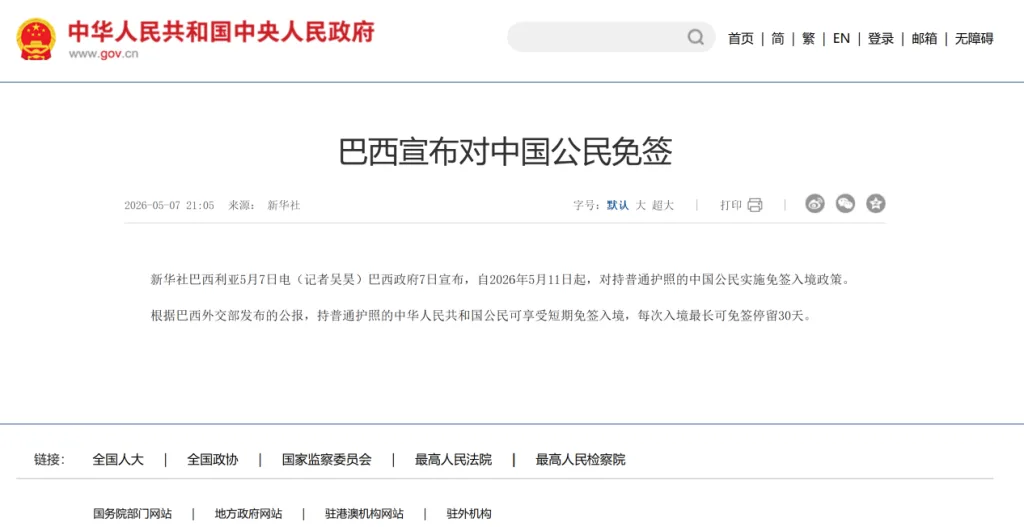
Brazil has officially implemented its visa-free policy for Chinese citizens, structurally accelerating the movement of personnel, capital, and information across the South American continent. As Latin America’s largest economy and home to one of its largest Chinese diaspora communities, Brazil represents an immense strategic frontier.
To maximize the economic dividends of this mobility, this comprehensive legal brief outlines critical compliance guardrails for outbound Chinese investors, dispute resolution frameworks for Brazilian entities in China, and high-growth sectoral opportunities.

(source:xinhua news agency)
I. Inbound to Brazil: Full-Lifecycle Compliance Guide for Chinese Capital
1. Outbound Security: Domestic ODI Approval is Non-Negotiable
Before remitting capital, Chinese enterprises must complete outbound direct investment (ODI) procedures. This requires a sequential three-step process: National Development and Reform Commission (NDRC) filing, Ministry of Commerce (MOFCOM) approval, and State Administration of Foreign Exchange (SAFE) registration. Retroactive registrations are strictly prohibited.
(source:www.gov.cn)
2. Market Entry Strategy: Greenfield Investment vs. M&A
- Greenfield Investment: Most sectors are fully open to foreign equity, excluding limited restrictions in healthcare, media, insurance, aviation, and nuclear energy. Standard incorporation takes approximately one month, though specialized licenses may extend this timeline.
- Mergers & Acquisitions (M&A): A faster route to local distribution networks and mature technologies. Key precedents include Oriental Yuhong's RMB 144 million acquisition of a 60% stake in Brazilian cement additives manufacturer Novakem, and Geely’s acquisition of a 26.4% stake in Renault Brazil alongside an RMB 5.1 billion joint venture for localized electric vehicle (EV) manufacturing.
- Antitrust Notice (CADE Regulation): Mergers must obtain prior regulatory clearance from the Administrative Council for Economic Defense (CADE) if one party’s annual Brazilian revenue equals or exceeds BRL 750 million and the other party's revenue equals or exceeds BRL 75 million.
NEO-ARK Strategic Recommendation: Small and medium-sized enterprises (SMEs) should opt for Greenfield entry to minimize historical liability exposure.

(source:xinhua news agency)
3. High-Risk Operational Domains
- Labor and Employment Law: Brazil enforces some of the world's most protective labor standards. Even under visa-free entry and in the absence of a written employment contract, the factual provision of labor under managerial oversight establishes a local employment relationship. This triggers mandatory costs including the 13th-month salary, 30 days of paid annual leave, and Severance Indemnity Fund (FGTS) contributions. Personnel staying beyond 90 days must secure a formal work visa; working under a tourist status constitutes illegal employment.
- Tax Compliance Architecture: Brazil’s tripartite tax regime (Federal, State, and Municipal) is exceptionally complex. Key vulnerabilities include unfamiliarity with the electronic invoicing system, inaccurate customs declarations, permanent establishment (PE) risks for unregistered entities, cross-border data transfer violations, and unregistered foreign exchange movements.
- Intellectual Property (IP) Defense: Brazil operates under a strict "first-to-file" trademark system. Launching a product prior to trademark registration often results in bad-faith registrations by local distributors or competitors, exposing the investor to infringement counterclaims. Trademark applications should be submitted immediately to the National Institute of Industrial Property (INPI), a process taking 12 to 24 months.

(source:xinhua news agency)
4. Cross-Border Dispute Resolution
Contracts should explicitly specify the governing law and designate preferred arbitration institutions (with a strategic preference for Chinese arbitral bodies for China-based entities). Under the 1993 China-Brazil Treaty on Judicial Assistance in Civil and Commercial Matters, both nations recognize and enforce court judgments and arbitral awards, allowing Chinese judicial rulings to be executed directly in Brazil.
5. Criminal Compliance: Severe Discrepancies in Statutory Thresholds
Brazilian authorities enforce severe criminal penalties for tax, environmental, and intellectual property offenses. Outbound enterprises must closely monitor two distinct operational risks:
- Anti-Money Laundering (AML) Risks: Avoid any structural or facilitating roles in unauthorized financial routing. In 2026, Brazilian authorities dismantled an e-commerce money-laundering network involving BRL 6 billion, resulting in severe criminal enforcement against the participating entities and executives.
- Environmental Crimes: Pursuant to the Brazilian Environmental Crimes Act (Law No. 9,605/1998), corporations face direct corporate criminal liability for ecological disruption, carrying severe institutional penalties.

(source:xinhua news agency)
II. Inbound to China: Legal Protections for Brazilian Entities & Citizens
1. Core Litigation Categories in China
Brazilian commercial entities and citizens navigating the Chinese market frequently require legal assistance across the following areas:
- International Trade Disputes: Resolving payment defaults, supply chain delays, and product quality variances.
- Corporate Setting & Employment: Structuring foreign-invested enterprises (FIEs) and aligning human resource policies with local labor laws.
- Intellectual Property Protection: Combating bad-faith trademark registrations and resolving involuntary infringement claims.
- Criminal Defense & Compliance: Navigating enforcement actions within high-stakes, zero-tolerance areas such as narcotics trafficking, cross-border telecom fraud, anti-money laundering compliance, and illegal employment.

(source:xinhua news agency)
2. Power of Attorney (POA) Verification Protocols
Retaining legal counsel within Mainland China requires formal authentication of the Power of Attorney (POA):
- Offshore Execution: If the Brazilian client is outside China, the POA must be notarized locally and verified via the Hague Apostille Convention framework to be valid in Chinese courts.
- Onshore Execution: If the client is physically present in China, they may execute the POA directly before a domestic notary public or perform an in-person verification with the presiding judge.
III. Strategic Growth Sectors: Emerging & Established Verticals
1. Primary Established Sectors
- New Energy Vehicles (EVs): Chinese manufacturers dominate the local consumer shift. By April 2026, BYD achieved a monthly retail volume of 14,911 vehicles in Brazil, capturing a 12.8% market share and securing the top position in total retail automotive sales.
- Clean Energy & Infrastructure: The China-Brazil Science and Technology Innovation Center is fully operational. State Grid has commenced construction on major ultra-high-voltage (UHV) DC transmission lines, while manufacturers like JA Solar and Goldwind lead the renewable market.
- Critical Minerals: Institutional acquisitions are highly active. China Molybdenum (CMOC) completed a USD 1.015 billion acquisition of four operating gold mines in Brazil within a 40-day timeframe, while Chinalco collaborated with Rio Tinto to secure a 68.6% stake in Albras for approximately RMB 6.286 billion.
- Cross-Border E-Commerce: Shopee leads total order volumes, complemented by the aggressive expansion of SHEIN, Temu, and TikTok Shop as high-growth market entrants.

(source:xinhua news agency)
2. Future Investment Frontiers
- Bioeconomy & Carbon Credit Trading: Supported by the joint USD 1 billion China-Brazil Sustainable Development Fund targeting green technologies and carbon-neutral initiatives.
- Fintech & Artificial Intelligence: High prioritization for Information and Communications Technology (ICT), IoT deployment, and integrated fintech infrastructure.
- Agrotech & Precision Agriculture: Growing market demand for smart agricultural hardware, automated farming systems, and digital transformations across food processing supply chains.

(source:xinhua news agency)
Conclusion
The implementation of bilateral visa-free entry is a structural catalyst for cross-border commerce, but technological and operational mobility must match regulatory compliance. Whether executing an outbound strategy into the South American market or protecting corporate rights within China, navigating localized legal frameworks with expert counsel is essential to safeguarding corporate growth.
Disclaimer & Copyright: This article is co-authored by Mandy Wu and Yu Yuting. The insights shared are for general compliance trends only and do not constitute formal legal advice.As a specialized cross-border legal institution, Neo-Ark Law Firm provides comprehensive global compliance and rights-protection support for expanding enterprises. For more international legal updates, please visit the Neo-Ark Law Firm Official Websites (https://www.neoarklawyers.com/news).