
News

News

Inclusion ▪ Respect ▪ Professionalism ▪ Excellence

Overview

A cross-border divorce dispute arose between a married couple with family and property connections between Mainland China and Hong Kong.

The parties had been married for many years and had two children. Their daughter was born in Hong Kong and required ongoing care and additional medical-related expenses.

After the parties separated, the client initiated divorce proceedings before the Haizhu District People's Court in Guangzhou, seeking divorce, custody of the daughter, child support, and division of the couple's marital property.

Representing the client, Yu Yuting, Attorney at NEO-ARK Law Firm, helped address the interconnected issues of divorce, child custody, child support, and cross-border marital property.

The matter was ultimately resolved through court mediation, with the parties reaching an agreement covering the divorce, custody arrangements, child support, division of multiple properties, and litigation costs.

Case Snapshot

ItemDetails
Practice AreaCross-Border Family Law
Case TypeDivorce, Child Custody & Marital Property
Cross-Border ElementMainland China – Hong Kong
ClientSpouse Seeking Divorce
Core IssuesDivorce, Child Custody, Support & Property Division
PropertyResidential Properties and Parking Spaces in Guangzhou and Foshan
Key ConsiderationHong Kong-Born Child and Cross-Border Family Arrangements
ResolutionCourt-Mediated Settlement
Lead LawyerYu Yuting / Li Wanjun
Law FirmNEO-ARK Law Firm

Situation

1. Long-Term Marriage and Separation

The parties registered their marriage in 1999 and had two children.

After years of marital conflict, including serious disagreements concerning family life, the parties began living separately in 2020.


2. Hong Kong-Born Child

Their daughter was born in Hong Kong and remained a central consideration in the divorce proceedings.

The dispute required the parties to establish clear arrangements concerning:

  • Custody;
  • Child support;
  • Additional education and medical expenses;
  • Long-term care needs.

3. Cross-Border Property

The couple also owned multiple properties and parking spaces in Guangzhou and Foshan.

The parties needed a practical mechanism for dividing these assets and implementing the agreed property arrangements following divorce.


Legal Strategy

FocusObjective
Divorce and settlementResolve the marital relationship efficiently
Child custodyEstablish a clear and practical custody arrangement
Child supportAddress regular support and significant additional expenses
Special medical needsProvide for substantial medical-related expenses where necessary
Property divisionClearly allocate properties and parking spaces in Guangzhou and Foshan
Property disposalEstablish practical rules for sale, pricing and distribution of proceeds
Post-divorce liabilitiesClarify responsibility for future property-related obligations
Litigation costsEstablish a clear allocation of court-related expense

Outcome

With the assistance of the court, the parties reached a comprehensive settlement covering:

  • Divorce;
  • Custody of the Hong Kong-born daughter;
  • Child support and additional expenses;
  • Division of three properties and related parking interests in Guangzhou and Foshan;
  • Arrangements concerning the sale and distribution of property proceeds;
  • Allocation of post-divorce property-related liabilities;
  • Litigation costs.

The settlement provided a clear framework for implementing the parties' agreements and resolving the principal financial and family issues arising from the divorce.


Why This Case Matters

Cross-border divorce disputes often involve much more than the question of whether a marriage should end.

Where children have connections to Hong Kong and marital assets are located in multiple cities in Mainland China, a workable settlement must address family arrangements and financial implementation together.

This case demonstrates the importance of designing a divorce settlement that is not only legally acceptable but also practical to implement.

For cross-border families, issues such as child support, special medical expenses, property sales, and post-divorce liabilities should be addressed with sufficient clarity to minimise the risk of further disputes.


Frequently Asked Questions

Can a divorce in Mainland China involve a child born in Hong Kong?

Yes.

Depending on the circumstances, Mainland Chinese courts may handle divorce proceedings involving children born in Hong Kong. Child custody and support arrangements should be considered based on the child's circumstances and applicable law.


How are child support and additional medical expenses handled in a divorce?

Regular child support can be addressed together with responsibility for significant additional expenses. Where a child has particular medical or care needs, these expenses may require specific arrangements in the settlement.


How should multiple properties be divided in a divorce settlement?

The parties may agree on ownership, transfer, sale, or other appropriate arrangements. Where property is to be sold, clearly defining the sale process and distribution of proceeds can help make the settlement more practical and reduce future disputes.


Why is mediation useful in cross-border divorce disputes?

A negotiated settlement can allow the parties to address custody, support, property, and financial responsibilities together, rather than resolving each issue separately through prolonged litigation.


Key Takeaways

  • Cross-border divorce may involve complex child custody and property issues.
  • A child's special medical or care needs should be addressed specifically where relevant.
  • Property division should be structured around practical implementation.
  • A comprehensive settlement can reduce the risk of further post-divorce disputes.
  • Early legal advice can help families address cross-border issues before they become more difficult to resolve.

About the Author

Yu Yuting
Partner | NEO-ARK Law Firm

Lawyer Yu focuses on foreign-related litigation, cross-border disputes, commercial matters, and legal services for overseas individuals and businesses in China.

Email: [email protected]

About NEO-ARK Law Firm

NEO-ARK Law Firm provides legal services in foreign-related litigation, commercial disputes, family law, and cross-border legal matters, assisting both international and domestic clients throughout China.


Overview

A couple preparing to marry sought legal advice on how to structure and protect their respective assets located in Mainland China and Hong Kong.

Their assets included a wholly owned Hong Kong company, Mainland Chinese real estate, bank deposits, and other financial assets. Given the cross-border nature of their property and the potential legal consequences of marriage, the couple wished to establish clear rules regarding ownership, management, and liabilities before registering their marriage.

Representing the couple, Yu Yuting, Attorney at NEO-ARK Law Firm, advised on the structure of a cross-border marital property agreement designed to clarify the ownership of premarital assets, establish rules for property acquired during the marriage, and address potential liabilities arising during the marriage.

Case Snapshot

ItemDetails
Practice AreaCross-Border Family Law
Case TypeMarital Property Agreement
Cross-Border ElementMainland China – Hong Kong
ClientCouple Preparing for Marriage
Core Legal IssueCross-Border Marital Property Planning
Key AssetsHong Kong Company Shares, Mainland Property and Financial Assets
Legal FocusProperty Ownership, Debt Allocation and Applicable Law
Lead LawyerYu Yuting / Li Wanjun
Law FirmNEO-ARK Law Firm

Situation

1. Cross-Border Assets Before Marriage

The couple held assets in both Mainland China and Hong Kong, including:

  • Shares in a Hong Kong company;
  • Real estate in Mainland China;
  • Bank deposits and financial assets in different jurisdictions.

The parties wanted to clearly distinguish their respective premarital property from assets that might be acquired jointly after marriage.


2. Need for Clear Property Rules

Without a clear agreement, questions could arise regarding:

  • Ownership of premarital assets;
  • Appreciation and other proceeds derived from those assets;
  • Ownership of property jointly acquired during the marriage;
  • Responsibility for marital debts;
  • Management of cross-border assets.

3. Cross-Border Legal Considerations

Because the parties' assets were located in different jurisdictions, the agreement also needed to take into account the potential application of different legal systems and the legal characteristics of different types of assets.


Legal Strategy

The legal work focused on establishing a clear and practical framework for the couple's financial relationship.

Planning AreaObjective
Premarital assetsClearly identify and preserve each party's separate property
Hong Kong company sharesClarify ownership and treatment of related interests
Mainland real estateEstablish ownership and treatment of property interests
Financial assetsDistinguish individual and jointly owned assets
Marital propertyEstablish a separate-property regime with defined exceptions
Joint living expensesCreate a dedicated arrangement for shared household expenses
Joint investmentsEstablish ownership proportions for jointly funded assets
Marital debtsClarify responsibility for liabilities incurred during marriage
Applicable lawEstablish a clear contractual framework subject to applicable Chinese law


Outcome

NEO-ARK Law Firm completed a cross-border marital property agreement addressing the couple's assets and financial interests in Mainland China and Hong Kong.

The agreement provided a structured framework for:

  • Protecting premarital property;
  • Clarifying ownership of business interests and real estate;
  • Managing jointly funded assets;
  • Allocating household expenses;
  • Addressing marital debts;
  • Reducing uncertainty concerning cross-border property rights.

Rather than waiting for a property dispute to arise after marriage, the parties established their respective financial arrangements in advance.


Why This Case Matters

Cross-border marriages can involve significantly more complicated property issues than domestic marriages, particularly where one or both spouses own assets in different jurisdictions.

A well-structured marital property agreement can help couples clarify their financial expectations before marriage and reduce uncertainty over the ownership and management of assets.

For couples with Hong Kong and Mainland China connections, issues involving company shares, real estate, financial assets, jointly acquired property, and marital liabilities should be considered together rather than addressed separately.

The objective is not simply to divide assets, but to establish a clear legal framework before disputes arise.


Frequently Asked Questions

Can couples with assets in Mainland China and Hong Kong enter into a marital property agreement?

They may be able to establish contractual arrangements concerning their marital property, subject to the applicable laws and the nature and location of the relevant assets.

Because cross-border property arrangements may involve different legal systems, professional legal advice is important before signing an agreement.


Can a prenuptial agreement protect a company owned by one spouse?

A marital property agreement can clarify the intended ownership of business interests and related property rights. However, the legal treatment of company shares and related interests should be assessed separately under applicable company and property laws.


Why should cross-border couples address property issues before marriage?

Clarifying ownership and financial responsibilities before marriage can reduce uncertainty and help prevent disputes concerning assets, investments, and liabilities later in the relationship.


Key Takeaways

  • Cross-border couples should consider marital property issues before marriage.
  • Premarital business interests and real estate should be clearly identified.
  • Jointly acquired assets can benefit from clearly defined ownership rules.
  • Marital debt arrangements should be addressed in advance.
  • Cross-border property agreements require careful consideration of applicable law.

About the Author

Yu Yuting
Partner | NEO-ARK Law Firm

Lawyer Yu focuses on foreign-related litigation, cross-border disputes, commercial matters, and legal services for overseas individuals and businesses in China.

Email: [email protected]

About NEO-ARK Law Firm

NEO-ARK Law Firm provides legal services in foreign-related litigation, commercial disputes, family law, and cross-border legal matters, assisting both international and domestic clients throughout China.
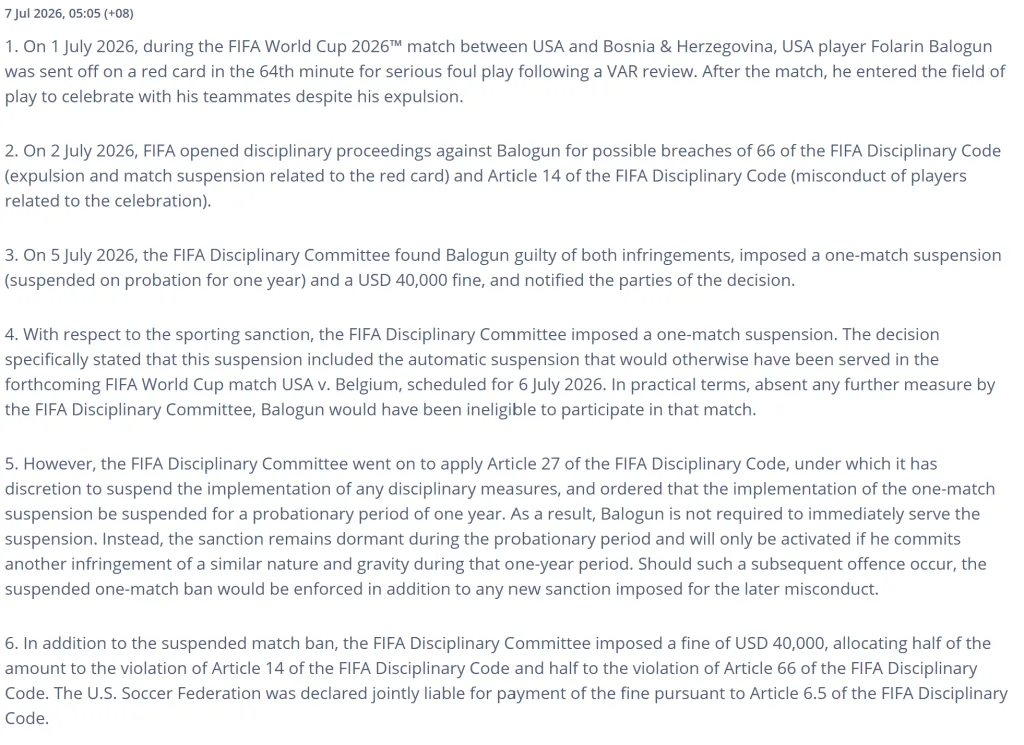
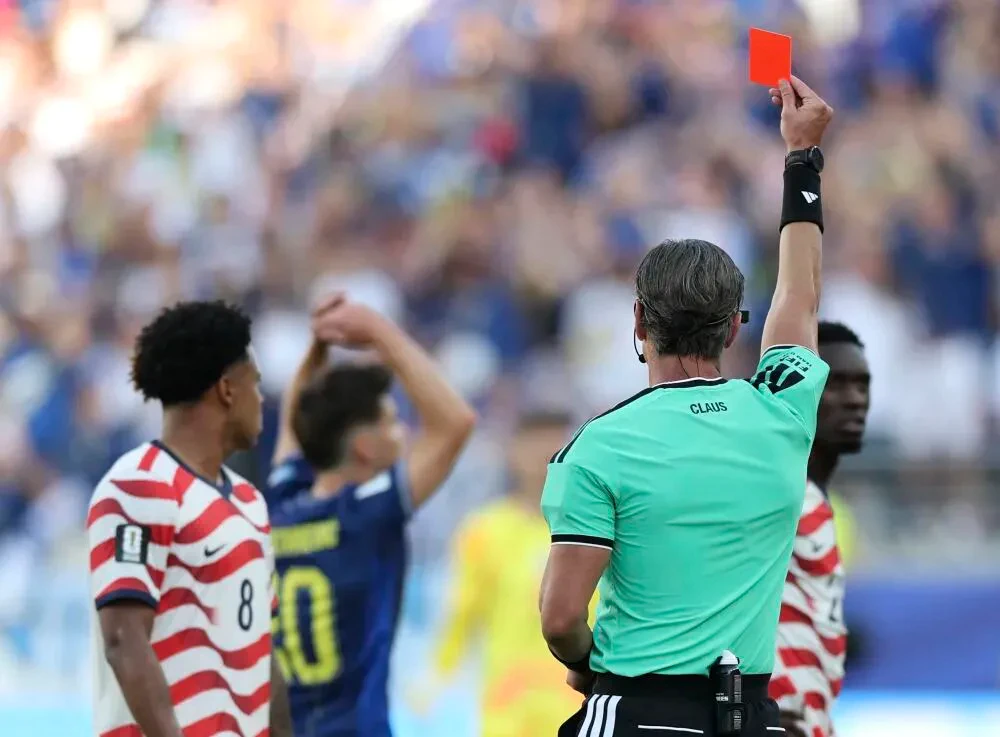
During the knockout stage of the 2026 FIFA World Cup, a historic disciplinary decision triggered intense debate across global sports law and regulatory compliance circles. On July 1, 2026, during the Round of 32 match between the United States and Poland, American star forward Folarin Balogun received a direct red card for a serious stamping foul.

(US player Folarin Balogun receiving a direct red card following a referee review during the World Cup Round of 32 match on July 1. Source: Agence France-Presse)

Under Article 10.5 of the Regulations for the FIFA World Cup 2026, a direct red card entails an automatic match suspension for the team's subsequent fixture (the Round of 16 match against Belgium).

However, on July 5, 2026, the FIFA Disciplinary Committee announced a unprecedented verdict: imposing a one-match suspension but suspending its execution under a one-year probation period. This ruling allowed Balogun to take the pitch against Belgium, sparking accusations of host-nation bias and procedural overreach.

This article dissects the statutory logic, procedural mechanics, and international dispute resolution principles underlying FIFA's controversial exercise of administrative discretion.

(Official press release published by the Chairman of the FIFA Disciplinary Committee addressing the legal basis of the decision on July 6. Source: FIFA)

I. The Two-Step Statutory Logic of FIFA's Disciplinary Framework

The FIFA Disciplinary Committee navigated a precise two-step legal methodology to uphold judicial authority while granting procedural relief:

Step 1: Statutory Affirmation ──> Affirm red card validity (Art. 66.4) + Impose $40,000 fine (Art. 14 & 66)
                                   ↓
Step 2: Execution Discretion   ──> Activate probation power (Art. 27) + Institute 1-year probationary period
1. Step 1: Fact-Finding and Authority Preservation

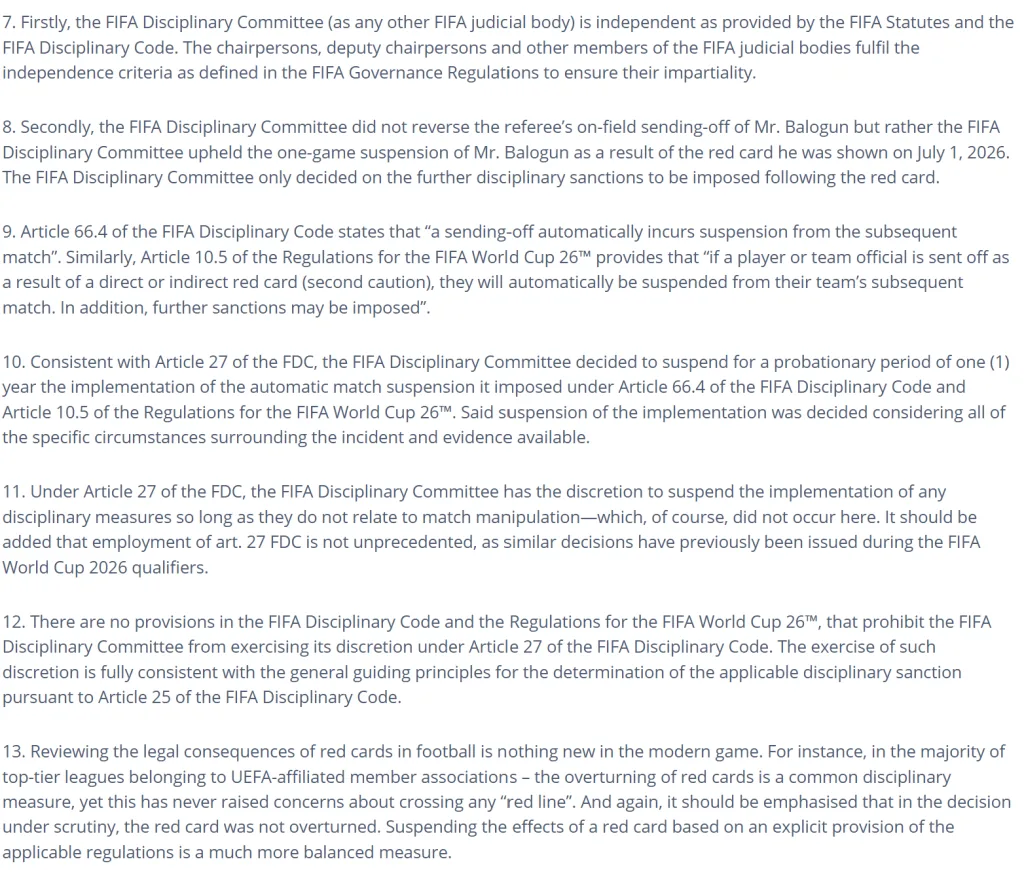
The Disciplinary Committee did not overturn the referee's pitch decision. Pursuant to Article 66.4 of the FIFA Disciplinary Code (FDC) and Article 10.5 of the World Cup Regulations, the automatic one-match suspension was officially confirmed. Additionally, a $40,000 fine was levied against the player and the US Soccer Federation under joint liability principles (Articles 14 and 66) for post-match pitch infractions, preserving referee authority.

2. Step 2: Activating Administrative Discretion Under Article 27

Under Article 27 of the FDC, the Disciplinary Committee possesses statutory authority to grant a suspension of implementation (probation) for disciplinary sanctions, except in cases involving match manipulation. FIFA did not "annul" the red card; rather, it converted the immediate suspension into a 1-year conditional probation. A repeat infraction within twelve months automatically triggers cumulative enforcement of both penalties.

                      ┌── Article 25 (FDC): Determination of Sanctions ──> Defines WHAT penalty is imposed.
Discretionary Matrix ─┤
                      └── Article 27 (FDC): Probation Mechanism       ──> Defines HOW penalty is executed.

This statutory interaction aligns with FIFA judicial precedent, as suspended bans and red-card probation mechanisms have been applied within UEFA domestic leagues and 2026 World Cup qualifying rounds.

(Full text of the official compliance statement issued by the Chairman of the FIFA Disciplinary Committee regarding Article 27 application. Source: FIFA)

II. Harmonizing Mandatory Suspensions with Discretionary Powers

A central legal question emerged: Does applying Article 27 probation to a World Cup match violate the legal canon lex specialis derogat legi generali (special law overrides general law), given that World Cup Regulation Article 10.5 mandates "automatic" suspensions?

FIFA’s official statement clarified that the two provisions operate in complementary legal dimensions rather than in conflict:

  • Substantive Sanction vs. Procedural Execution: Article 10.5 of the World Cup Regulations establishes the substantive rule (confirming that a red card results in a one-match ban). Article 27 of the FDC governs the procedural execution (determining whether the ban must be served immediately or conditionally deferred).
  • Absence of Exclusionary Language: No statutory provision within the World Cup Regulations explicitly waives or excludes the application of FDC Article 27 probation mechanisms during final tournament phases.

III. Procedural Standing Barriers: The Dismissal of Belgium's Appeal

Following the ruling, the Royal Belgian Football Association lodged an immediate appeal. The FIFA Appeal Committee dismissed the challenge on procedural grounds, ruling that Belgium lacked procedural standing (locus standi) as a non-party to the underlying disciplinary proceeding.

PartyProcedural StatusStatutory Rights Under FIFA Code
US Soccer Federation & PlayerDirect Parties to ProceedingFull right to be heard, receive formal notice, and submit defense.
Belgian Football AssociationSubsequent Opponent / Affected Third PartyClassified as Non-Direct Party; denied formal standing to appeal internal administrative discretion.

This ruling highlights a fundamental tension in international sports arbitration: balancing strict procedural boundaries (limiting standing to direct sanction targets) against the rights of third parties whose competitive interests are directly impacted by administrative rulings.

(Match referee issuing a direct red card to US forward Folarin Balogun during the Round of 32 fixture. Source: Xinhua News )

IV. Judicial Independence in Multi-Stakeholder Governance

To counter allegations of geopolitical or commercial bias favoring the host nation, FIFA anchored its defense on the structural independence of its judicial bodies.

Under the FIFA Statutes and FIFA Governance Regulations, members of the Disciplinary Committee are subject to strict neutrality standards, operating independently of the FIFA Council and commercial partners. In transnational compliance and international arbitration, structural judicial independence serves as the primary safeguard for institutional legitimacy when handling high-stakes corporate or geopolitical disputes.

Conclusion & Cross-Border Legal Insights

On July 6, Belgium defeated the United States 4–1 in the Round of 16, ending the host nation's tournament run. However, the legal precedents established by this decision extend far beyond the pitch.

For cross-border corporate governance and regulatory compliance, the Balogun precedent offers valuable strategic lessons:

Sports Litigation Parallel ──> Uncovering procedural discretion to secure probation for a key athlete.
                                         ↓
Cross-Border Compliance   ──> Utilizing precise statutory interpretations, jurisdictional defenses, and procedural 
                              remedies to insulate commercial assets during extraterritorial regulatory enforcement.

Whether defending against administrative sanctions, trade restrictions, or long-arm enforcement, mastery of procedural rules and statutory discretion remains the cornerstone of effective international risk management.

(Official FIFA statement confirming the procedural dismissal of the appeal submitted by the Royal Belgian Football Association. Source: FIFA)

About the Author

Yu Yuting
Partner | NEO-ARK Law Firm

Lawyer Yu focuses on foreign-related litigation, cross-border disputes, commercial matters, and legal services for overseas individuals and businesses in China.

Email: [email protected]

About NEO-ARK Law Firm

NEO-ARK Law Firm provides legal services in foreign-related litigation, commercial disputes, family law, and cross-border legal matters, assisting both international and domestic clients throughout China.
When individuals encounter debt or property disputes, the urgency to recover funds often leads them to seek quick solutions online. Scammers exploit this anxiety by posing as senior attorneys, promising "100% recovery rates," and collecting substantial fees before abandoning the case or disappearing altogether.

Recently, Attorney Fang Zhilin's team at Guangdong NEO-ARK Law Firm successfully assisted a victim in filing a criminal complaint against a bogus attorney. By organizing a complete chain of evidence, the team helped the client report the matter to public security authorities.

The case was officially opened as a criminal fraud investigation, and the suspect has been placed under criminal detention, with a nationwide fugitive warrant issued. Below is a detailed breakdown of the case, the common tactics used by fake attorneys, and a step-by-step verification guide for legal clients.

(source:baidu)

I. Case Study: Posing as a Law Firm Director to Defraud RMB 32,000

1. The Scam

Faced with a private lending dispute, the victim, "Zhang San," met a man online who claimed to be a senior law firm director. The suspect showcased fabricated winning precedents, verbally guaranteed a 100% recovery of the debt, and offered a low upfront retainer paired with a contingency fee model.

They signed an agreement stating that all upfront fees would be fully refunded if the debt was not recovered. Following the signing, the suspect repeatedly requested additional payments under various pretexts, including investigation fees, travel costs, and court filing expenses. In total, Zhang San transferred RMB 32,000 directly to the suspect's personal WeChat and private bank accounts without receiving official law firm invoices or visiting a physical law firm.

2. The Inaction

Over two years, Zhang San repeatedly inquired about progress. The suspect continuously offered excuses and failed to initiate any real legal proceedings, such as court filings, litigation, or formal mediation. Furthermore, the suspect falsely represented himself as Zhang San's attorney to third parties, relatives, and the debtor.

3. Criminal Investigation & Detention

Realizing he had been defrauded, Zhang San retained Attorney Fang Zhilin. Attorney Fang systematically compiled WeChat records, bank transfer receipts, written agreements, call recordings, and screenshots of false advertising to establish a complete evidentiary chain.

Attorney Fang drafted a formal criminal complaint and accompanied the client to the public security bureau. Police verification confirmed that the suspect held no legal practice qualification. Because the fraudulent collection of funds met the statutory threshold for criminal fraud under Article 266 of the Criminal Law of the People's Republic of China, the police formally opened a criminal case and placed the suspect under criminal detention.

II. Deconstructing the Four Common Modus Operandi of Fake Attorneys

                    ┌── 1. Fabricating Qualifications & Misleading Credentials
                    ├── 2. Guaranteeing 100% Win Rates & Full Fund Recovery
Modus Operandi ─────┼── 3. Contingency Retainers & Incremental Cash Requests
                    └── 4. Inaction, Subcontracting Trials, or Disappearing
  1. Fabricating Credentials: Using titles such as "Attorney," "Director," or "Senior Counsel" without holding a Law Practice Certificate (律师执业证) issued by judicial administration authorities.
  2. Guaranteeing Results: Professional codes of conduct strictly prohibit licensed attorneys from guaranteeing litigation outcomes. Fake attorneys frequently include explicit promises in informal contracts, such as "100% debt recovery" or "full refund upon failure," to disarm the client's vigilance.
  3. Low Upfront Fees & Incremental Demands: Enticing clients with contingency fee promises ("pay only when recovered"), then continuously requesting additional money for alleged administrative or court expenses. Payments are routinely routed to personal accounts or unaccredited consulting firms.
  4. Complete Inaction or Unauthorized Subcontracting: After receiving funds, scammers delay court filings or generate generic court documents using templates without attending hearings. Some secretly pay unauthorized individuals to appear in court, often leading to dismissed cases before severing contact with the client.

III. Four-Step Verification Protocol for Authentic Legal Services

Step 1: Check Practice Certificate ──> Verify on Official ACLA Registry Platform
  ↓
Step 2: Inspect Office Premises    ──> Ensure Seal Matches Registered Law Firm
  ↓
Step 3: Transfer to Escrow Account ──> Avoid Personal Accounts & Require Official Invoices
  ↓
Step 4: Formal Contract Execution  ──> Confirm Standard Mandate Agreement Formats
Step 1: Verify the Lawyer Practice Certificate (Primary Step)
  • A licensed attorney in China must hold a physical Lawyer Practice Certificate (律师执业证) issued by a provincial Department of Justice.
  • Official Online Verification: Check the credentials on the National Lawyer Practice Credit Information Disclosure Platform (全国律师执业诚信信息公示平台: https://credit.acla.org.cn by entering the attorney's name and license number to confirm their active law firm affiliation.
  • Note: Employees of legal consulting companies, general corporate legal staff, or citizen agents are not licensed practicing lawyers and are legally barred from charging litigation representation fees under a "lawyer" capacity.
Step 2: Verify the Entity & Require Official Seals
  • Exercise caution with individuals operating solely online without a fixed law firm office, or those attempting to execute representation agreements under the name of a "Legal Studio" (法务工作室) or "Consulting Firm" (咨询公司).
Step 3: Remit Funds Only to Corporate Law Firm Accounts
  • All legal fees and administrative retainers must be wired directly to the official bank account of the registered law firm. The firm will issue a formal value-added tax (VAT) invoice. Avoid transferring funds to personal WeChat/Alipay accounts or private bank cards.
Step 4: Execute Formal Representation Contracts
  • Ensure that the representation agreement uses standard law firm contract templates and bears the official red seal (公章) of the registered law firm.

IV. Action Plan If You Encounter Legal Service Fraud

  1. Preserve All Digital Evidence: Export complete WeChat chat histories, bank statements, call recordings, promotional screenshots, signed agreements, and witness statements.
  2. Report to Public Security: File a formal report at the local police station in the jurisdiction where the transaction or fraud occurred.
  3. Engage Certified Counsel for Criminal Complaints: Retain a certified criminal attorney to review the evidence chain, issue a professional legal opinion, accompany you to file a criminal complaint with law enforcement, and pursue civil asset recovery.

Conclusion

There are no shortcuts in litigation, nor are there genuine attorneys who can guarantee a 100% win rate. When facing debt, contractual, or property disputes, clients should engage established law firms, verify attorney qualifications in person, transfer funds directly to official firm accounts, and execute formal contracts to mitigate fraud risk.

About the Author

Yu Yuting
Partner | NEO-ARK Law Firm

Lawyer Yu focuses on foreign-related litigation, cross-border disputes, commercial matters, and legal services for overseas individuals and businesses in China.

Email: [email protected]

About NEO-ARK Law Firm

NEO-ARK Law Firm provides legal services in foreign-related litigation, commercial disputes, family law, and cross-border legal matters, assisting both international and domestic clients throughout China.
Following a landmark settlement stemming from the European Court of Justice (CJEU) ruling in the Lassana Diarra v. FIFA case, FIFA officially adopted the revised Regulations on the Status and Transfer of Players (2027 RSTP), set for global implementation on January 1, 2027.About Ushttps://www.pinsentmasons.com/out-law/news/fifa-announces-new-player-transfer-regulations-following-diarra-settlement#:~:text=Revamped%20football%20transfer%20rules%20announced%20by%20FIFA,ruling%2C%20they%20did%20not%20go%20far%20enough.

(Lionel Messi and Cape Verde goalkeeper Vozinha competing during the World Cup Round of 32. Source: Xinhua News Agency)

The CJEU determined that FIFA's former transfer restrictions unlawfully impeded the free movement of workers and restricted market competition under EU law. Departing from unilateral rulemaking, FIFA formulated these amendments through collective negotiation via the newly established Global Social Dialogue Platform, alongside FIFPRO, the European Club Association (ECA), and the World Leagues Association (WLA).

This landmark shift marks the evolution of global football governance from unilateral regulatory authority to structured collective bargaining.

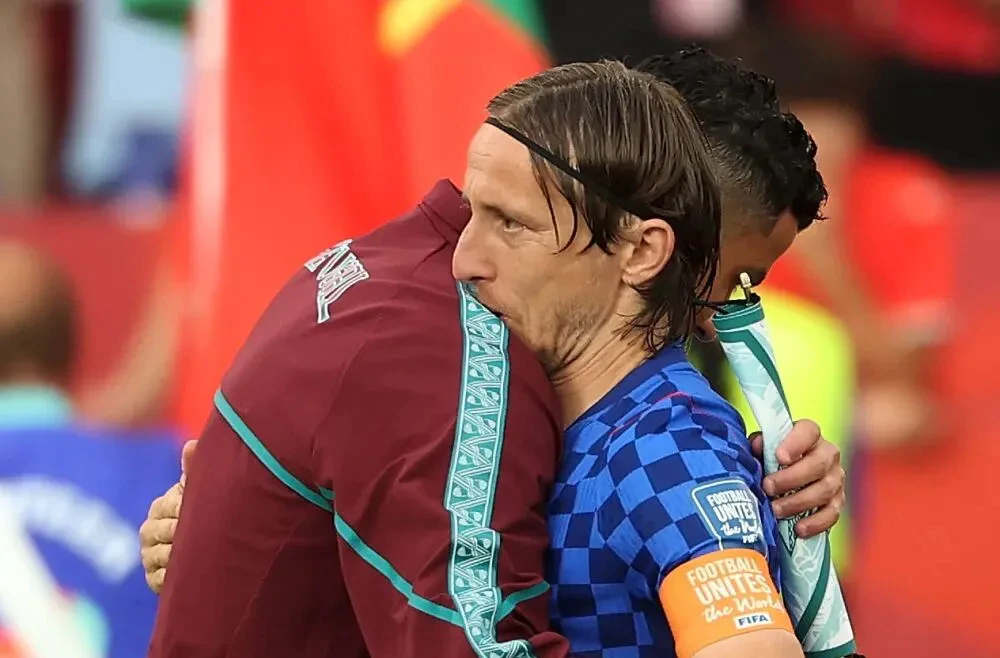
(Cristiano Ronaldo and Luka Modrić on the pitch during the World Cup Round of 32. Source: Xinhua News Agency)

I. Scope and Universal Application

  • Regulated Entities: Applies universally to professional football players, professional clubs, national member associations, licensed football agents/intermediaries, and sports dispute resolution bodies (such as the FIFA Football Tribunal and the Court of Arbitration for Sport).
  • Geographic Jurisdiction: Universally binding across all 211 FIFA member associations worldwide.

II. Core Structural Changes: Articles 17–21 Breakdown

1. Standardization of Contract Breach Calculations (Article 17)

Historically, unilateral contract terminations without just cause exposed buying clubs to unpredictable compensation awards and joint liability, discouraging the signing of players in contract disputes. The 2027 RSTP introduces two key structural fixes:

  • Enforceability of Liquidated Damages Clauses: Validates pre-agreed contractual liquidated damages (buyout clauses). When a buying club meets the pre-agreed valuation, the releasing club cannot impose artificial procedural barriers.
  • Standardized Compensation Benchmarks: Establishes predictable compensation floors tied to the residual value of the unfulfilled employment contract, eliminating speculative parameters such as unproven expected commercial revenue. Furthermore, buying clubs face joint financial liability only if proven to have actively induced the breach.
2. Statutory 5% Transfer Fee Equity Cut for Players (Article 21)

For the first time in football history, players hold a statutory right to participate directly in the financial value generated by their transfer fee:

  • Lower-Income Players (Earning under €150,000 / year): Entitled to a non-waivable, mandatory 5% direct cut of the fixed transfer fee received by the releasing club.
  • Higher-Income Players: May partially negotiate or waive their entitlement. However, the net payment received cannot fall below the higher of:
    • (a) The player’s total fixed annual salary during their final contract year; or
    • (b) 2.5% of the total fixed transfer fee.

(Opening ceremony performance at the FIFA World Cup. Source: Xinhua News Agency)

3. 5-Year Professional Contracts for Homegrown Academy Minors (Article 18)

To balance player mobility with academy investment protection, the default 3-year cap on professional contracts for minors under 18 can now be extended up to 5 years, provided:

  • The player has been registered with the club's academy for at least 20 months or two consecutive competitive periods.
  • The contract complies with local minimum wage statutes and respects annual squad allocation limits for long-term youth deals.
4. Tripartite Rulemaking via the Global Social Dialogue Platform

Substantive regulatory modifications regarding transfer frameworks, player welfare, international match calendars, and health standards can no longer be unilaterally enacted by FIFA. Future regulatory changes require formal consensus between FIFA, player unions (FIFPRO), and employer representatives (ECA, WLA) through the Global Social Dialogue Platform.

III. Strategic Legal & Industry Impact

  • Redefining Contractual Nature: Employment agreements transition from restrictive, life-binding lock-ins to redeemable commercial employment contracts with transparent buyout valuations and exit mechanisms.
  • Prohibition of Constructive Dismissal ("Solo Training"): Explicitly classifies squad exclusions, forced reserve-team demotions, or isolated training regimes as material employer breaches. Affected players gain immediate statutory grounds to terminate their contract for just cause and claim full residual compensation.
  • Sophisticated Financial Planning: Cross-border transfer budgets must account for mandatory 5% player distributions, agent commissions, training rewards, and an annualized 8% default interest penalty on late payments, squeezing unearned transfer markups.

IV. Star Player Case Studies Under the 2027 Framework

  • Constructive Breach Protections (The Mbappé Scenario): Unilateral exclusions from pre-season tours or isolated training routines—previously legal gray areas—are now statutory employer breaches. Players can immediately cancel their contract for just cause and claim full remaining salary payments.
  • Standardized Buyout Clauses (The Haaland Model): Pre-agreed buyout clauses, historically limited to elite negotiations, become the global statutory baseline. Acquiring clubs like Real Madrid or Manchester City can secure talent cleanly by meeting clear buyout thresholds without facing prolonged contractual holds.

(From left to right: Lionel Messi, Neymar Jr., Cristiano Ronaldo, Kylian Mbappé, and Erling Haaland. Source: Xinhua News Agency)

Conclusion

The 2027 RSTP represents a fundamental structural overhaul of global football governance. By pairing substantive legal protections with a collaborative social dialogue platform, the new framework establishes a more balanced, legally compliant, and predictable cross-border transfer market.https://www.pinsentmasons.com/out-law/news/fifa-announces-new-player-transfer-regulations-following-diarra-settlement#:~:text=Revamped%20football%20transfer%20rules%20announced%20by%20FIFA,ruling%2C%20they%20did%20not%20go%20far%20enough.

Disclaimer & Copyright: This article is co-authored by lawyer Yu Yuting and Mandy Wu. The insights shared are for general compliance trends only and do not constitute formal legal advice.As a specialized cross-border legal institution, Neo-Ark Law Firm provides comprehensive global compliance and rights-protection support for expanding enterprises. For more international legal updates, please visit the Neo-Ark Law Firm Official Websites (https://www.neoarklawyers.com/news).

Overview

A cross-border commercial dispute arose between a Hong Kong resident investor and business partners in Mainland China regarding the investment and operation of a catering company.

The claimant alleged that he had provided investment funds for the establishment of a catering business but was not formally registered as a shareholder. He therefore requested termination of the agreement and repayment of his investment.

Representing the Hong Kong investor, Yu Yuting, Attorney at NEO-ARK Law Firm, argued that the relationship between the parties was not a personal partnership but a corporate shareholder relationship after the company had been legally established.

The court ultimately accepted this legal analysis, overturned the first-instance judgment, and rejected the claimant's request for repayment.

Case Snapshot

ItemDetails
Practice AreaCross-Border Commercial Disputes
Case TypeShareholder and Investment Dispute
Cross-Border ElementHong Kong – Mainland China
ClientHong Kong Resident Investor
IndustryCatering Business Investment
Core Legal IssueWhether the Relationship Was a Partnership or Shareholder Relationship
Dispute ValueApproximately RMB 520,000
Lead LawyerYu Yuting / Li Wanjun
Law FirmNEO-ARK Law Firm

Client's Situation

The dispute developed through the following stages.

1. Business Investment Arrangement

The parties entered into an agreement concerning investment, equity allocation, and cooperation for establishing a catering business in Mainland China.

The Hong Kong investor participated in the establishment and operation of the business.


2. Investment Dispute

The claimant alleged that:

  • Investment funds had been provided for the business;
  • The promised shareholder registration had not been completed;
  • The investment agreement should therefore be terminated;
  • The investment amount should be returned.

3. Counterclaim Regarding Business Losses

The Hong Kong investor argued that:

  • The business had already been established and operated;
  • The claimant had participated in business management;
  • The investment had become part of the company's assets;
  • Business losses should be considered according to the parties' actual investment relationship.

4. Appeal Proceedings

The first-instance court treated the relationship as a personal partnership and ordered repayment of the investment amount.

The client appealed, arguing that the legal relationship had been incorrectly classified.


Legal Strategy

StrategyPurpose
Reassess the legal nature of the agreementDetermine whether the parties formed a partnership or shareholder relationship
Present evidence of corporate operationDemonstrate the company's actual establishment and management structure
Challenge the investment refund claimArgue that company investment cannot simply be withdrawn as personal repayment
Protect shareholder interestsPrevent improper recovery claims against company assets

Key Legal Findings

The central issue was the correct classification of the legal relationship between the parties.

The legal team argued that:

  • Although the agreement contained partnership-related language, the actual circumstances showed that a company had been legally established.
  • The claimant had participated in company operations and exercised shareholder-related rights.
  • Once investment funds were contributed to a company, they became company assets rather than personal funds that could be directly reclaimed.
  • Disputes involving shareholders and company assets should be analysed under corporate law principles rather than simple partnership rules.

Outcome

The appellate court accepted the legal arguments presented by NEO-ARK Law Firm.

The court determined that the relationship between the parties was related to corporate shareholder rights rather than a personal partnership.

The first-instance judgment was overturned, and the claimant's request for repayment of the investment was dismissed.

The result protected the client's interests by avoiding liability for repayment of approximately RMB 520,000 plus related interest.


Why This Case Matters

Investment disputes often depend on the true legal nature of the relationship between the parties.

An agreement may describe cooperation as a "partnership", but courts may examine the actual business structure, company establishment, management participation, and investment arrangements to determine whether the parties are truly partners or shareholders.

For Hong Kong investors and overseas investors participating in businesses in Mainland China, accurately identifying the legal structure of an investment is essential.

A misunderstanding between partnership arrangements and shareholder relationships may significantly affect investment rights, liability, and dispute outcomes.


Frequently Asked Questions

Can a Hong Kong resident invest in a Mainland Chinese company?

Yes.

Hong Kong residents may invest in businesses in Mainland China, subject to applicable investment and regulatory requirements.


Can an investor demand a refund after investing in a company?

Not always.

Where investment funds have become company assets, the investor may not simply request repayment as if it were a personal loan or partnership contribution.


Why does the legal classification of an investment matter?

The classification determines the applicable legal rules, including whether investors have shareholder rights, partnership rights, or contractual claims.


Key Takeaways

  • The substance of an investment relationship is more important than the wording of an agreement.
  • Courts may distinguish between partnership arrangements and shareholder relationships.
  • Investors should clearly structure their rights when investing in Chinese businesses.
  • Proper legal classification can significantly affect litigation outcomes.

About the Author

Yu Yuting
Partner | NEO-ARK Law Firm

Lawyer Yu focuses on foreign-related litigation, cross-border disputes, commercial matters, and legal services for overseas individuals and businesses in China.

Email: [email protected]

About NEO-ARK Law Firm

NEO-ARK Law Firm provides legal services in foreign-related litigation, commercial disputes, family law, and cross-border legal matters, assisting both international and domestic clients throughout China.

Scroll to Top

+86 13503030053

BackToTop

Inquiry Inquiry Email Email Tel Tel

Request A Quote

×
Please enable JavaScript in your browser to complete this form.